

The five love languages are a powerful framework for understanding how people give and receive love: Words of Affirmation, Quality Time, Receiving Gifts, Acts of Service, and Physical Touch. Developed by Dr. Gary Chapman, this concept explains how even the most devoted couples can feel disconnected if they're not speaking the same emotional language.
Have you ever felt like you and your partner are on completely different wavelengths? You’re showing love in a way that feels natural and heartfelt to you, but for some reason, it just doesn’t seem to land with them. This common frustration is exactly what understanding the 5 love languages can help solve.
Think of it as a decoder ring for your relationship. It’s a simple yet profound tool that helps you understand what truly makes your partner feel seen, cherished, and loved—and helps you recognize your own emotional needs, too.
The core idea is that each person has a primary love language that resonates more deeply than the others. When you learn to speak your partner’s language and they learn to speak yours, you create a stronger, more resilient bond. This isn't about grand romantic gestures; it's about making your efforts count. Ready to figure out your own style? You can start by discovering your love language.
Your Guide to Understanding the 5 Love Languages
Since its release in 1992, Dr. Chapman's book, The 5 Love Languages: The Secret to Love That Lasts, has sold over 20 million copies and been translated into 49 languages, a testament to how universally these ideas resonate with couples. The framework offers a clear path toward better communication and intimacy.
The concept is straightforward. This diagram shows the five primary channels through which people communicate affection, from encouraging words to simple, focused presence.
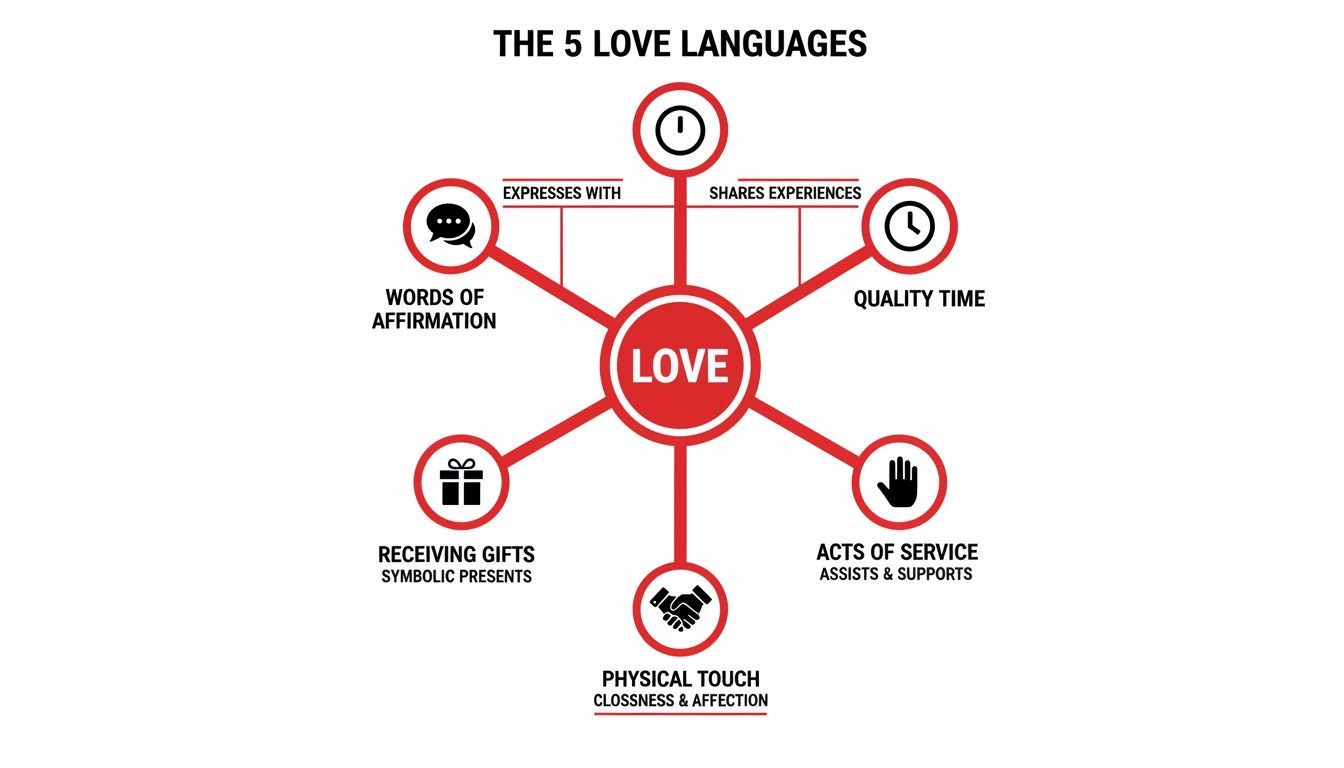
As you can see, love isn't a one-size-fits-all experience. It’s a core human need, but it flows through different channels for different people. As we explore each language, you'll start to recognize which of these channels you and your partner tune into most. Want to learn more about applying these concepts? You can explore our blog articles for more insights.
Key Takeaway: The goal isn't to change your personality. It's about adding new 'languages' to your emotional vocabulary so you can connect on a deeper level. It’s about being intentional and showing you care enough to meet your partner where they are.
By understanding these five approaches, you can move past recurring frustrations and build a relationship where you both feel genuinely seen, heard, and cherished.
The 5 Love Languages at a Glance
This table offers a snapshot of each language, what it means to the person who speaks it, and what you might hear them say.
| Love Language | What It Means | What You Might Hear |
|---|---|---|
| Words of Affirmation | Unsolicited compliments, verbal encouragement, and kind words mean the world. | "It meant so much when you told me you were proud of me." |
| Acts of Service | Actions speak louder than words. Helping out with tasks feels like true love. | "I feel so cared for when you take care of the dishes without me asking." |
| Receiving Gifts | It’s the thought and effort behind the gift, not the price tag, that matters. | "I can't believe you remembered I loved this! It shows you listen." |
| Quality Time | Nothing says "I love you" like giving someone your undivided attention. | "I just want to turn our phones off and spend time together, just us." |
| Physical Touch | Hugs, holding hands, and other forms of physical connection are essential. | "I feel so close to you when we're just cuddling on the couch." |
Recognizing these distinctions is the first step. Identifying which one resonates most with you—and your partner—is where the real transformation begins.
1. Words of Affirmation: The Power of Spoken Affection
You've probably heard the saying, "actions speak louder than words." Well, for some of us, that's just not true. If your primary love language is Words of Affirmation, then what you hear matters most. Positive words of appreciation, encouragement, and love are what make you feel truly seen and valued.
This isn't just about fishing for compliments. These words are direct deposits into your emotional bank account, confirming your worth and your partner's affection in a way nothing else can.

What This Language Sounds Like
This goes way beyond a routine "I love you." The real power is in the why. It’s about sincerity and specifics that show you’re truly paying attention.
- Showing Appreciation: "I really appreciate you making dinner tonight. It was delicious, and it meant a lot to me to be able to relax after a long day."
- Giving Encouragement: "I know you're going to nail that presentation tomorrow. I believe in you so much."
- Expressing Empathy: "It sounds like today was really tough. I'm so proud of how you handled it, and I'm here for you."
- Voicing Affection: "I just have to say, you looked incredible today. I couldn't stop thinking about you."
How to Recognize This Love Language
Do you or your partner light up after a heartfelt compliment? Do you treasure old birthday cards or save sweet text messages? Those are big clues. On the flip side, harsh criticism or a lack of verbal praise can cut deeper for someone with this love language than for others.
Expert Tip: For someone who speaks this language, hearing their value is the same as feeling it. The absence of affirming words can create a void that other expressions of love might not fill.
Understanding this is the first step. To discover your own unique love language profile, getting a full report of your love language results can give you personalized insights into what truly fills your tank.
2. Quality Time: Giving Your Undivided Attention
In a world buzzing with notifications and endless to-do lists, one of the most precious gifts you can offer someone is your undivided attention. If your primary love language is Quality Time, you’re not just looking for your partner to be in the same room; you’re craving genuine, focused connection. This language is all about carving out moments where you are truly present with each other, free from the pull of a million distractions.

It’s not about orchestrating grand, expensive dates. Instead, it’s about the conscious decision to put everything else on hold and focus completely on one another. This makes your partner feel like they’re the center of your universe, even if it's just for a little while.
For someone whose heart speaks this language, a partner who's physically present but mentally somewhere else can feel like a quiet rejection. Sitting together while you both scroll through social media on your phones? That doesn't fill the tank. The real magic happens through active engagement and shared experiences.
What Quality Time Looks Like in Action
Making time for this kind of connection doesn't need to be complicated. It’s the intention behind the action that counts. Small, consistent efforts often carry far more weight than big, infrequent gestures.
Here are a few simple ideas:
- Take a tech-free walk. Leave your phones behind and just enjoy the conversation as you wander through a park or your neighborhood.
- Cook a meal together. Turn a daily chore into a fun, collaborative activity where you can talk, laugh, and work as a team.
- Schedule a daily check-in. Set aside just 15 minutes every evening to share the highs and lows of your day, without any interruptions.
Expert Tip: Quality Time is all about building a bank of shared memories. It sends a powerful message: "You matter more to me than anything else I could be doing right now."
The Most Popular Love Language
It’s no surprise that in our fast-paced culture, so many people are starved for focused connection. Quality Time consistently ranks as the most popular of the 5 love languages in the United States. A nationally representative study found that 31.5% of Americans identify it as their number one way of feeling loved.
This preference cuts across generations, too, with about 32% of Gen Z, Millennials, and Gen X all choosing it as their top love language. If you're curious, you can read the full research on love language popularity to dig into the details.
3. Receiving Gifts: More Than Just Material Things
It's one of the most misunderstood love languages, but Receiving Gifts has very little to do with materialism or price tags. For someone who feels loved this way, a gift is a powerful, tangible symbol that says, "I was thinking of you." It’s a physical token of affection they can actually see and hold.
The real value isn't monetary—it's in the thought and care that went into the gesture. A last-minute, impersonal present can feel like an afterthought, while a small, meaningful gift can speak directly to their heart. It's all about the intention.
What the Gift Truly Represents
A person with this love language treasures these physical reminders of love. They see a gift as a solid representation of a memory or a feeling, which is why a forgotten birthday or a thoughtless anniversary present can be deeply painful.
But these gestures don't have to be expensive or elaborate. In fact, the simplest things often mean the most:
- Grabbing their favorite pastry on your way home from work.
- Picking up a cool rock for them on a hike.
- Finding that quirky little thing you saw in a shop that just screamed "them."
- Making a custom playlist of songs that remind you of your relationship.
Expert Tip: For someone whose primary love language is Receiving Gifts, a present is a memory made solid. It's a bridge to a moment of thoughtfulness, a physical confirmation that they are known and prized.
How to Recognize This Love Language
Does your partner light up when you give them something, no matter how small? Do they carefully save every card, ticket stub, and little trinket from your time together? That's a huge clue.
Someone who speaks this language often remembers the story behind every gift they've received because each one represents a moment of being seen and cared for. They aren't looking for you to spend a lot of money; they're looking for proof that you pay attention and that you get them.
4. Acts of Service: Showing You Care Through Action
For some people, the old saying "actions speak louder than words" isn't just a cliché—it's the core of how they experience love. If your primary love language is Acts of Service, you feel cherished and seen when your partner steps in to make your life just a little bit easier.
This isn't about grand, sweeping gestures. It’s about the quiet, thoughtful things that ease the burdens of your day-to-day life. It’s your partner noticing you’re overwhelmed and taking something off your plate, simply because they care.
What Acts of Service Look Like
True Acts of Service come from a place of genuine support, not obligation. They are small, often unseen efforts that say, "I see you, and I'm on your team."
- Filling up your car with gas on their way home so you don't have to worry about it during your morning rush.
- Bringing you a hot cup of coffee, made exactly how you like it, before you even get out of bed.
- Quietly taking over a chore they know you despise, like scrubbing the bathroom or taking out the overflowing trash.
- Packing your lunch for the next day, saving you a few precious minutes in the morning.
Expert Tip: The four words that mean the world to someone with this love language are: "Let me do that for you." It’s a simple phrase, but it carries the weight of true partnership and deep, practical care.
When your partner speaks this language, a simple, helpful act can feel more romantic than a dozen roses. On the flip side, forgotten promises or a lack of follow-through can feel like a direct message that their needs and their stress don't matter. It's a powerful reminder that for many, love is something you do.
5. Physical Touch: Building Intimacy and Connection
For some people, love is felt most profoundly through Physical Touch. This isn't just about what happens behind closed doors; it’s one of the most direct and instinctual ways we communicate care, comfort, and connection.

If this is your partner’s love language, a hug after a long day isn’t just a hug—it’s a powerful dose of reassurance. A hand on their shoulder during a stressful moment or holding hands on a walk speaks volumes. Every touch sends a clear, grounding message: "I am here with you."
More Than Just Romance
It's easy to assume this love language is all about sexual intimacy, but its meaning runs much deeper. It’s about creating a sense of security and belonging through everyday, non-sexual contact.
Think about these simple but powerful gestures:
- A gentle squeeze of the arm that says, "I've got your back."
- Cuddling on the couch while watching a movie.
- A playful tap as you pass each other in the kitchen.
- Resting a hand on their back in a crowded room.
These small acts communicate warmth and presence in a way words often can't. They are quiet, consistent affirmations of your bond.
How to Spot This Love Language
Does your partner naturally reach for your hand? Do they lean in close when you’re talking or seem to crave a hug after being apart? These are tell-tale signs. They initiate physical contact because it's how they instinctively show and feel love.
Expert Tip: For someone whose primary language is Physical Touch, the absence of it can feel like emotional distance or even rejection. They feel most seen, valued, and connected when they are physically close to their partner.
A lack of physical affection can leave them feeling profoundly lonely, even if you’re showering them with gifts or kind words. Recognizing this is absolutely crucial for building a strong, lasting connection.
How to Find Your Love Language and Start Connecting
Now that you know what the 5 love languages are, it's time to figure out which one speaks to you. Discovering your primary love language is the key that unlocks a deeper connection. It gives you the vocabulary to ask for what truly fills your emotional tank and, just as importantly, to understand what your partner needs from you.
Simple Ways to Discover Your Language
You can learn a lot just by paying attention. Your everyday actions and reactions are full of clues. Start by asking yourself a few simple questions:
- How do you naturally show love to others? We often give love in the way we'd like to receive it. Do you find yourself constantly praising your friends or jumping in to help someone with a task?
- What do you complain about most in your relationship? If you often hear yourself saying, "We never just spend time together," you're not just complaining about a schedule. You're expressing an unmet need for Quality Time.
- What do you ask for most often? A simple request like, “Can you just give me a hug?” is a direct bid for Physical Touch. These requests are signposts pointing directly to your primary love language.
Self-reflection is a fantastic starting point. It’s also worth noting that while some critics argue people value all five languages, recent research found that couples who shared a primary love language reported significantly higher relationship and sexual satisfaction. There's a lot to it, and you can explore more of the science behind it if you're curious.
The Clearest Path Forward
While introspection is valuable, the most straightforward way to get a clear answer is by taking a quiz designed for this very purpose. It cuts through the guesswork and gives you a clear snapshot of what resonates most with you.
Taking just a few minutes to take our free love language test can provide you with powerful, actionable insights.
Understanding your love language isn't about fitting into a box. It's about finding a clear starting point for better conversations and a more intentional connection in your relationship. So, what are you waiting for? Why not discover your love language today and take the first step toward a more fulfilling connection?