
When infidelity shatters your world, the first step isn't healing—it's triage. The goal is to create emotional and physical safety for both partners. This is not about solving the problem; it's about stopping the bleeding long enough to think clearly.
Right now, you both need to pause any major decisions. You need to establish temporary ground rules to stop the fighting. It's about allowing space for the initial shock to settle. But that first step is often the hardest one to take.
Surviving The Immediate Aftermath
When infidelity is discovered, it feels like the floor has dropped out from under you. It’s an earthquake that shatters your sense of reality, leaving you in a dizzying fog of shock, rage, and a type of betrayal that cuts to the bone.
In the first 48 hours, your gut will scream at you to either lash out or desperately fix everything at once. Resist that urge. The most important thing you can do right now is create immediate emotional safety.
This is not the time for life-altering decisions or painful cross-examinations. Think of it as emotional first aid. The only goal is to prevent more damage while you both process the trauma. Your relationship is in the ICU—the focus is stabilization, not a recovery plan.
But how do you create stability when everything feels so completely broken?
Create Immediate Emotional Space
Those first 48 hours are a blur of raw, unfiltered emotion. Forcing conversations now will almost certainly turn into screaming matches that only inflict more pain. It's crucial to agree to a tactical pause. This isn't the silent treatment; it's a conscious choice to prevent more hurt.
This might mean one of you stays with a friend for a night or two. If that’s not possible, create separate, "safe" zones in your home. The goal is to lower the emotional temperature so you can both just breathe. Without that space, you risk making the wounds even deeper.
The relationship as you knew it is over. The immediate aftermath isn't about saving that relationship—it’s about surviving the moment long enough to decide if you want to build a new one together.
Establish Temporary Boundaries
With emotions this high, you need clear, temporary rules of engagement. These aren't permanent solutions; they're emergency measures to get you through the next few days. Agreeing on them is the first small step toward doing something constructive, which is a powerful shift.
- Limit Contact: Decide how and when you'll talk. Maybe you agree to only text about essential logistics (like who's picking up the kids) for the next day. This stops conversations from spiraling when you're both on edge.
- No Big Decisions: Make a pact not to make any permanent decisions about the relationship for at least a week. That means no ultimatums and no threats of divorce. This buys you precious time to think.
- Postpone the "Why": The need for answers can feel all-consuming, but these initial hours are not the time for a full disclosure. Agree to table the deep, painful questions until you can have a calmer, more intentional conversation.
Navigating this crisis means choosing intentional actions over knee-jerk emotional reactions. It's incredibly difficult, but it's the only way to avoid making a terrible situation even worse. The real test of your commitment to healing begins with these very first choices.
First Actions Vs Impulsive Reactions
| Constructive Action | Destructive Reaction | Why It Matters |
|---|---|---|
| Take a time-out | Forcing a conversation immediately | Pushing for answers when emotions are high leads to more hurt, not clarity. |
| Set temporary communication rules | Constant calls, texts, or interrogations | Boundaries reduce conflict and prevent panicked, escalating arguments. |
| Agree to pause major decisions | Issuing ultimatums ("Leave now!") | Life-altering choices made in a state of shock are almost always regretted. |
| Focus on self-care (sleep, eat) | Trying to "fix it" all at once | You can't think clearly if you're physically and emotionally depleted. Basic needs first. |
Choosing these constructive actions creates the stability needed to face what comes next. It’s about managing the crisis, not solving it. And once the immediate storm passes, an even harder challenge awaits.
This simple guide breaks down these essential first steps for navigating this incredibly difficult initial phase.
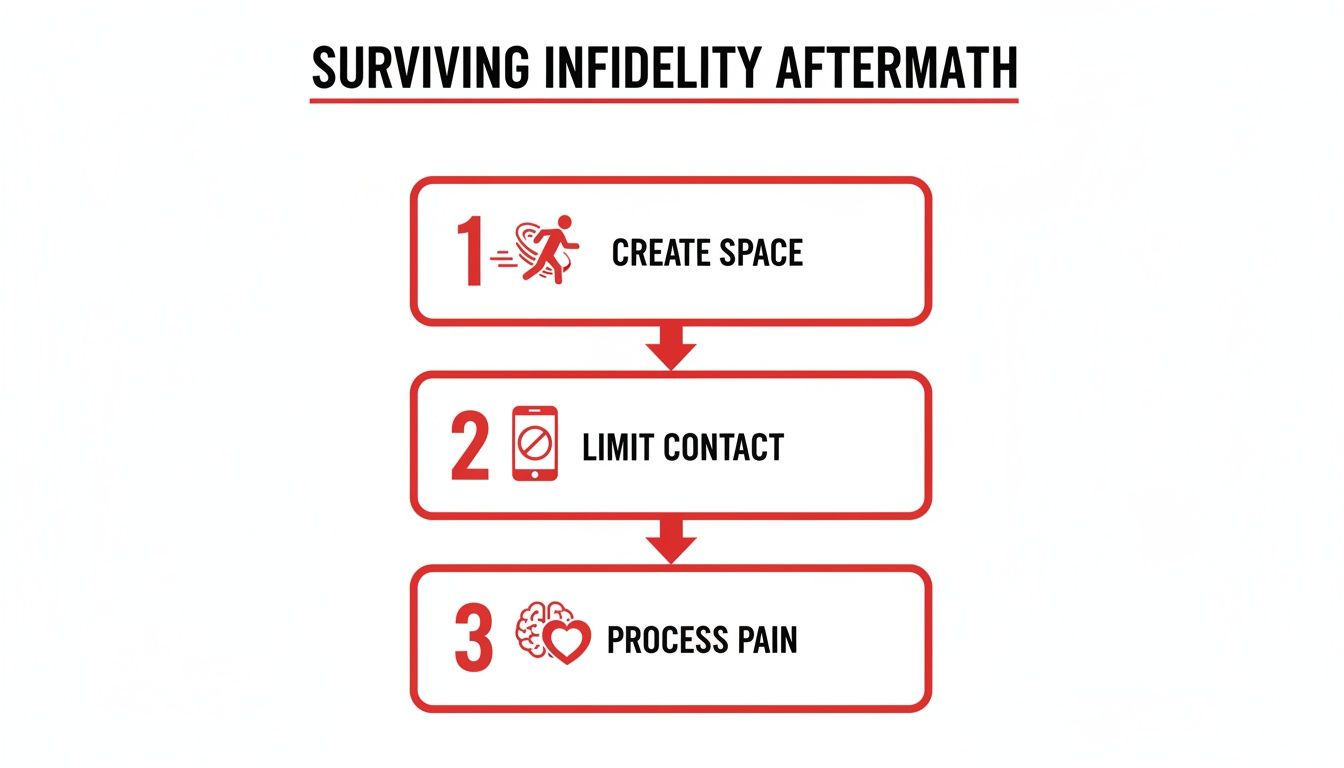
These actions—creating space, limiting contact, and processing pain—are all designed to de-escalate the crisis. They build a fragile foundation for the difficult, honest conversations that absolutely must come next.
The Uncomfortable Truth And Honest Disclosure
Once the initial shock begins to fade, the road to rebuilding trust leads straight to one of the most difficult, yet non-negotiable, steps: a full and honest disclosure. This is where the real work begins. It’s often the very first test of whether the unfaithful partner is truly committed to changing.
This conversation isn't about dredging up details to inflict more pain or to satisfy morbid curiosity. It’s about getting rid of secrets for good. Secrets allowed the affair to happen, and they will absolutely poison any attempt to heal.
If the betrayed partner has gaps in the story, their mind will fill them with the worst possible scenarios. You simply can't feel safe again without the whole picture. For the unfaithful partner, this is the moment to take complete ownership. It's time to prove through actions, not just words, that they are ready to face the truth.
Getting this right lays the first real brick for a new foundation. So, how do you even begin this conversation without causing more trauma?
A Framework For The Conversation
A healing disclosure is about transparency, not sharing graphic details that create painful mental movies. The goal is to provide clarity around the "what," "where," "when," and "why" of the affair without turning it into a dramatic reenactment.
The unfaithful partner must lead this. They should come prepared to share the truth without waiting to be cross-examined for every detail. This isn't an interrogation; it's a confession that should come from a genuine desire to heal what's been broken.
A productive disclosure needs to cover a few key areas:
- The Timeline: When did it start and when did it end? How often did you see or talk to each other? This helps put a frame around the scope of the betrayal.
- The Nature of the Relationship: Was it just physical, or was there an emotional connection? Be honest about how deep it went. To better grasp this distinction, read our guide on what is emotional cheating.
- The Logistics: How did you communicate? Where did you meet? Understanding the mechanics of the deception is a key part of rebuilding a sense of safety.
- The Ending: How and why did it end? Was it because you got caught, or did you end it on your own? The answer says a lot about the motivation for finally coming clean.
This information is incredibly painful to hear, but it's the only way to draw a firm line between the past and the future you're hoping to build together. And the way it’s delivered is just as crucial.
Taking Full Ownership Is Everything
Just rattling off the facts isn't enough. How the unfaithful partner shares this information is just as important as the information itself. Any hint of defensiveness, blame-shifting, or downplaying what happened will immediately shatter any progress you’re trying to make.
"I’m so sorry. I know this is going to be incredibly painful to hear, and you have every right to be angry. There are no excuses for what I did. I chose to do this, and I take full responsibility for the pain I've caused you. I am ready to answer your questions honestly because I want to rebuild our life together, with no more secrets."
A statement like this sets the stage for a productive, if agonizing, conversation. It shows true accountability and a real commitment to being transparent.
For the betrayed partner, try to ask questions that lead to understanding, not just more pain. Instead of asking for explicit sexual details, focus on questions that help you understand the why. For instance, "What were you missing that you felt you found with them?" can open the door to healing.
This will be one of the hardest conversations you ever have. But it's the only way to truly wipe the slate clean and find out if a new, more honest relationship is even possible.
Navigating The Emotional Aftermath Together
Once the truth is out, the real work begins. This next phase is less of a single event and more of an emotional marathon. It's a chaotic storm of grief, white-hot anger, shame, and a profound sense of betrayal. It’s a painful journey through the wreckage, but it’s one you must travel together if you want to heal.
For the betrayed partner, this is nothing short of trauma. The world feels unsafe, and emotional flashbacks can be triggered by anything—a song, a place, a name on a screen. These feelings are intense, real, and valid. They need a safe space to land.
For the partner who was unfaithful, this is the moment for a crucial shift. Guilt has to evolve into genuine remorse—a deep, empathetic understanding of the pain you've caused. Healing is messy and unpredictable, filled with good days and agonizingly bad ones.
The only way through this is to create an environment where the hurt partner can voice their pain without fear of judgment, and the unfaithful partner can listen without getting defensive. This shared vulnerability is where a new, more honest connection has a chance to begin.
Validating The Trauma Of Betrayal
Infidelity isn’t just breaking a rule; it’s shattering your partner's entire sense of reality. The emotional pain is so intense because it activates the same neural pathways in the brain as physical pain. This is a deep, visceral wound.
It's common for the betrayed partner to experience symptoms that look a lot like post-traumatic stress, including:
- Intrusive thoughts: Unwanted, painful mental images or memories of the affair that just won't stop.
- Emotional numbness: Feeling detached and empty as a way to cope with overwhelming pain.
- Hypervigilance: Constantly being on alert, checking phones, and looking for any sign of more deception.
- Intense mood swings: Shifting rapidly from overwhelming sadness to intense, blinding anger.
It’s so important to recognize these as normal trauma responses. You aren’t "going crazy"; you are having a human reaction to a devastating emotional injury. You can learn more about managing these complex emotions in our article on the feelings of betrayal.
From Guilt To Genuine Remorse
For the partner who was unfaithful, the single most important factor in rebuilding trust is understanding the difference between guilt and remorse. They are not the same thing.
Guilt is self-focused. It’s the uncomfortable feeling of "I'm a bad person" or "I feel terrible for getting caught." Guilt often leads to defensiveness or a rush to "move on" just to escape the discomfort.
Remorse is partner-focused. It’s feeling the true weight of your partner's pain and showing a deep, consistent commitment to helping them heal. Remorse says, "I see how much I've hurt you, and I will do whatever it takes, for as long as it takes, to help you feel safe again."
True remorse is shown through patient, empathetic action, not just a quick apology. It’s about sitting with your partner’s anger and tears without making it about your own discomfort. This is where the real healing can start to take hold.
Creating A Safe Space For Pain
Healing can't happen in a climate of fear, judgment, or blame. You have to intentionally create a new space in your relationship where painful feelings can be expressed and truly heard. This often requires a new set of communication rules.
- For the Betrayed Partner: Try to express your feelings using "I" statements. For instance, "I feel overwhelmed with anger right now" is much more constructive than "You're a horrible person." This allows your partner to hear your pain without immediately shutting down.
- For the Unfaithful Partner: Your most important job right now is to listen. Don't interrupt, defend yourself, or explain away your actions. Validate their feelings by saying things like, "It makes perfect sense that you feel that way," or "I understand why you're so angry."
This process isn't about re-litigating the affair over and over. It's about processing the emotional fallout. These raw, difficult conversations are what begin to drain the toxicity from the wound, but the statistics show just how hard this journey is.
The sobering reality is that not all relationships recover. While 60-75% of couples might stay together initially, this doesn't guarantee a healthy outcome. A 2019 survey found that only 15.6% of relationships truly survived long-term. This underscores how important it is to navigate this emotional aftermath with real intention.
Rebuilding With Action, Not Just Words

Once the emotional dust from the disclosure starts to settle, the real work begins. Apologies and promises, no matter how sincere they feel, can ring hollow without consistent, observable proof of change. This is the pivot point where rebuilding trust after cheating shifts from talk to action.
For the betrayed partner, this is a time of watching and waiting for evidence that things really are different. For the partner who was unfaithful, it’s about understanding that every move is now under a microscope.
Trust isn’t rebuilt with one grand gesture. It's painstakingly earned back through hundreds of small, honest, and consistent actions. And these actions must begin immediately.
From Vague Promises to Concrete Proof
It’s one thing to say, “I’ll be more transparent.” It’s another thing entirely to live it. The partner who strayed has to proactively live a life that’s an open book, showing their commitment through tangible, everyday behaviors. This isn't about punishment; it’s about providing the evidence needed to help the betrayed partner feel safe again.
These actions can't be prompted or demanded. They have to be offered freely.
- Total Digital Transparency: This means voluntarily sharing passwords for phones, email, and social media. It means leaving your phone face-up on the table and not clearing call logs or message histories.
- Unwavering Accountability for Your Time: Be proactive about your schedule. Share your phone's location, call when you’re on your way home from work, and be completely open about where you are and who you’re with. No exceptions.
- Cutting Off All Contact: This is non-negotiable. The affair partner must be blocked everywhere. A final, clear message ending things needs to be sent, preferably with the betrayed partner present to witness it.
This level of transparency can feel deeply invasive, but it’s a temporary and necessary scaffolding to hold things together while you rebuild. The next step involves going beyond just transparency.
The goal isn't to control your partner's life forever. It's to create a period of radical transparency that proves, through consistent action, that there are no more secrets. This is the antidote to the deception that broke the relationship.
Over time, as trust is slowly restored, these measures can be dialed back. But in the beginning, they are absolutely essential. If you need some structured ideas, exploring different trust exercises for couples can be a huge help.
Using Love Languages as a Tool for Repair
After a betrayal, the old ways of connecting can feel contaminated. An "I love you" might land with a thud. This is where understanding and using The 5 Love Languages® becomes an incredibly powerful tool for reconnecting. It provides a new framework for communication that can feel safe and intentional.
Expressions of love now need to be loud, clear, and unmistakable. Speaking your partner's primary love language translates your remorse into actions they can actually feel and believe.
Think about how this might look:
- Their language is Quality Time? Put your phone away. Completely. Schedule dedicated, uninterrupted time just to talk, proving they are your only priority.
- Their language is Acts of Service? Now, more than ever, actions speak louder than words. Take on household tasks without being asked. Anticipate their needs and lighten their load.
- Their language is Words of Affirmation? This is about more than "I'm sorry." It's about repeatedly acknowledging their hurt, validating their feelings, and verbalizing your commitment to earning back their trust.
- Their language is Receiving Gifts? A small, thoughtful gift can become a tangible symbol of your remorse. It says, “I was thinking of you, and only you.”
- Their language is Physical Touch? Focus on re-establishing safe, non-sexual touch. If they consent, holding their hand or offering a hug when they're distressed can help rebuild a sense of safety.
Learning and actively speaking each other's love languages can feel like you’re creating a brand new way to be together. It’s a practical method for showing—not just telling—your partner that you are all in on their healing.
When It's Time To Bring In a Professional

Trying to rebuild a relationship after an affair is a monumental task. Sometimes, doing it alone feels like navigating a hurricane without a compass. While many couples attempt to work through it on their own, there are moments when professional guidance isn't just helpful—it's essential for any real progress.
Deciding to see a therapist isn’t a sign of failure. Far from it. It's a powerful demonstration of your commitment to the relationship and its survival. It shows you’re both willing to invest in a structured, guided process to heal the deepest of wounds.
So, how do you know when you’ve hit that wall?
Signs Your Healing Has Stalled
You might be putting in the work, having the tough conversations, and trying to change your behaviors, but the needle just isn't moving. Progress has flatlined. You find yourselves stuck in the same painful loop, day after day.
This is a critical sign that your communication patterns are too deeply entrenched to be broken without outside help. You might be experiencing:
- Endless Loops: You have the same exact argument over and over again with no resolution. The conversation always ends in frustration, defensiveness, or exhaustion.
- Persistent Mistrust: Despite the unfaithful partner’s genuine efforts at transparency, the betrayed partner's anxiety and suspicion are still sky-high.
- Emotional Disconnection: You're going through the motions of repair, but you feel more like roommates than partners. The intimacy is gone, and you have no idea how to get it back.
If any of this sounds painfully familiar, it’s a strong indicator that you need a neutral third party to help you find a new path forward.
When Communication Remains Toxic
Healing is absolutely impossible in a toxic environment. If your attempts to talk about the infidelity consistently spiral into blaming, yelling, or a complete emotional shutdown, you're not healing. You're just re-traumatizing each other.
A therapist specializing in infidelity recovery acts as both a referee and a coach. They create a safe, contained space where you can both express yourselves without the constant fear of the conversation blowing up. They teach you how to actually listen and how to be heard.
Seeking therapy isn't about finding someone to take sides. It’s about finding an expert who can hold the emotional chaos for both of you, providing the structure and safety you currently lack.
The Power of Guided Therapy
Professional counseling offers more than just a safe space; it provides proven frameworks for recovery. Approaches like Emotionally Focused Therapy (EFT) are specifically designed to help couples rebuild secure emotional bonds after a crisis like infidelity. EFT helps you get beneath the surface-level anger to the core fears driving the conflict.
The effectiveness of this approach is backed by solid research. While few couples successfully recover without help, the success rates for those who commit to therapy are remarkably high.
According to the American Psychological Association, couples therapy has an overall effectiveness rate of around 70%. Specifically for infidelity, research shows that 60-80% of couples who attend therapy can successfully rebuild their relationship. You can explore more about the success rates of couples counseling after cheating on anaffairoftheheart.us.
Finding The Right Therapist For You
Not all therapists are equipped to handle the unique trauma of infidelity. When you're looking for help, you need someone with specific expertise in this area.
Here’s what to look for:
- Specialization: Search for therapists who explicitly list "infidelity," "affair recovery," or "betrayal trauma" as a specialty on their website.
- Therapeutic Approach: Ask if they use evidence-based models like EFT or the Gottman Method, which are highly effective for couples in crisis.
- A Good Fit: This is crucial. You should both feel comfortable and respected by the therapist. Schedule a brief consultation call with a few candidates to see whose style works for you as a couple.
Your first few sessions will likely focus on establishing safety and setting ground rules for communication. This professional support can be the very thing that makes rebuilding your relationship a real possibility.
Frequently Asked Questions About Healing
The path to rebuilding trust after cheating is usually flooded with the same painful questions, playing on a loop in your mind. It makes perfect sense to crave certainty when your entire world feels upside down.
Let's walk through some of the most common and difficult questions couples face on this journey.
How Long Does It Realistically Take to Rebuild Trust?
There's no magic number here. Anyone who promises a quick fix isn't being straight with you about the depth of this kind of wound.
For most couples who are truly all-in on the process, you're looking at anywhere from one to two years of consistent, hard work. The initial crisis—that phase of raw pain and instability—can last for several months. What follows is a longer period of actively rebuilding and reconnecting.
Healing isn't a straight line; it's more like two steps forward, one step back. The goal is to see those bad days become less frequent and less intense over time. The timeline is set by the unfaithful partner's commitment to transparency, accountability, and empathy.
Can Our Relationship Ever Be The Same Again?
No, it can't. And honestly, that might be a good thing.
The relationship you had before—the one that had cracks that may have contributed to the affair—is gone. The moment the affair came to light, it drew a permanent line between "before" and "after."
Trying to get back to "the way things were" is a setup for failure. The real opportunity here is to build something entirely new. Think of it as Relationship 2.0, one founded on radical honesty and a much deeper, more intentional connection.
A surprising number of couples who make it through this crisis say their new relationship is stronger, more intimate, and more honest than the first one ever was. The betrayal forces you to finally deal with issues you might have been sweeping under the rug for years.
How Do I Cope With Triggers And Painful Memories?
Triggers are an unavoidable part of recovering from this kind of trauma. For the partner who was betrayed, something as simple as a song, driving past a certain restaurant, or a specific notification sound can bring all the pain rushing back in an instant.
The key is to have a plan—one you both agree on before a trigger hits.
- For the betrayed partner: When you feel that wave of panic or anger, try to communicate it calmly. Instead of lashing out, you could say, "I'm feeling really triggered right now." Then, focus on your breathing to manage the physical reaction.
- For the unfaithful partner: Your job is to respond with immediate empathy and reassurance, not defensiveness. This is a moment to prove you are a safe partner now. A good response sounds like, "I'm right here with you. I am so sorry my actions caused this pain. What can I do for you right now?"
With consistent, compassionate responses over time, the power of these triggers will start to fade. They may never go away completely, but they will become less overwhelming.
Is It Possible To Forgive My Partner And Move On?
Forgiveness is a deeply personal journey for the betrayed partner, and it's crucial to understand what it is—and what it isn't.
Forgiveness isn't about saying the affair was okay or letting your partner "off the hook." It's about making a conscious choice to let go of the crushing weight of anger and resentment, mainly for your own peace of mind. It’s a gift you ultimately give yourself.
It can't be rushed, and it certainly can't be demanded. Real forgiveness usually comes much later in the healing process, long after a new foundation of trust has been painstakingly built. The focus at the beginning needs to be on the tangible actions of repair.
Trying to force forgiveness before you feel safe again will only breed more resentment. Give yourself the grace to heal on your own clock. Forgiveness might be the final chapter, but it's definitely not the first.
The journey to rebuild trust is challenging, but understanding each other on a deeper level can be a powerful catalyst for healing. The Love Language Test can provide a clear roadmap to expressing love and commitment in ways that truly resonate.
Discovering your love languages is a simple yet profound step toward building a new, more intentional connection. Take the free test today at thelovelanguagetest.com.