
What exactly is an attachment style test? Think of it as a roadmap to your heart. It’s a self-assessment tool designed to uncover your unique way of bonding with others. It helps pinpoint those subconscious behaviors and emotional needs that shape your connections, often showing if your pattern is secure, anxious, or avoidant.
But what does this really mean for your love life? Let’s find out.
What an Attachment Style Test Reveals About You
Have you ever wondered why you react a certain way when you’re dating someone? Or why you seem drawn to the same type of partner over and over? The answer is often rooted in your attachment style—a blueprint for connection formed when you were young.
An attachment style test isn't just about sticking a label on yourself. It’s a powerful tool for self-discovery. It shines a light on the automatic, subconscious patterns that drive your behavior in relationships, revealing the "why" behind your instincts.
By figuring out whether you lean secure, anxious, or avoidant, you can start to understand your communication habits and emotional triggers. It clarifies the personal balance between needing intimacy and needing independence. These aren't just random quirks; they're patterns that influence who you’re attracted to and how you handle disagreements.
Getting a handle on these patterns is the first step toward building healthier, more fulfilling connections. But how deep do these roots actually go?
The Foundation of Your Connections
Your attachment style functions like an internal operating system for your relationships. It runs quietly in the background, guiding your expectations and reactions. Ultimately, it shapes how you give and receive love, often without you even realizing it.
An attachment style test gives you a peek behind the curtain. It helps you understand the "why" behind your relational instincts—like why you crave reassurance, or why you instinctively pull away when things get serious.
This kind of awareness is a game-changer. It shifts you from being a passenger in your relationships to being the one in the driver's seat. You’re empowered to respond consciously instead of just reacting on autopilot.
This diagram breaks down the core ideas of attachment theory. It shows how the main styles—secure, anxious, and avoidant—all stem from our "internal working models" of how relationships are supposed to work.
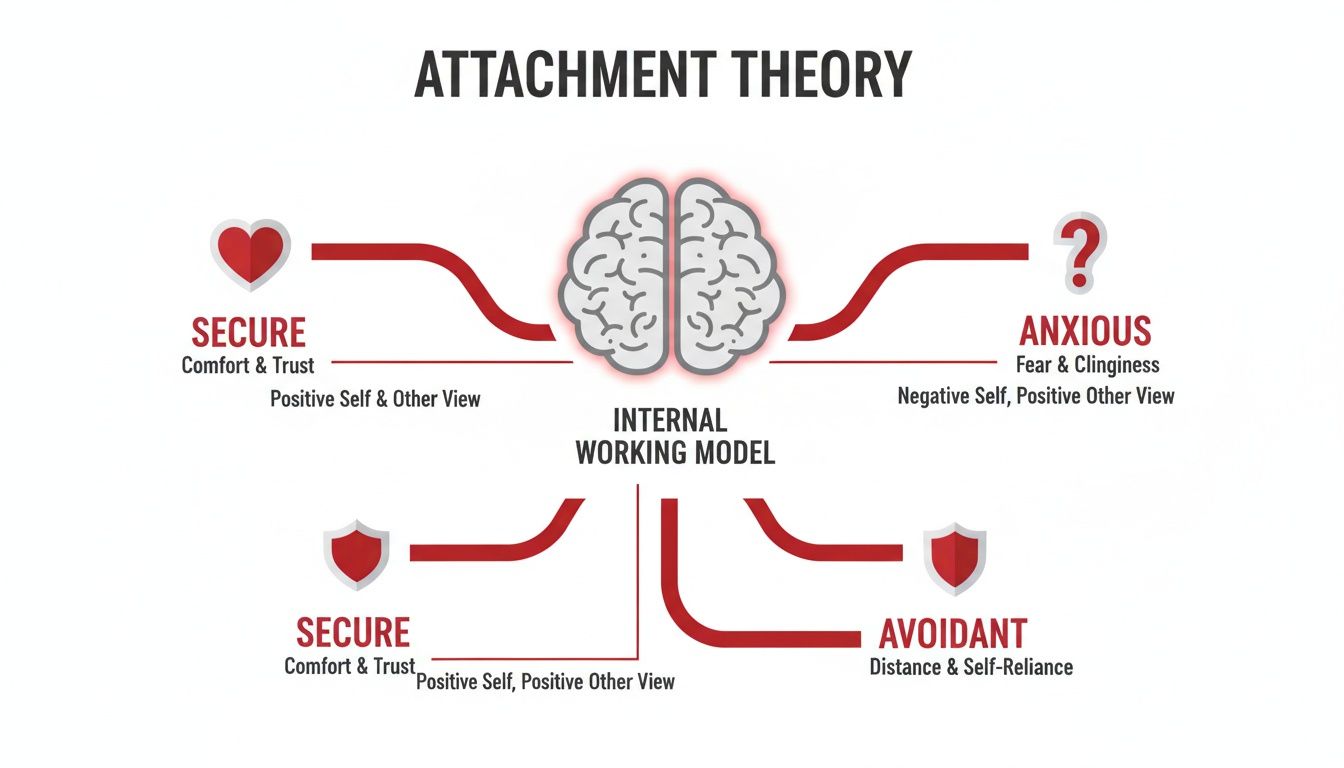
The image highlights how our core beliefs about self-worth and trust directly impact our partnerships. But how does this play out for most people?
Secure vs. Insecure Attachment
Not everyone experiences relationships the same way, and that's completely okay. Researchers estimate that about 55–65% of people have a secure attachment style. The other 35–45% fall into the insecure categories (anxious or avoidant).
These are common patterns that therapists help people work through all the time. So if you discover your style isn't "secure," you are far from alone. These patterns are well-understood, and there's a clear path forward. For a deeper dive, the Attachment Project offers great insights on these developmental findings.
Knowing where you land on this spectrum can be incredibly validating. It’s not about judgment; it's about getting a clear starting point for growth. It helps you focus on what will make your connections stronger.
The next step is learning to recognize these traits in your day-to-day life.
The Four Main Attachment Styles at a Glance
To make this clearer, here's a quick breakdown of the four main attachment styles.
| Attachment Style | Core Belief | Typical Behavior |
|---|---|---|
| Secure | "I am worthy of love, and others are trustworthy." | Comfortable with intimacy and independence. Easily connects with others and manages conflict constructively. |
| Anxious | "I'm worried I'll be abandoned; I need you to prove you love me." | Craves closeness but often fears their partner doesn't feel the same. Can be sensitive to rejection. |
| Avoidant | "I am self-sufficient and don't need others to feel complete." | Values independence and self-reliance. Tends to suppress feelings and may pull away when others get too close. |
| Disorganized | "I want intimacy, but I'm afraid of getting hurt." | A confusing mix of anxious and avoidant traits. May desire connection but also fear it, leading to unpredictable behavior. |
Seeing these laid out can often spark an "aha" moment. You might recognize yourself—or even past partners—in these descriptions. This recognition is the first step toward creating meaningful change.
Why Your Earliest Bonds Still Matter Today
Attachment theory isn't some passing trend; it’s a deeply researched framework that explains so much about how we connect. It all began with the work of British psychologist John Bowlby, who uncovered something fundamental about human nature.

He realized that the critical bond we form with our caregivers as infants doesn't just fade away. It creates a blueprint—a kind of relational DNA—that shapes how we approach relationships for the rest of our lives. This idea completely shifted our thinking.
The Roots of Your Relationship Instincts
This history is important because it means your instincts aren’t random. They’re learned behaviors with deep roots, forming what Bowlby called an "internal working model" of the world.
Think of this model as the lens through which you see relationships. It shapes your beliefs about two core things:
- Your own worthiness: Do you believe you are fundamentally deserving of love and care?
- The reliability of others: Can you truly count on other people to be there for you when you need them?
Your earliest experiences taught you what to expect from others. This is why you might feel anxious when a partner asks for space, or why you might prize your independence above all else. It all connects back to that foundational programming.
But here's the good news: your past doesn't have to dictate your future.
From Past Patterns to Future Strengths
John Bowlby first introduced attachment theory in 1958, and his work changed our understanding of human connection. His observations grew into a comprehensive theory, detailed in his work Attachment and Loss. If you're curious, you can discover more about Bowlby's foundational work and see its powerful legacy.
The history shows these patterns have long been central to our emotional lives.
But the most empowering takeaway is this: your attachment patterns can be understood. Once you see them clearly, you can reshape them with conscious effort, turning past experiences into future strengths.
Getting a handle on this foundation is the first step. An attachment style test is your personal map—it shows you where you're starting from so you can navigate toward more secure and fulfilling connections.
So, How Does an Attachment Style Test Actually Work?
Taking an online attachment style test isn't like a silly "Which type of bread are you?" quiz. It's a structured tool designed to get a snapshot of your ingrained relationship patterns. Let's pull back the curtain on what's happening when you answer those questions.
Good tests aren't pulling questions out of thin air. They're built on proven psychological scales, with each question carefully worded to measure how you typically feel and act. The point is to map your "internal working model"—your subconscious rulebook for intimacy.
But how does a list of answers turn into a specific style? It all comes down to where you land on two key spectrums.
The Two Core Ingredients: Anxiety and Avoidance
Every question you answer is designed to measure one of two things: attachment anxiety and attachment avoidance. Picture them as two volume knobs that, together, create your unique attachment "sound."
- Anxiety is about the fear of rejection or abandonment. If this knob is turned up, you likely worry about your partner's commitment and whether they truly love you.
- Avoidance measures your comfort with emotional closeness. High avoidance means you put a huge premium on independence and might feel smothered when things get too deep.
A test doesn't ask, "Are you anxious?" That wouldn't work. Instead, it uses specific statements to get at these feelings more indirectly.
For instance, to read your anxiety level, it might say: "I often worry that my partner doesn't really love me." To measure avoidance, it might offer: "I prefer not to depend on others or have others depend on me."
You rate how much you agree with a series of these, and the test tallies a score for both dimensions. Low anxiety and low avoidance? That points to a secure attachment style. High anxiety with low avoidance suggests an anxious style. And low anxiety but high avoidance indicates a dismissive-avoidant style.
By plotting your scores for both anxiety and avoidance, the test can pinpoint your dominant attachment pattern. It’s not about putting you in a box, but about giving you a clear picture of your relational roadmap.
Seeing it this way is a game-changer. It shows these styles are tendencies on a spectrum, not rigid categories. Knowing this helps you answer honestly and make sense of your results with more clarity.
The real magic isn't just getting the label—it's what you do with this powerful new insight.
Turning Your Test Results into Real Growth
Okay, you took an attachment style test, and the results are in. What now? This is where the real work—and the real growth—begins. The label itself isn’t nearly as important as what you choose to do with that insight.
First things first: your attachment style isn't a life sentence. It’s not set in stone. Think of it as a starting point on a map. You might be mostly secure but have a few anxious tendencies that pop up when you feel disconnected from your partner. That nuance is totally normal.
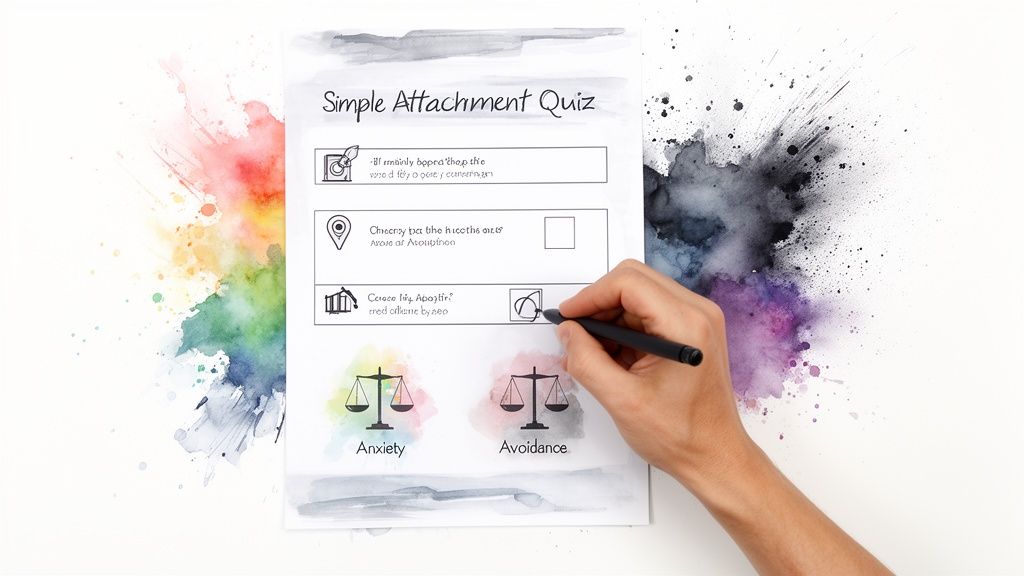
The goal is to move from knowing your style to doing something with that knowledge. It's about building a bridge from the test result to your real-world behaviors. But how do you actually make that leap in your day-to-day life?
From Label to Lived Experience
Your attachment style test result is a new pair of glasses. It gives you a fresh lens to see your relationships through. Instead of just feeling "mad" during an argument, you can pinpoint the specific attachment-related fear pulling the strings. This is the first step toward conscious change.
Let's break down what these styles look like in real life:
-
Anxious Style in Conflict: You might feel a desperate need to fix things right now. The idea of going to bed angry is torture because it pokes at a deep fear of abandonment. This might look like sending a string of texts or pushing for resolution when your partner needs space.
-
Avoidant Style with Affection: Your way of showing love might be more about doing things than saying things. When your partner has a tough day, your instinct is to solve the problem—maybe by ordering takeout—rather than having an emotional heart-to-heart, which can feel overwhelming.
-
Secure Style with Needs: You're able to state what you need clearly and kindly, without attacking. Instead of saying, "You never pay attention to me," you can say, "I feel a little disconnected when we're both on our phones. Could we try putting them away?"
The key is to see your result not as a flaw but as a roadmap. It shines a bright light on the exact areas where you can build new skills and healthier habits. It shows you where the work is.
Once you see these patterns, you can be more intentional about building stronger connections. For example, a huge part of feeling secure is building trust, which is why practicing trust exercises for couples can be a game-changer.
This self-awareness turns your test result from an idea into something you can work with. So, now that you can see the patterns, what concrete steps can you take?
Actionable Steps for Every Attachment Style
Getting your attachment style test results is like being handed a map. It’s a fantastic starting point, but the real journey begins when you decide where to go and start walking.
The goal for anyone with an insecure attachment style is what experts call “earned security.” This is where you consciously build the secure, healthy relationship patterns you might not have picked up naturally. It’s about recognizing your triggers, hitting pause, and intentionally choosing a new way forward.
This process looks different for everyone, but over time, these conscious choices create much stronger and more fulfilling connections.
If Your Style Is Anxious
For you, the work is about building self-worth and learning to be your own anchor. That deep fear of abandonment drives the need for constant reassurance, but you can learn to give that comfort to yourself.
First, get curious about what sets off your anxiety. Is it the minutes ticking by after you’ve sent a text? When your partner wants a night out with friends? Once you know your triggers, you can prepare for them instead of being ambushed by them.
Here’s how to start:
- Practice grounding yourself: When anxiety hits, bring yourself back to the present. Instead of letting your mind spiral into worst-case scenarios, focus on the feeling of your feet on the floor or the rhythm of your breathing.
- Create a self-soothe toolkit: What genuinely calms you down? Make a list. Maybe it's a walk, a specific playlist, journaling, or a quick call with a trusted friend. Turn to this list before you reach out from a place of panic.
- Communicate your needs calmly: There's a world of difference between "Why are you ignoring me?!" and "I feel a little anxious when we haven't touched base, and I'd love to connect when you have a free moment." One is an accusation; the other is a calm, clear "I" statement.
If Your Style Is Avoidant
Your path to growth is about gently leaning into emotional closeness instead of pulling away on autopilot. The core challenge is to reframe vulnerability—not as a weakness, but as the very thing that makes a connection real.
This won't happen overnight. It requires patience and a willingness to sit with the discomfort that closeness can sometimes bring.
The goal isn't to erase your need for independence. It's about finding a balance where you can depend on others without feeling like you're losing a part of yourself.
Start with small, manageable steps to slowly build your tolerance for intimacy. You could explore structured bonding activities for couples, which can feel less intimidating than a wide-open, emotional conversation.
If Your Style Is Fearful-Avoidant
Your journey is about navigating that internal tug-of-war between desperately wanting connection and being terrified of it. The key is to build safety and trust, first with yourself and then with your partner.
Since you experience both anxious and avoidant tendencies, your healing path will involve addressing both sides of that coin.
Start by acknowledging the internal conflict without judging yourself. It makes sense to want closeness and fear it at the same time, especially given past experiences. From that place of self-compassion, you can begin to slowly test the waters of a safe connection.
Combining Your Attachment Style with Love Languages
Think of your attachment style as the why behind your relationship patterns. It explains why you crave reassurance, pull back from closeness, or find connection easy. It's a massive piece of the puzzle.
But there's another layer: the how. How do you prefer to show and feel loved day-to-day? That's where the 5 Love Languages® come in, giving you a practical toolkit that dovetails perfectly with the insights from your attachment style test.
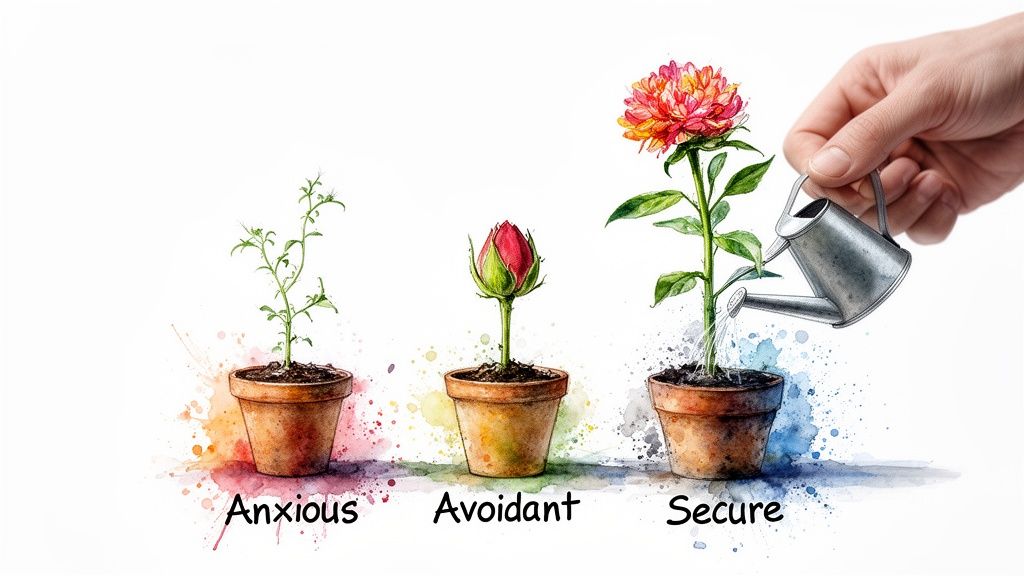
When you pair these two frameworks, you create a complete roadmap for connection. You get the deep psychological wiring from attachment theory alongside the simple, actionable language of love. This combination helps you move from understanding your patterns to actively improving them.
How Styles and Languages Interact
It helps to think of your attachment style as the operating system running in the background. Your love language, then, is the specific app you use to connect. They’re constantly influencing each other, and seeing that interplay can spark major "aha" moments.
Here’s a look at how they often show up together:
-
Anxious Style + Quality Time: Someone with an anxious style often needs undivided attention to feel secure. For them, Quality Time isn't just a nice-to-have; it's the ultimate antidote to their fear of disconnection. Those focused moments send a clear message: "You are my priority."
-
Avoidant Style + Acts of Service: A person with an avoidant style can feel uncomfortable with big emotional displays. They often prefer to show love through practical support. Fixing a leaky faucet or running an errand is their way of saying, "I care about you," which feels safer than words.
-
Secure Style + Any Love Language: A securely attached person can usually give and receive love in all five languages. But knowing their primary language helps their partner love them in the most impactful way possible, making a great bond even stronger.
By understanding both your attachment needs and your love language, you can finally communicate what makes you feel both safe and cherished. This duo gives you the exact words to ask for what you need.
This deeper self-awareness changes the game. If you're still fuzzy on your primary love language, taking a few minutes to discover the 5 Love Languages in our detailed guide can provide that missing piece. This knowledge bridges the gap between your deepest emotional needs and your partner's expressions of love.
A Few Common Questions About Attachment Styles
Once you start digging into attachment theory, a few questions almost always pop up. It’s one thing to understand the patterns on paper, but it’s another to figure out what they mean for your actual, day-to-day life.
Let’s clear up some of the most common questions we hear.
Can My Attachment Style Change Over Time?
Yes, it absolutely can. Think of your attachment style less like a permanent trait and more like a default setting—one programmed in childhood but that can be updated.
While early experiences are powerful, they don't lock you in forever. Major life events, personal growth, therapy, or being in a stable, loving relationship can shift your settings toward security. This is called "earned security," and it's one of the most hopeful parts of this theory.
Are Online Attachment Style Tests Accurate?
For the most part, yes. The good ones are usually based on scientifically-backed questionnaires used in research, so they're great at giving you a snapshot of your dominant patterns.
An attachment style test isn't a substitute for a formal diagnosis from a therapist, of course. But it's an incredibly valuable starting point. It gives you the language to understand your own tendencies and shines a light on where you can start to grow.
What if My Style Feels Permanent?
It can feel that way, but the research tells a different story. One landmark study tracked people from age 13 to 72. It found that attachment anxiety and avoidance tend to drop off significantly over a lifetime, particularly in mid-life. You can read more about how attachment styles change throughout life.
This is fantastic news. It confirms that the work you put in and the healthy relationships you build can create real, lasting change. Your starting point doesn't have to be your destination.
Understanding your attachment style is a huge step toward building stronger, more fulfilling relationships. The next piece of the puzzle is learning how you and your partner give and receive affection in your day-to-day lives. Are you ready for that clarity?
Discover your love language in just a few minutes. Take the free test now.