

The first step toward healing a relationship isn't a grand gesture. It's a quiet, courageous decision to acknowledge the emotional distance that has grown between you. It's choosing to take that first step back toward each other.
This space isn't a failure, but fertile ground. It's a chance to build a connection that's deeper and more intentional than ever before. But how do you bridge a gap that feels impossibly wide?
Recognizing the Distance Before It Becomes a Divide

The moment you realize something is off is rarely a lightning bolt. It's quiet. It’s the conversations that get cut short or the inside jokes that fall flat. That comfortable silence suddenly feels heavy with unspoken words.
If you’re feeling this, you’re not alone. So many couples go through this phase. It's a painful but surprisingly common part of long-term partnerships. The key is seeing the distance for what it is.
It’s not a sign that the love is gone. It's a signal that your connection needs tending to, like a garden that needs water and sunlight. This is your turning point, and what you do next will define everything.
Why Small Gaps Feel So Big
A small emotional gap can quickly become a chasm if ignored. Often, it starts with a simple crossed wire in your emotional communication. You might be putting in a ton of effort to show your partner you love them.
But if it's not in the "language" they understand, the message gets lost. This is where the real work of healing a relationship begins.
It’s not about huge apologies, but about small, consistent acts of understanding each other again. The journey back isn't about gluing broken pieces together. It’s about building something new and far more resilient. But where do you even start?
The goal isn't just to get back to how things used to be. It's to create a new dynamic built on a deeper understanding of each other, turning this period of disconnect into a catalyst for incredible growth.
Your first step isn't a scary, sit-down conversation. It's a simple act of awareness. It's about figuring out what you and your partner truly need to feel seen, heard, and loved. This single insight is the foundation for everything that follows.
Figuring out that emotional blueprint is easier than you might think. Ready to find out how? You can start the process today by taking the free Love Language Test and getting a fresh perspective on what makes you both tick.
Pinpointing the Cracks Without Placing Blame

Before you can mend anything, you have to know what's broken. This isn’t about building a case against your partner or listing every little thing they’ve done wrong. It’s about a gentle, honest look at your relationship.
I like to think of it like finding a hairline crack in a foundation. You can ignore it, but it will only get worse. Or you can find it, repair it, and make the whole structure even stronger. Relationships are the same.
The trick is to approach these issues with curiosity, not criticism. Getting this clarity moves you from a defensive crouch into a proactive, "we're-in-this-together" headspace. But how do you actually do that without starting a fight?
A Gentle Relationship Health Check
The first step in pinpointing the issues is to look inward. Seriously. The goal here is to get a handle on your own feelings and experiences before you even think about your partner's intentions.
Start by asking yourself a few key questions. Answer them honestly, just for you, before ever bringing them up with your partner. This is a moment for quiet reflection, not an investigation.
Questions for Personal Reflection:
- When did I first notice the distance? Was it a specific event, like a new job, a move, or a baby? Or has it been a slow, creeping fade?
- What moments make me feel most disconnected? Is it when you talk about money? Plan the weekend? Or is it in the quiet moments with no distractions?
- When do I feel the most loved and connected? This isn't just nostalgia; it’s about gathering clues for what’s gone missing from your dynamic.
- What is one core need I have that isn't being met? Get specific. Is it more appreciation? More help around the house? Or just more focused, one-on-one time?
Answering these helps you draw a map of your relationship's emotional landscape. You'll start to see where the connection is solid and where it needs serious reinforcement. This clarity is the first step toward real change.
Moving From "You Did" to "I Feel"
The biggest trap at this stage is the blame game. It’s so easy to point fingers and say, "You never listen," or "You always put work first." While that might feel true to you, those words immediately put your partner on the defensive.
The fix is a simple but powerful shift in language: reframe everything from accusation to personal experience. This is the difference between diagnosing a problem together and just starting another fight.
Instead of talking about what your partner did, talk about how their actions made you feel. For example, "You never listen to me" becomes, "I feel unheard when we talk about our day." See the difference? One invites a fight, the other invites empathy.
This isn't about sugarcoating the truth. It's about delivering it in a way your partner can actually hear and absorb. You're opening a door for them to understand your world, not just defend their own.
You are far from alone in feeling this way. A recent global survey from Ipsos found that while 63% of people are satisfied with their partners, a massive 37% are not. You can explore more about these global relationship trends and see how common this is.
Recognizing Common Disconnect Patterns
As you reflect, you might see your issues fall into common categories. Being able to name the pattern can make you feel less alone and give you a much clearer place to start. This is how you stop feeling lost.
Common Culprits of Disconnection:
- The Slow Fade: This is death by a thousand papercuts. It happens when small, unresolved annoyances pile up. Nobody did anything catastrophically "wrong," but you both stopped doing the small things "right."
- The Aftershock: A major life event hits—a health scare, losing a job, a death in the family—and sends shockwaves through your relationship. Emotionally, you're on two different planets.
- Mismatched Expectations: This is a sneaky one. It happens when you both have unspoken ideas about roles or how to show love. You might think you're showing love by working long hours, while your partner is starving for quality time.
Putting a name to your pattern is incredibly empowering. You’re no longer lost in a vague fog of unhappiness—you finally have a starting point. And that starting point is learning to talk again.
Learning to Talk Again Without Starting a Fight
When a relationship hits a rough patch, good communication is usually the first casualty. Conversations feel like walking through a minefield. One wrong word could set off an explosion, so you end up avoiding talking altogether.
The goal isn't just to talk more, but to create a space where you can both speak honestly and be heard. Healing a broken connection almost always comes down to relearning how to talk to each other.
It means you finally have the right tools to handle disagreements in a way that brings you closer instead of pushing you further apart. This is how you stop the cycle of fighting.
The Power of "I Feel" Over "You Did"
Think about the last argument you had. How did it start? Chances are, it began with an accusation. Phrases like "You always…" or "You never…" immediately put your partner on the defensive.
Once that happens, they stop listening to understand and start building a case for their own defense. It’s a guaranteed recipe for a fight, not a resolution. So how do you break this pattern?
The single most powerful shift you can make is to trade your "You" statements for "I" statements. It's a simple tweak that completely changes the dynamic, turning an accusation into a personal feeling.
- Instead of: "You never help with the kids."
- Try: "I feel so overwhelmed and unsupported when I'm handling the kids' bedtime routine by myself."
This isn't about tiptoeing around the issue; it's about being incredibly clear. You’re owning your feelings and calmly explaining how a situation impacts you. That simple act invites empathy and is a game-changer for healing communication.
Bringing Some Structure to the Chaos
When emotions are high, a little structure can be a lifesaver. It stops the interruptions, misunderstandings, and old arguments that always seem to resurface. One of the best methods for this is the Speaker-Listener Technique.
The rules are straightforward but incredibly effective. You create a turn-based dialogue where one person has the floor to speak without being cut off, while the other’s only job is to listen and understand.
The goal of the Speaker-Listener Technique isn't to solve the problem right then and there. It's to make sure both partners feel completely heard and understood, which is the crucial first step before you can solve anything together.
Here’s the breakdown:
- Pick a Speaker and a Listener: One of you agrees to start as the Speaker.
- The Speaker Talks: Using "I" statements, the Speaker shares their thoughts in short bursts.
- The Listener Paraphrases: After a few sentences, the Listener repeats back what they heard, starting with, "Okay, so what I'm hearing you say is…"
- The Speaker Confirms: The Speaker either says, "Yes, that's it," or gently clarifies, "Not quite, what I was trying to say was…"
- Switch Roles: Once the Speaker feels totally understood, you trade places.
This process forces you both to slow down. It makes you engage with what your partner is actually saying, not what you assume they're saying. For couples ready to rebuild connection, you can explore similar methods in our guide to intimacy exercises for couples.
Why Your Words Might Still Be Missing the Mark
Here’s the thing: even with flawless "I" statements, your efforts can still fall flat. Why? Because you might not be speaking your partner's core emotional language. This is the missing piece for so many couples.
You could be offering thoughtful words when what they desperately need is a long hug. Or you might be taking over chores when all they really want is 20 minutes of your undivided attention.
This is where the real breakthrough happens. Getting communication right isn't just about the words you use. It’s about understanding the specific ways your partner feels loved. But how do you figure out what those needs are?
Using Love Languages as Your Relationship Repair Kit
It's a frustrating feeling. You’re trying so hard to show love, but it’s just not landing. You feel like you're sending heartfelt messages that are getting lost in translation, and the disconnect keeps growing.
Often, the real pain isn't a lack of love, but a mismatch in how that love is expressed. The good news? Healing can start the moment you stop guessing and start speaking a language your partner can understand.
Think of the 5 Love Languages as your repair kit. Each one—Words of Affirmation, Acts of Service, Receiving Gifts, Quality Time, and Physical Touch—is a tool designed to meet a core emotional need.
Figuring out your primary languages is often the "aha!" moment that explains why your best efforts have missed the mark. It’s the classic scenario: you've been offering a gift when all your partner craved was your attention.
Cracking the Code of Connection
Understanding your partner's love language isn't just trivia; it’s a strategic roadmap straight to their heart. It lets you deliver affection with precision, making sure your efforts are not only seen but deeply felt.
For instance, if your partner’s language is Acts of Service, tackling the dishes without being asked can scream "I love you" louder than any flowery compliment ever could. And what if their language is different?
But if their language is Words of Affirmation, that same helpful act might go unnoticed. For them, a simple, heartfelt "I'm so proud of you" could completely change the course of their day.
Learning these languages is the first step. For a deeper dive into each one, check out our guide on what the 5 Love Languages are and see how they show up in daily life. But how does this apply to your communication?
The key to all of this is understanding what truly makes your partner feel secure, valued, and loved. The visualization below breaks down the two sides of communication: how you express yourself and how you hear your partner.
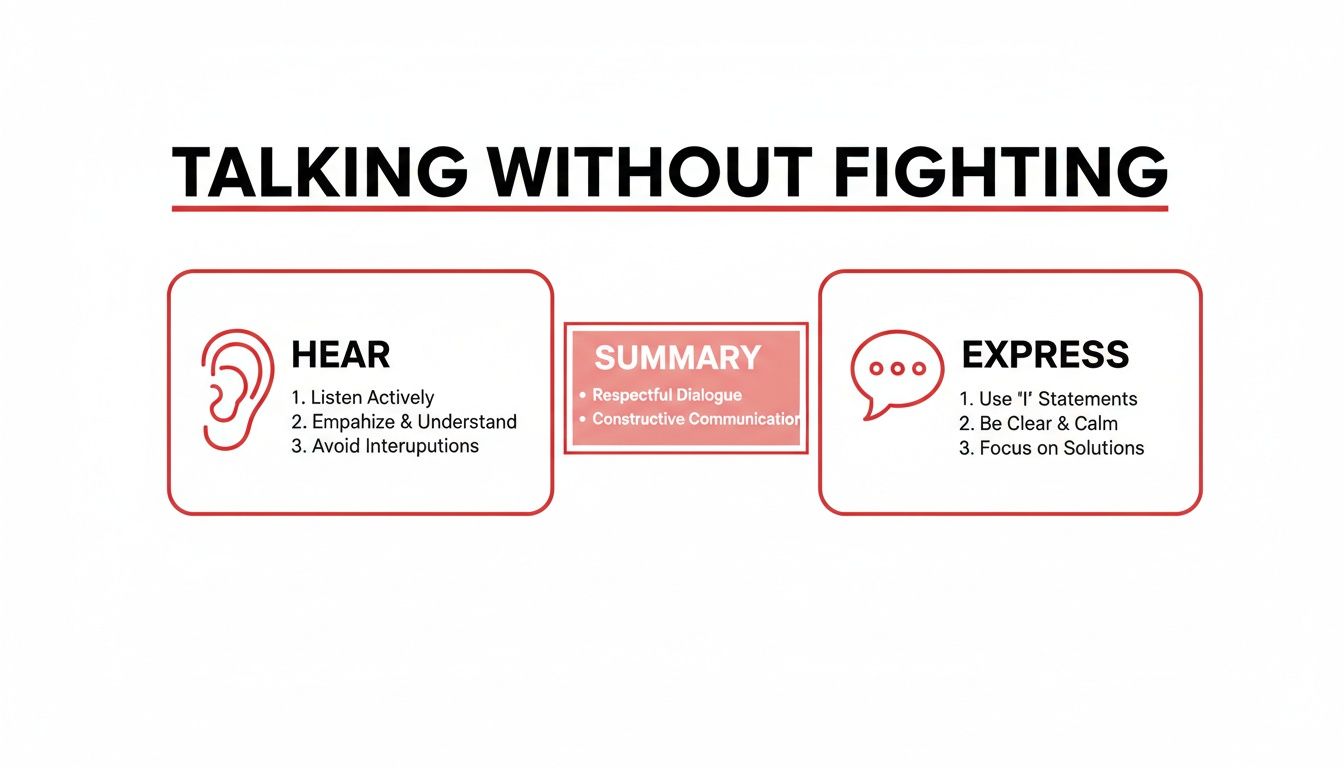
This balance is where the magic happens. Your love languages tell you what to say and do, and they help you listen for your partner's unspoken needs. That's how real healing begins.
Applying Love Languages for Relationship Repair
Knowing your love languages is great, but the real work starts when you turn that knowledge into consistent, meaningful action. The table below shows how to translate each language into a concrete healing step.
| Love Language | What It Looks Like When Neglected | Actionable Healing Step |
|---|---|---|
| Words of Affirmation | Feeling unappreciated, criticized, or taken for granted. | Leave a handwritten note expressing your gratitude for something specific they did. |
| Acts of Service | Feeling overwhelmed, unsupported, or like they carry the whole burden. | Proactively take a chore off their plate without them having to ask. |
| Receiving Gifts | Feeling forgotten or that the relationship lacks thoughtfulness. | Bring home their favorite snack or a small, meaningful object that says "I was thinking of you." |
| Quality Time | Feeling lonely, ignored, or second-best to phones and other distractions. | Schedule a 20-minute "no-phones-allowed" chat at the end of the day. |
| Physical Touch | Feeling distant, disconnected, or un-desired. | Offer a hug that lasts longer than three seconds or hold their hand while watching TV. |
These small, targeted actions can feel like a deposit into a depleted emotional bank account, slowly but surely rebuilding trust and connection. But how do you start this conversation?
How to Share Your Results (Without Starting a Fight)
So, you've taken the test and had a lightbulb moment. Awesome. But how you share this new insight is critical. The goal is to frame it as a team-building exercise, not a scorecard of past failures.
Instead, try an approach that feels collaborative and non-threatening. This isn't the time to say, "See? This is what you've been doing wrong all along." That will backfire immediately.
"Hey, I did this really interesting quiz and it helped me understand myself a bit better. My results said my top love language is Quality Time, which makes so much sense to me. I’d love for you to take it too, so I can learn how to love you better."
This invitation positions the test as a tool for connection, not a weapon. It’s about building a shared vocabulary to discuss your needs without blame. It becomes a collaborative journey forward.
Taking the free Love Language Test at thelovelanguagetest.com is a simple, five-minute investment that can pay massive dividends. Once you both have your results, you can finally start turning your repair efforts into a true reconnection.
Creating New Habits to Protect Your Connection
Healing a relationship isn’t a one-time fix. It’s a quiet, daily commitment to new habits that act as a shield for your bond. The hard work of repair can be exhausting.
The real goal is to shift that effort from reactive damage control to proactive, joyful connection. This is where you build something that lasts.
It’s about turning those hard-won insights into everyday actions, creating a new normal where your relationship doesn't just survive—it actually thrives. This doesn’t just happen by magic; it’s built on intentional routines.
From Repair Work to Daily Rituals
Sustainable change comes from small, repeatable actions that reinforce your bond. Think of these not as chores, but as tiny rituals that protect your emotional intimacy. They are the guardrails that keep you on track.
These new habits don't need to be grand gestures. In fact, their power lies in their simplicity and consistency. You want to weave them so seamlessly into your life that they become the default rhythm of your partnership.
So, where do you start? Begin with one or two rituals that feel both manageable and meaningful.
- The Weekly Check-In: Set aside dedicated, distraction-free time. This isn't for solving big problems, but for asking, "How are we doing?" Share one thing you appreciated this week and one thing that would make you feel more connected.
- Dedicated Date Night: You have to reclaim time that is just for the two of you. It could be a walk after dinner or cooking a new recipe together. The only rule? No phones and no talk about household logistics.
- The "Six-Second Kiss": This simple habit is about reconnecting physically every single day. A longer-than-usual kiss when you leave or come home sends a clear signal that your connection is a priority.
Choosing habits like these sends a powerful message: "This relationship is important, and I am actively choosing to nurture it." But what happens when old arguments flare up, despite your best efforts?
Creating Your Conflict Game Plan
Even the healthiest couples disagree. The real difference is that they have a plan for navigating conflict before it ever starts. Instead of getting stuck in the same reactive loops, create a shared strategy together.
Sit down when you're both calm and create your "Rules of Engagement." This isn’t about winning an argument; it's about protecting the relationship while you work through a problem. That's the key.
Our Conflict Plan
- We agree to take a 20-minute timeout if things get heated. The person who calls the timeout is responsible for restarting the conversation later.
- We will use "I feel" statements instead of "You always" accusations.
- We will not bring up past mistakes. We focus only on the current issue.
- We will remind ourselves that it's "us versus the problem," not "me versus you."
Having these agreements gives you a script to follow when emotions are running high. For more ideas on rebuilding this sense of teamwork, you might find great ideas in these trust-building activities for couples.
The investment in these habits pays dividends. The famous Harvard Study of Adult Development, which has tracked lives for over 85 years, found the quality of our close relationships is the single greatest predictor of our long-term health and happiness.
Got Questions About Healing Your Relationship? Let's Talk.
When you’re trying to mend a relationship, it’s natural for questions to pop up. The path forward can feel uncertain, and it’s normal to wonder how long it will take or if it’s even possible to come back from a deep hurt.
Having these questions is a great sign. It means you’re invested and thinking seriously about how to rebuild something that truly matters to you. Let's get you some real answers.
How Long Does It Realistically Take to Heal a Relationship?
Honestly? There’s no magic number. Anyone who gives you a specific timeline isn't telling you the whole story. The real answer depends on the depth of the issues and how committed both of you are to the work.
Minor disconnects can often be repaired in a few weeks with consistent, focused effort. But deeper wounds, like a breach of trust, can take many months, or even years, to fully mend.
The key is to stop watching the clock and start watching your progress. Are your conversations getting safer? Are you moving forward, even in tiny ways? That's what really matters.
The most important metric isn't speed; it's momentum. Celebrating the small wins—like a tough conversation that didn't end in a fight—is what builds the foundation for lasting change.
Focusing on intentional actions, like speaking your partner's love language, can move the needle. When your efforts to repair the bond are delivered in a way your partner can truly feel, it rebuilds trust much faster.
What if My Partner Is Unwilling to Work on the Relationship?
This is, without a doubt, one of the most painful situations to be in. You can’t force someone to change or meet you halfway. What you can do is change your own approach, and sometimes, that’s enough to shift the dynamic.
Start by modeling the communication you want to have. Use "I" statements to share how you're feeling without pointing fingers. For example, "I feel unheard when we talk, and I really miss feeling connected to you."
See the difference? One invites a fight; the other invites empathy. It creates an opening. A great, low-pressure way to get the ball rolling is by suggesting a simple activity you can do together.
- Introduce The Love Language Test: Frame it as something fun and insightful. You could say, "I found this interesting quiz, and my results were spot-on. I'd be curious to see yours so I can understand you better."
- Focus on learning, not fixing: By presenting it as a tool for mutual understanding, you take the pressure off. It becomes a collaborative exploration, not a confrontation.
If you’ve made a consistent effort and your partner still won’t engage, it might be time to think about professional counseling. A therapist can create a neutral space where you can both finally be heard.
Can a Relationship Truly Recover from Betrayal?
Yes, it absolutely can. But it requires a massive amount of courage, transparency, and hard work from both people. Recovering from something like infidelity is one of the toughest challenges a couple can face.
For recovery to be possible, a few things are non-negotiable. The person who broke the trust has to take full ownership of their actions—no excuses. There must be total transparency to help the betrayed partner feel safe again.
In these situations, professional therapy is almost always a good idea. Rebuilding is slow, but this is where love languages can be a critical tool. Intentional Acts of Service can slowly, brick by brick, demonstrate a renewed commitment.
When Should We Consider Professional Couples Therapy?
Thinking about therapy isn't a sign of failure—it's a sign of strength. It means you value your relationship enough to call in an expert to help you protect it. So when is it time to make that call?
- You're stuck on a hamster wheel: You're having the same argument over and over again with no resolution in sight.
- The silent treatment has taken over: You’re either avoiding all the hard topics or have pretty much stopped talking altogether.
- There's been a major betrayal: Things like infidelity are incredibly difficult to navigate on your own.
- One or both of you are thinking about leaving: A therapist can help you explore your options in a structured, compassionate way.
A good therapist doesn't take sides. They act as a neutral guide, giving you the tools to have the conversations that feel too scary to have on your own. They can help you finally break those destructive patterns.
The journey of healing a relationship is built one intentional step at a time. The most powerful changes often start with a simple desire to understand each other better. Discovering your love languages provides a clear and practical roadmap for reconnection. To start your journey today, take the free test with The Love Language Test at https://www.thelovelanguagetest.com/.