
You know that sinking feeling. You try to start a meaningful conversation, but within minutes, you’re caught in the same frustrating loop. You're both talking, but neither of you is really hearing the other, and it all fizzles out into a tense silence.
If that sounds painfully familiar, you're not alone. Many couples get stuck here, wondering why their attempts to connect just seem to push them further apart. The real issue isn't about who’s right or wrong; it's a sign of a much deeper disconnect.
This cycle happens when core emotional needs go unheard, leaving you both feeling misunderstood. But what if you could change that pattern for good? The key is learning how to get beneath the surface-level arguments.
That's exactly what we're going to explore.
Why Your Conversations Are Falling Flat
To fix a communication breakdown, you have to look past the surface arguments and tune into the emotions underneath. Think about it: when does a simple discussion turn into a fight? It’s usually when one person feels criticized, dismissed, or ignored.
That feeling triggers our defensive walls to shoot right up. Once those walls are up, any chance of making real progress is gone. The conversation stops being about the issue and becomes about emotional self-preservation.
The biggest communication problem is we do not listen to understand. We listen to reply.
Changing this starts with a shift in your mindset. Instead of gearing up for a debate, try approaching conversations with genuine curiosity. What is your partner really trying to tell you? What fear or need is hiding behind their words?
Figuring this out is a game-changer. It’s also helpful to understand how your own history shapes your reactions. For instance, our article on how different attachment styles affect relationships can offer powerful insights.
But first, you have to spot the habits that are sabotaging you before you even begin.
Identifying the Hidden Saboteurs
Sometimes, the problem isn’t what you’re saying, but how you’re saying it. Little things you might not even notice—your tone or body language—can completely derail a conversation before it even gets going.
Watch out for these common conversation killers:
- Terrible Timing: Launching into a serious talk when your partner is visibly exhausted, stressed, or walking out the door is setting yourself up for failure.
- The Blame Game: Kicking things off with "You always…" or "You never…" instantly puts your partner on the defensive and kills any hope of working together.
- Ignoring the Unspoken: A subtle eye-roll, a heavy sigh, or turning your body away can scream contempt louder than any words, and they’ll shut down communication fast.
But here’s a thought. What if the problem isn’t just about avoiding these negative habits? What if it’s about learning to speak a language your partner can truly hear? That one insight could unlock everything.
Decoding the Four Communication Killers
Have you ever been in a conversation that spirals into a massive fight, leaving you wondering, how did we even get here? More often than not, the real culprit isn't what you're arguing about—it's the destructive communication habits silently chipping away at your connection.
Relationship expert Dr. John Gottman famously identified four of these toxic behaviors, calling them "The Four Horsemen." Their presence can predict the end of a relationship with terrifying accuracy. One study found that couples who consistently used these patterns had a 93% chance of divorcing. You can read the full research on these predictive behaviors here.
But here’s the good news: once you can spot these habits, you can consciously choose healthier ways to communicate.
It’s easy to see how things go off the rails. A simple conversation can quickly become a major misunderstanding.
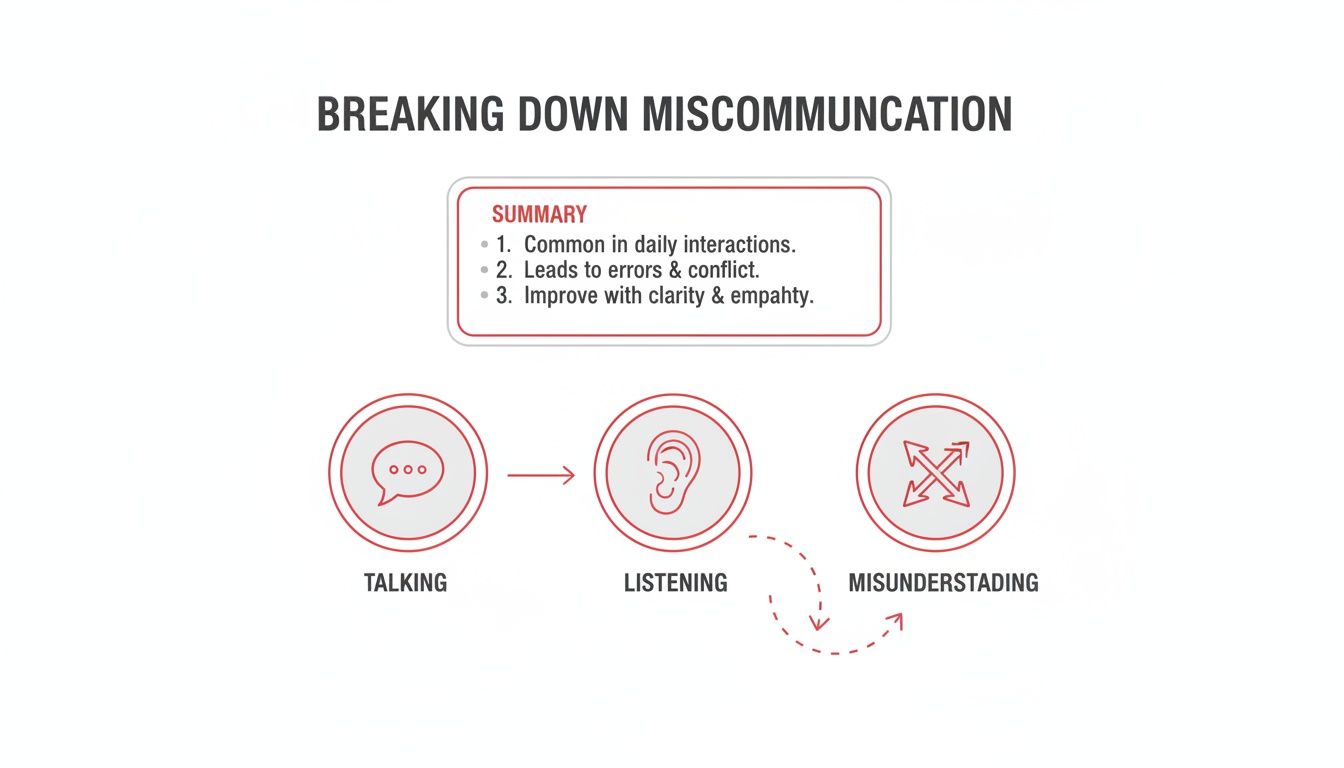
The breakdown usually isn't about what was said, but how it landed. So what are these four behaviors that cause so much damage? Let's break them down.
Criticism: The Personal Attack
Criticism isn't just voicing a complaint; it's a direct attack on your partner's character. Instead of talking about a specific action that bothered you, you end up blaming them for a personality flaw. This is a critical distinction.
- A complaint sounds like: "I was worried when you didn't call to say you were running late."
- Criticism sounds like: "You're so thoughtless. You never think about how your actions affect other people."
See the difference? The first addresses a behavior. The second is a personal jab that immediately puts your partner on the defensive, making resolution nearly impossible.
Contempt: The Ultimate Insult
Contempt is the most corrosive of the four. It’s any statement or non-verbal behavior that puts you on a moral high ground, looking down on your partner. This shows up as sarcasm, cynicism, name-calling, eye-rolling, or hostile humor.
Contempt is fueled by long-simmering negative thoughts about a partner. It is the single greatest predictor of relationship failure.
When contempt rears its ugly head, you’re not just arguing anymore. You’re communicating pure disgust. It’s so toxic because it conveys a total lack of respect, making it nearly impossible to repair the damage.
Defensiveness: The Blame-Shifter
Defensiveness is a classic gut reaction to feeling attacked, but it's a trap. It's essentially a way of pushing blame back onto your partner, saying, "The problem isn't me, it's you." All it does is escalate the conflict.
Defensive responses usually sound like one of these:
- Making excuses: "It's not my fault I didn't call! I was swamped at work."
- Cross-complaining: "Well, what about you? You didn't unload the dishwasher yesterday!"
These reactions completely shut down the conversation. A non-defensive approach, where you take responsibility for even a tiny part of the conflict, can de-escalate the tension almost instantly.
Stonewalling: The Impassable Wall
Stonewalling is what happens when one partner completely checks out of the interaction. They shut down, stop responding, and basically become a brick wall. This isn't just taking a healthy timeout; it's a complete disengagement.
This behavior often happens when someone feels emotionally flooded and overwhelmed. While it might feel like a way to avoid a fight, it sends a powerful and painful message to the other person: "You don't matter." Learning to recognize when you or your partner is feeling flooded is the key to stopping this pattern.
To help you spot these in real-time, here’s a quick guide to The Four Horsemen and what you can do instead.
The Four Horsemen and Their Antidotes
| Destructive Habit (The Horseman) | What It Sounds Like | Constructive Alternative (The Antidote) |
|---|---|---|
| Criticism | "You always…" or "You never…" followed by a character attack, like "You're so lazy." | Use "I" statements to express your feelings and needs. "I feel frustrated when the trash isn't taken out." |
| Contempt | Sarcasm, eye-rolling, name-calling, or mockery. "Oh, you're such a genius." | Build a culture of appreciation. Focus on what you admire about your partner and express it often. |
| Defensiveness | Making excuses ("It's not my fault…") or cross-complaining ("Well, you didn't…"). | Take responsibility for even a small part of the problem. "You're right, I should have called. I'm sorry." |
| Stonewalling | Shutting down, ignoring, or physically leaving the room without a word. Complete silence and lack of eye contact. | Learn to self-soothe. Agree to take a 20-minute break and then come back to the conversation when you're calmer. |
Learning to recognize these "horsemen" is the first, most crucial step. Once you can name the destructive pattern, you can start consciously choosing the antidote and building a much stronger, healthier connection.
Learning to Speak Your Partner's Love Language
Ever spent a ton of time and effort planning the perfect gesture, only for it to fall completely flat? It’s a gut punch. Maybe you splurged on an expensive gift when all they really wanted was for you to put your phone down and listen for a few minutes.
That kind of disconnect is a classic communication breakdown. It happens because you and your partner are often speaking completely different emotional languages. To really connect, you have to learn what makes them feel truly seen and cherished.
That’s the entire idea behind the five love languages—it’s not about grand gestures, but making your efforts actually count.

What Are the Five Languages of Love?
Everyone has a primary way they prefer to give and receive affection. When your expressions of love line up with their primary language, the emotional impact is huge. But when they don't, it often leads to feeling unloved or misunderstood.
Here’s a quick look at the five distinct ways people express and experience love:
- Words of Affirmation: For people with this love language, words are everything. Unsolicited compliments, hearing "I'm so proud of you," or a simple "I love you" makes them feel secure.
- Acts of Service: Actions truly speak louder than words for this group. Doing a chore without being asked or making them breakfast in bed are powerful expressions of care.
- Receiving Gifts: Don't mistake this for materialism. It's the thought and effort behind the gift that resonates. A thoughtful present shows them they are known, cared for, and prized.
- Quality Time: Nothing says "I love you" more than giving someone your undivided attention. That means no phones, no TV, no distractions—just you, them, and a shared focus.
- Physical Touch: For this person, physical connection is paramount to feeling loved. Hugs, holding hands, or a reassuring touch on the arm create a deep sense of security.
Want to go deeper? You can learn more about what the 5 love languages are and how they work.
Why This Is a Game-Changer for Your Relationship
Imagine trying to have a conversation where one person only speaks French and the other only speaks Japanese. You could shout sweet nothings all day, but the message would never land. That's exactly how love languages work.
Understanding and speaking your partner's love language isn't just a nice idea—it's a fundamental tool for effective emotional communication. It translates your good intentions into impactful actions.
Knowing their language stops the guesswork. You no longer have to throw things at the wall and hope something sticks. Instead, you can focus your energy on the specific actions that will make your partner feel cherished, strengthening your bond.
Ready to discover your love language? Take our free, quick test and get a personalized report to start improving your connection today. Find out your love language now.
Actionable Exercises to Rebuild Your Connection
Knowing you need to communicate better is one thing; actually doing it is another. Insight alone won't fix a strained connection—that takes consistent, intentional practice. This is where we move from theory to action.
We've laid out a few simple but powerful exercises you can try tonight. Think of them as practical routines that build the muscle memory for healthier communication, turning new skills into natural habits.

The Weekly Check-In
One of the most effective ways to improve communication in relationships is to make time for it. The Weekly Check-in is a scheduled, safe space where you can talk about your life together without things spiraling into an argument.
Here’s how to make it work:
- Set a Time: Pick 20-30 minutes each week when you’re both relaxed and won't be interrupted. Put it on the calendar like any other important appointment.
- No Blame, No Shame: This is a judgment-free zone. The goal is to connect, not to correct each other.
- Use Gentle Prompts: Take turns sharing your answers to a few simple questions.
Conversation Starters for Your Check-In
- "What was one thing that made you happy this week?" (Shares joy)
- "What was one thing that was stressful this week?" (Builds empathy)
- "What is one thing I could do to make you feel more loved next week?" (Actionable and forward-looking)
- "Is there anything that felt unresolved or incomplete between us this week?" (Clears the air)
This simple routine keeps small resentments from piling up into major blow-ups. It creates a predictable rhythm of connection you can both count on.
Guided Conversation Starters for Tricky Topics
Talking about sensitive subjects like money or intimacy can feel like walking through a minefield. Often, it’s not the topic that’s so hard, but finding the right words to start the conversation. Using guided prompts can take away that initial awkwardness.
For example, when bringing up finances:
- Instead of: "You spent too much money again."
- Try: "I feel anxious when I look at our credit card bill. Could we sit down this weekend and make a plan together that makes us both feel secure?"
See the difference? This shifts the conversation from an accusation to a collaborative problem-solving session. For those wanting to deepen their bond, exploring specific intimacy exercises for couples can also provide a structured way forward.
Active Listening Drills
So much of good communication isn't about talking—it’s about making your partner feel truly heard. Try this simple active listening exercise for just ten minutes.
- Set a Timer: One person is the Speaker for five minutes, the other is the Listener. Then you'll switch roles.
- Speaker's Job: Talk about anything on your mind. Your day, a worry, a dream—it doesn't matter.
- Listener's Job: Your only task is to understand. You can't interrupt, offer solutions, or jump in with your own story. Just listen.
- Reflect Back: When the Speaker finishes, the Listener’s only job is to say, "What I heard you say was…" and summarize the Speaker’s main points and feelings.
This drill feels unnatural at first, but it's incredibly powerful. It trains you to stop listening just to reply and start listening to actually understand.
How to Stay on Track When Old Habits Return
You’ve been trying so hard. You’re using "I" statements and practicing active listening. For a minute there, you really felt like you were making progress.
Then, a stressful day hits. Before you know it, you’re right back in that old, familiar pattern—getting defensive and watching the connection fizzle out. It’s a gut-punch moment that can make you feel like all your hard work went down the drain.
But this is completely normal. Lasting change isn't a straight line; it's more like two steps forward, one step back. The goal isn't perfection. It’s resilience. It's learning to get back on track faster each time you slip.
Seeing a setback as a temporary detour, not a dead end, is the most important step. The trick is to turn these moments into learning opportunities. What was the trigger? Was it stress, feeling unheard, or just pure exhaustion? Nailing down the cause helps you get ahead of it next time.
Navigating a Communication Relapse
When you find yourself sliding back into those old habits, the immediate goal is to stop the downward spiral. This isn't about winning the argument; it's about protecting your connection. You need a simple, blame-free way to hit the reset button.
Here's a quick recovery plan:
- Acknowledge the Slip-Up: Be the first to own it. A simple, "You know what, I just slipped back into my old habit of getting defensive. I'm sorry," can instantly take the heat out of the moment.
- Take a Mindful Pause: Agree on a timeout. Something like, "I'm feeling overwhelmed and don't want to say something I'll regret. Can we take 20 minutes and come back to this?" This isn't the silent treatment; it's a strategic pause.
- Repair and Reconnect: After cooling down, the focus shifts to repairing the emotional damage. Apologize for your part in how things went down. This isn't about admitting you were "wrong," but about taking responsibility for your reaction.
A setback is a setup for a comeback. Every time you catch yourself falling into an old pattern and choose a new response, you're strengthening the foundation of your relationship.
Using Your Love Language as a Reset Button
This is where knowing your love languages becomes your secret weapon for recovery. After a tough conversation, intentionally speaking your partner's primary love language is one of the fastest ways to rebuild your connection.
- If their language is Words of Affirmation, a heartfelt text saying, "I love you and I know we can work through this," can work wonders.
- For Acts of Service, quietly taking care of a chore they usually handle communicates your care and support without a single word.
- If it's Quality Time, try suggesting a quick walk around the block to reconnect without any pressure.
These small, intentional actions send a powerful signal: your bond is more important than the disagreement. You can always refer back to your results from The Love Language Test for a quick reminder of what truly fills their tank.
Your Communication Questions, Answered
Even with the best plan, trying to change old communication habits can feel tricky. It’s completely normal to hit a snag and wonder if you’re doing it right.
Let's walk through some of the most common questions we see. Think of this as a quick-reference guide to help you and your partner build that stronger connection you're looking for.
What if my partner won't try?
This is a tough one, but you can only control your side of the equation—and often, that’s enough to shift the entire dynamic. Start by being the change you want to see. Consistently model healthy communication yourself.
Use "I" statements, practice listening without jumping in, and work on managing your own defensiveness. When one person changes their steps, the dance changes. Your positive actions can slowly create a safer space, making them more likely to engage differently over time.
How does knowing our love languages actually help?
Think of your love language as a translator for your heart. Many breakdowns happen because you're showing love in a way your partner doesn't fully recognize. It's like you're broadcasting your affection on an FM station, but they're tuned to AM.
Once you identify your primary languages, you get a precise roadmap for making each other feel seen, understood, and cherished. It moves the conversation away from "You don't care about me" and toward a crystal-clear "I feel most loved when you do this."
This clarity cuts through the guesswork. It ensures your efforts to show love actually land and have the impact you intend, creating a solid foundation for more empathetic conversations.
We're too busy for this. What should we do?
Life is busy, but consistency is far more important than intensity. You don't need to schedule long, formal "talks" to make progress. The real magic happens when you weave small practices into the rhythm of your daily life.
- Try a 10-minute check-in while you're making dinner.
- Practice active listening for five minutes when your partner talks about their day.
- Send a quick text that speaks their love language.
Small, frequent, positive interactions build a much stronger foundation than big, infrequent gestures ever could. Start small and make it a habit you can actually stick with.
Are communication styles really that different?
Absolutely. Our upbringing, personalities, and past experiences have all shaped how we communicate. One partner might be direct and logical, needing to solve a problem right away. The other might need to talk through their feelings first.
Love languages show this perfectly. An act of service might feel like the ultimate expression of love to you, but it might barely register for a partner who craves words of affirmation.
The breakthrough comes when you learn to recognize and respect these differences instead of judging them. That’s how you start bridging the gap.
Ready to stop the guesswork and start connecting on a level that truly matters? This guide is your starting point, but the next step is discovering your unique emotional blueprint. The Love Language Test provides the clear insights you need.
Discover your unique love languages in just a few minutes and get practical tips to transform your communication today.
Take the free test now at https://www.thelovelanguagetest.com/.