
When trust is broken, the emotional fallout can feel like a seismic shock. Feelings of betrayal aren't just about disappointment; they represent a fundamental violation of the safety and security you believed you had in a relationship. It's the moment a promise is shattered or an infidelity comes to light, leaving you reeling.
This guide will help you understand that deep pain, recognize the signs of betrayal, and give you a clear, step-by-step path to start healing. Your journey out of this hurt begins with understanding exactly what you're up against.
But what makes this pain so uniquely devastating? Let's explore why betrayal cuts so much deeper than any other kind of hurt.
Understanding the Deep Pain of Betrayal
That initial shockwave can be completely overwhelming. This isn’t a simple case of hurt feelings—it’s the ground beneath you giving way. The pain you're experiencing is a legitimate, normal response to having the unspoken rules of your relationship completely upended. You are not overreacting.

Betrayal cuts deeper than disappointment because it attacks the very foundation of your connection. It can make you question everything, not just about your partner, but about your own judgment. So, what is it that makes this experience so uniquely painful?
The answer lies in something experts call betrayal trauma.
The Core of Betrayal Trauma
We call the intense emotional fallout betrayal trauma. This happens when the person you depend on for safety becomes the source of your pain. It creates a terrible conflict: your instinct is to seek comfort from the person you love, but they are the one who caused the wound.
This trauma often unfolds in layers, leading to:
- Intense Confusion: You might find yourself obsessively replaying conversations, trying to find the signs you missed. It can make you feel like you're losing your grip on reality.
- Overwhelming Anger: A fiery anger often surfaces—at your partner, at the situation, maybe even at yourself. This is a natural, protective response to being so profoundly hurt.
- Deep Grief: You aren’t just mourning a single action; you’re grieving the loss of the relationship you thought you had and the future you planned together.
Betrayal doesn't just break your heart; it shatters your sense of reality. The person you trusted most has shown you a different world, and now you have to figure out how to live in it.
Simply understanding that these messy emotions are normal is the first step toward healing. Giving yourself permission to feel your pain, without judgment, is what allows you to start putting the pieces back together.
But it’s natural to wonder, where do you even begin when the way forward is so unclear? Next, we’ll look at the common causes that lead to these devastating breaches of trust.
What Causes Betrayal in Relationships
When you hear "betrayal," your mind probably jumps to a physical affair. And while that’s a huge breach of trust, the feelings of betrayal can actually start much smaller. They often come from actions that are far more subtle but just as destructive over time.
Think of them as the slow burns that quietly eat away at a relationship's foundation. A partner can feel confused and unimportant long before any major blow-up happens.
At its core, betrayal is a violation of a promise, spoken or unspoken. It’s the breaking of that sacred agreement that holds a partnership together. Understanding the different ways this happens is the first step to seeing the cracks before they become unfixable.
More Than Just Physical Infidelity
A physical affair is an obvious betrayal, but an emotional affair can hurt just as much, if not more. This is when one partner builds a deep, private bond with someone else—sharing secrets and support that belong inside their main relationship. The classic "work spouse" that gets too close is a perfect example.
It happens more than you might think. A recent survey showed that nearly 25% of people who admitted to an affair said it began at the office. The combination of long hours and high stress can create an environment where inappropriate attachments take root.
For the person being betrayed, this kind of emotional cheating can make them feel completely invisible. It cuts deep because it sends the message that their emotional presence just isn't enough anymore. But betrayal has even more faces than this.
The Quiet Destroyers of Trust
Beyond affairs, other behaviors can make a person feel profoundly betrayed. They might not seem as dramatic on the surface, but when they add up, the damage is devastating.
- Financial Infidelity: This is when one partner hides debt, makes big secret purchases, or lies about their income. It’s a betrayal of the future you thought you were building together.
- A Pattern of Broken Promises: When someone consistently fails to do what they say they will, the message is clear: "You aren't a priority." Over time, this erodes all feelings of security and trust.
- Withholding Support in Times of Need: If your partner checks out emotionally during a family crisis or a health scare, it can feel like you’ve been completely abandoned.
The deepest betrayals are often silent. They are not the loud arguments, but the secrets kept, the promises unfulfilled, and the emotional support quietly withdrawn.
These actions are rarely just one-off mistakes. They're usually symptoms of deeper problems, like unmet needs or a breakdown in communication. Seeing this pattern is key—not to make excuses, but to understand what truly needs to be fixed.
So how do you know if these patterns are happening in your own relationship?
How to Recognize the Signs of Betrayal
It often starts quietly. A nagging feeling in your gut that something just isn't right. Long before you have proof, your intuition sounds a soft alarm. Recognizing the signs isn’t about becoming a detective; it's about learning to listen to that inner voice and the subtle shifts in your relationship’s climate.

These signs usually show up in two ways: noticeable changes in how your partner acts and the quiet turmoil you feel inside. Seeing both sides clearly is the first step out of confusion. So, what should you look for when your sense of security starts to fray?
Observable Shifts in Your Partner
The clearest red flags are often the ones you can see. A partner who was once an open book might start acting in ways that feel completely out of character. We're not talking about one bad day, but a consistent pattern of new, troubling behaviors.
You might start noticing things like:
- Increased Secrecy with Devices: Their phone is suddenly always on silent, face down, or clutched in their hand. Maybe they angle their laptop away from you or start clearing their search history.
- Unexplained Changes in Schedule: All of a sudden, there are late nights at "the office," new hobbies that take up weekends, or vague "errands" that don't add up. When you ask for details, the story is thin.
- Defensive and Evasive Communication: Simple questions are met with irritation or accusations that you're being nosy. They might even flip it around, making you feel guilty for just asking.
These changes can signal a deeper problem, like the secret connection that defines an emotional affair. We explore this tricky subject in our guide on what is emotional cheating. But what about the signs you feel inside?
Your Own Emotional and Intuitive Cues
What you feel is just as important as what you see. Your own internal radar often picks up on a breach of trust before your logical mind can piece it all together. It's crucial to give these feelings the weight they deserve.
Your intuition is your emotional alarm system. When it rings continuously, it's not paranoia—it's a signal that the safety and security of your connection have been compromised.
Pay close attention if you're experiencing:
- Constant Anxiety and Hypervigilance: You feel a low-grade dread that won't go away. You find yourself on high alert, analyzing every word for a hidden meaning.
- Intrusive Thoughts: Your mind gets stuck in a loop of worry. You're plagued with "what if" scenarios, making it impossible to focus on anything else.
- A Drop in Self-Worth: You start to feel like you're not good enough, not attractive enough, or somehow unlovable, even if you can't point to a specific reason why.
These emotional signals aren't just "all in your head." They are real responses to a relationship that has lost its foundation of trust. Recognizing them for what they are is the first step toward finding your footing again.
But how can you be sure? Let's break it down.
Healthy vs. Betrayal-Indicative Behaviors
Spotting the difference between a rough patch and a real breach of trust can be tough. The table below helps contrast healthy, open behaviors with those that might signal a problem.
| Healthy Relationship Behavior | Potential Sign of Betrayal |
|---|---|
| Sharing details about their day openly and without prompting. | Being vague about their whereabouts or who they were with. |
| Leaving their phone or computer unlocked and accessible. | Suddenly changing passwords or guarding their devices obsessively. |
| Welcoming your questions and engaging in open conversation. | Becoming defensive, angry, or accusatory when asked simple questions. |
| Maintaining consistent routines and schedules. | Having unexplained absences or frequent, last-minute changes of plans. |
| Expressing affection and emotional intimacy consistently. | Withdrawing emotionally or showing a sudden disinterest in intimacy. |
| Including you in their social life and with their friends. | Mentioning new "friends" you've never met or heard of before. |
While one sign in isolation might not mean much, a consistent pattern is a clear signal that something needs to be addressed. When that betrayal is infidelity, the impact is even more severe.
The Devastating Impact of Infidelity
When betrayal comes in the form of an affair, the damage runs deep. But when that affair happens with a coworker, it introduces a new layer of pain. The daily contact and shared projects of a workplace can create fertile ground for lines to get crossed and inappropriate bonds to form.
Discovering this kind of infidelity doesn't just break your heart; it can feel like your entire reality is shattering. This scenario is more common than we’d like to think. In fact, 31% of all affairs involve coworkers. The fallout is devastating, with infidelity being a major factor in 88% of divorces. You can explore more about these infidelity statistics and their impact.
The damage goes far beyond the numbers, affecting your mind, body, and social life.
The Psychological Aftermath
The psychological toll of this betrayal is immense and often mirrors symptoms of trauma. It's so much more than sadness. You might find your mind replaying scenes over and over, struggling with intrusive thoughts you can't control. You might feel constantly on edge and unable to relax—a state known as hypervigilance.
Your sense of reality gets twisted. The person you trusted has become the source of your deepest pain, and that contradiction is hard to process. This emotional whiplash can lead to serious consequences:
- Crippling Anxiety: A constant feeling of dread, like you’re just waiting for the other shoe to drop.
- Deep Depression: A heavy sense of hopelessness that makes even small tasks feel impossible.
- Loss of Self-Worth: You might start blaming yourself, wondering what you did wrong or why you weren’t “enough.”
This internal struggle is made worse by a profound sense of loneliness.
The Social and Emotional Isolation
A workplace affair adds a uniquely cruel social dynamic. This isn't some random stranger; it's someone from your partner's daily life, a world you're probably not a part of. It’s isolating. You start to wonder who knew, how long they knew, and why no one said anything.
This creates a painful ripple effect. It's not just your trust in your partner that's gone. You might lose trust in mutual friends who stayed silent. Your support system can feel like it's crumbling right when you need it most, leaving you completely alone with your feelings of betrayal.
The trauma of a workplace affair is that it makes the world feel unsafe. The betrayal isn't just confined to your home; it contaminates your partner's professional life, making it impossible to escape.
The most critical first step is to simply acknowledge how deep this wound is. Your pain is real. Your reactions are normal. Giving yourself permission to recognize the devastation is what opens the door to healing.
But how do you actually start to heal?
Your Step-By-Step Guide to Healing After Betrayal
When you’re reeling from a betrayal, the path forward can feel impossible to find. It’s like being lost in a thick fog without a map. This guide is meant to be that map—a practical, step-by-step way to navigate the pain and find your footing again.
The very first, and maybe hardest, step is to simply let yourself feel. There’s no right or wrong way to react. Anger, sadness, confusion, even numbness—it’s all part of the process. Trying to bottle it up will only prolong the hurt.
Instead of judging what comes up, just acknowledge it. This is about giving yourself the grace to be human in an overwhelmingly painful situation. You can't start healing a wound you won't even look at. This is where the real work begins.
Step 1: Acknowledge Your Emotions Without Judgment
Think of your emotional reaction as a built-in alarm system. That searing anger? It’s a signal telling you that a fundamental boundary has been violated. That profound grief? It’s for the loss of the future you thought you had. These feelings aren’t weaknesses; they’re a testament to your capacity to love.
Grab a journal or call a friend you can really open up to. The goal isn’t to find answers, but simply to name what’s happening inside you. Saying "I am absolutely furious" or "I feel completely broken" out loud can take away some of their overwhelming power. This is the foundation for everything else.
Healing doesn't mean the damage never existed. It means the damage no longer controls your life. Acknowledging your pain is the first act of taking back that control.
You've acknowledged the pain. Now it's time to get support.
Step 2: Seek Compassionate Support
You do not have to go through this alone. In fact, trying to isolate yourself can make the feelings of betrayal dig in even deeper. Reaching out is a sign of incredible strength, not a burden on others.
Your support system might look like this:
- Trusted Friends or Family: People who will just listen, without offering unsolicited advice or telling you to "just get over it."
- A Professional Therapist: A therapist provides a safe, objective space to unpack the trauma and build healthy coping skills.
- Support Groups: There’s a unique power in connecting with others who have been through something similar. It’s a reminder that you aren’t the only one.
The infographic below shows how an affair at work can ripple outward, shattering a relationship's foundation.
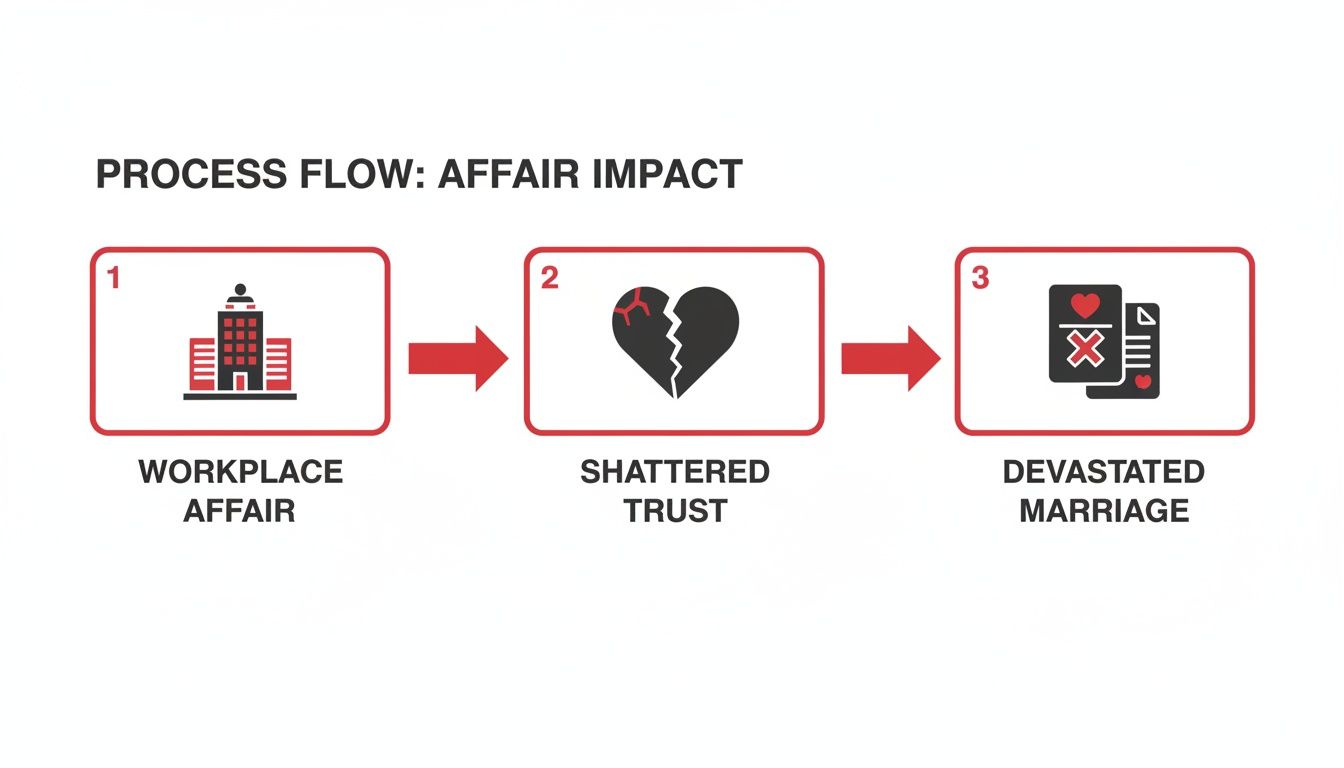
As you can see, a small breach of boundaries can quickly strike at the core of a partnership. To stop this from happening again, you need to protect yourself.
Step 3: Set Firm Boundaries for Your Wellbeing
Let’s be clear: boundaries aren’t about punishment. They are about protection. After a betrayal, your sense of safety is in pieces, and setting clear limits is the only way to start rebuilding it.
This could mean asking for physical space from your partner. It might look like limiting communication to certain times or requesting total transparency with phones. The most important thing is to figure out what you need to feel safe right now and then communicate those needs clearly.
When you're ready, our guide on trust exercises for couples has practical ideas you can explore together.
Step 4: Decide on Your Path Forward
Eventually, you’ll come to a fork in the road: do you try to repair the relationship, or is it time to move on? There is no one-size-fits-all answer here, and this decision cannot be rushed. See if your partner is genuinely remorseful, takes full responsibility, and is willing to do the hard work of earning back your trust.
Understanding what you truly need is everything. Discovering your love language can bring so much clarity, helping you articulate what it takes for you to feel loved and safe again. You can start that journey right now.
Ready to find out what you truly need in a relationship? Discover your love language with our free, quick, and insightful quiz. Take the test now at thelovelanguagetest.com.
How Love Languages Can Rebuild Your Connection
When betrayal fractures a relationship, it's almost always a symptom of a deeper issue. Often, a core emotional need has been ignored for so long that it creates a quiet vulnerability—a space where feelings of betrayal can easily take root. Healing, then, isn't just about the betrayal itself, but about understanding the needs that were neglected.
This is where the five love languages come in. They act like a personalized map, showing you what makes your partner feel truly seen, valued, and secure. Without this map, even your best attempts to fix things can completely miss the mark.
But how does this work in the real world?
Speaking the Right Emotional Language
Think about it: someone whose primary love language is Words of Affirmation will feel emotionally starved in a relationship where praise is rare. That void makes them uniquely susceptible to a coworker's consistent compliments, which can slowly build into an emotional affair. It’s no coincidence that a staggering 85% of affairs begin at work.
It's the same for someone who craves Quality Time. If their partner is always glued to a screen, a deep sense of loneliness can set in. They might drift toward someone else who offers the gift of undivided attention—not because they planned to betray, but because a fundamental human need was aching to be met.
Rebuilding after betrayal isn't just about apologizing for the past. It’s about learning the specific language of love your partner needs to hear to feel safe in the present.
This knowledge gives you a powerful tool for rebuilding.
A Blueprint for a Stronger Bond
This isn't about pointing fingers or placing blame. Far from it. It's about recognizing that a strong, resilient connection is your single best defense against future hurt. When you learn to intentionally speak each other's love language, you build an emotional fortress around your relationship.
Here's how it helps forge a new foundation:
- It creates genuine emotional security: When your partner consistently meets your core needs in the way you understand them, you feel safe and cherished.
- It closes the gaps of vulnerability: Speaking their language fills the emotional voids that outside influences might otherwise try to exploit.
- It fosters intentional connection: It transforms your daily interactions from routine into something purposeful, reinforcing your commitment to each other.
Learning your love languages isn't just a fun quiz; it's a critical tool for rebuilding what was broken. You can explore this framework in more detail in our guide on what are the 5 love languages.
Your Path Forward After Betrayal
Healing from the sting of betrayal isn't something that happens overnight—it’s a journey. Remember that your feelings are completely valid. Give yourself the grace and time you need to move forward with compassion for yourself. Once you understand what went wrong, set clear boundaries, and communicate your needs, you can begin to piece your security back together.
This is where understanding your love language can be a game-changer. It’s an incredible tool for building a more honest and deep connection, whether you’re repairing a relationship or preparing for a new one. Knowing what truly makes you feel loved is the bedrock for rebuilding trust.
Ready to take that first step toward healing and creating stronger relationships? Discovering your unique emotional needs is the perfect place to start. Find your love language in just a few minutes with our free quiz.
We Get It—You Have Questions About Betrayal
When you’re reeling from the shock of betrayal, your mind is a storm of painful and confusing questions. It’s natural to feel lost. We’ve put together some straightforward, empathetic answers to the questions we hear most often, hoping to offer a little clarity when your world feels turned upside down.
Can a Relationship Really Survive This?
Yes, a relationship can come back from betrayal, but let’s be honest: it takes a massive commitment from both people. The only way forward is if the person who broke the trust takes full and unwavering responsibility. That means no excuses, no blame-shifting, and a long-term dedication to transparency.
For the partner who was hurt, it means being willing to, eventually, work toward forgiveness. But this is so important: trust has to be earned back, slowly and patiently. It can't be demanded or expected. Healing from this is a marathon, not a sprint.
How Long Until I Stop Hurting?
There's no magic timeline for this kind of pain, and the healing process is almost never a straight line. You'll have good days and bad days, and that's completely okay. For some, the raw, intense pain might start to fade after a few months. For others, it can take years to truly process the feelings of betrayal.
Healing isn't about making the scar disappear. It's about getting to a place where the scar doesn't control your life anymore. Be patient and kind to yourself through this.
Do I Have to Forgive My Partner?
Forgiveness is a deeply personal choice, and it’s something you do more for yourself than for anyone else. Holding onto all that anger and resentment is like drinking poison and waiting for the other person to get sick. Forgiving them is what sets you free from that weight.
And here’s a crucial distinction: forgiveness doesn't mean you have to forget. It doesn't even mean you have to stay in the relationship. You can forgive someone for your own peace of mind while also deciding that the healthiest thing for you is to move on.
What if They Won't Even Admit What They Did?
This is a tough one. Without a real, genuine admission of what they did wrong, rebuilding trust is pretty much impossible. If your partner is still being defensive, downplaying their actions, or refusing to be accountable, that's a huge red flag. It shows they aren't ready to do the hard work needed to fix things.
In that case, your emotional safety has to be your number one priority.
Working through these questions is incredibly hard, but you don’t have to do it by yourself. A powerful first step toward healing is understanding what you truly need to feel safe and loved. At The Love Language Test, we offer a simple tool designed to help you discover just that.