
Feeling a growing distance in your marriage is a quiet struggle so many couples face. But here’s the thing: bridging that gap is more achievable than you might think.
The secret to real, lasting intimacy isn’t about grand, sweeping gestures. It's found in the small, consistent things you do every day. These actions create emotional safety, mutual understanding, and a willingness to be vulnerable.
But how do you ensure those small efforts actually work?
Understanding the Real Meaning of Marital Intimacy
True intimacy goes way beyond physical closeness. It’s that feeling of being completely seen, heard, and known by the person you love most. It’s the safe space you build together.
Many couples get stuck in a frustrating cycle. They know they love each other, but that deep, soul-level connection feels just out of reach. This usually happens when the way we show love doesn't match what our partner needs to feel loved.
This is where understanding your unique "intimacy blueprint" becomes a game-changer. Learning what actually connects with your partner is the first step, and we'll show you how.
Decoding Your Connection Blueprint
Before you can build a stronger bond, you have to understand the foundation you're working with. Every relationship has its own emotional wiring. Figuring that out is the first real step toward connecting on purpose.
Recent research highlights a fascinating paradox. While 62% of people say they're satisfied with their romantic lives, married couples show a gap. 83% report feeling loved, yet only 74% are satisfied with their relationship. That gap tells us love alone isn't enough. It requires intentional effort. Explore more about these relationship satisfaction trends for the full picture.
So, how do you bridge that gap? The process is a simple, three-part journey.
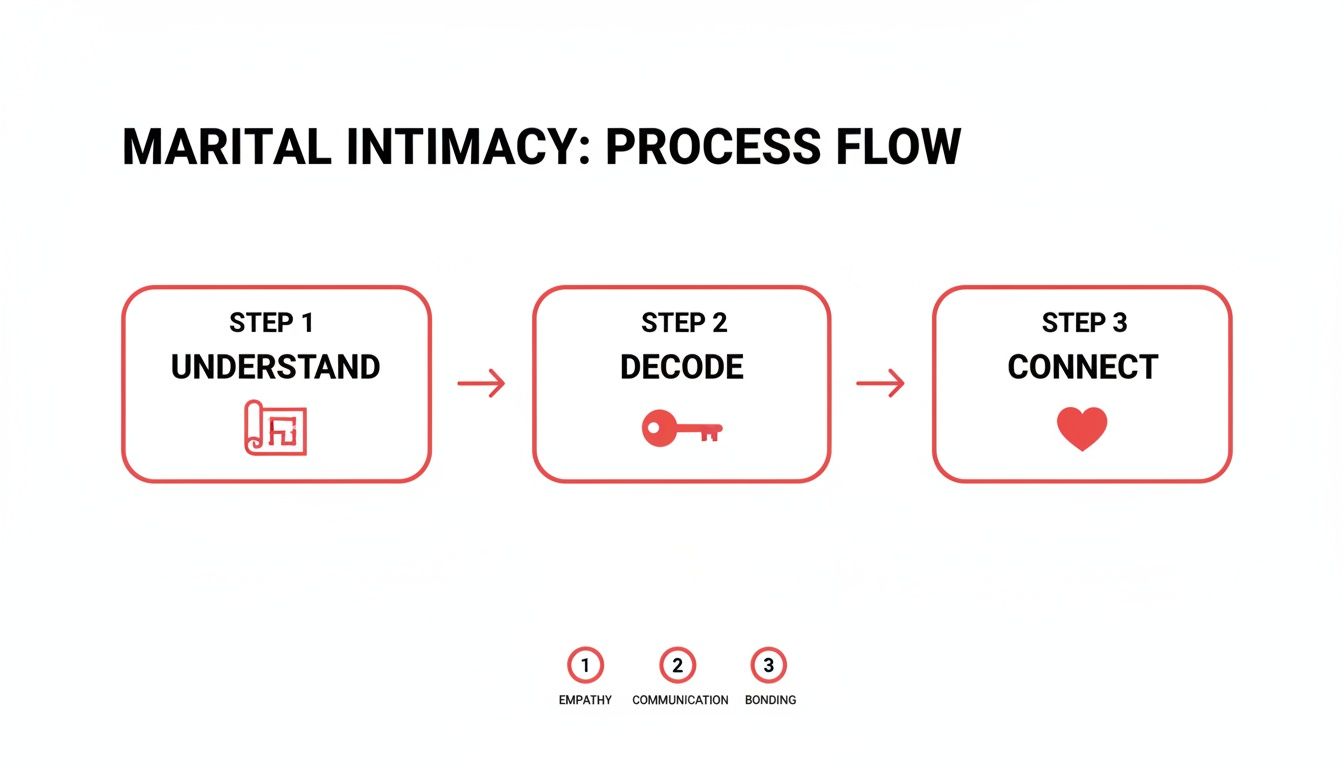
It really boils down to this: understand the core issue, decode what you each truly need, and then take action to connect in ways that actually work.
Intimacy isn’t a destination you arrive at; it's a garden you tend to daily. The small, consistent acts of watering and weeding are what allow deep roots of connection to grow and flourish over time.
Instead of guessing what might bring you closer, the most powerful first step is to get a clear look at your partner's emotional needs. It's about swapping assumptions for genuine insight.
From there, the journey is all about turning that knowledge into practical, everyday habits. But what exactly are we trying to build?
The Five Pillars of Intimacy
Here’s a quick look at the core components of a deeply connected marriage. We will explore each of these throughout the article.
| Pillar | What It Looks Like in Action | Your First Step |
|---|---|---|
| Emotional Intimacy | Sharing feelings, dreams, and fears without judgment. | Ask an open-ended question about their day and truly listen. |
| Intellectual Intimacy | Exchanging ideas, discussing topics you both find interesting, and respecting each other's minds. | Share an article or podcast you found interesting and ask for their thoughts. |
| Physical Intimacy | All forms of touch—from holding hands and cuddling to sexual connection. | Offer a non-sexual hug or back rub with no agenda. |
| Experiential Intimacy | Creating shared memories by doing things together, from hobbies to travel. | Plan a simple, low-pressure date or activity for the upcoming week. |
| Spiritual Intimacy | Connecting over shared values, beliefs, or a sense of purpose. | Talk about what gives you both a sense of meaning in life. |
Think of these pillars as the foundation. Focusing on these areas gives you a clear roadmap for creating the connection you're looking for. The best way to start is by discovering your intimacy blueprint.
Discovering Your Intimacy Blueprint with Love Languages
Before you can build a deeper connection, you have to understand what makes your partner feel loved. Think of it as finding the right key for the right lock. Without it, you’re just fumbling in the dark, hoping your efforts land the way you intend.

So many couples get stuck here. They’re both trying hard, but they still feel miles apart. It’s a frustrating cycle that often happens because they're speaking different emotional languages. Learning to speak your partner's love language can break that cycle for good.
This isn’t just a theory; it has a massive impact on how to build intimacy in marriage. But it requires understanding why your best efforts might be falling flat.
Why Your Best Efforts Might Be Missing the Mark
I see this all the time. A husband works exhausting hours to provide lavish gifts, genuinely believing he’s showing profound love. But his wife feels lonely. What she truly craves is his time—her love language is Quality Time. To her, the presents feel like a poor substitute for his attention.
In this scenario, both partners mean well, but their signals are crossed. He feels unappreciated, and she feels emotionally abandoned. The result? A growing distance, even though they love each other.
This is a textbook love language mismatch, and it's one of the most common—and fixable—reasons intimacy dies.
Key Insight: Real intimacy isn't built on the love you give, but on the love your partner receives. When you speak their language, your affectionate actions are actually felt as affection.
This is where you stop guessing and start connecting with purpose. It all begins with one simple, powerful first step. But first, let’s quickly break down what these languages are.
The Five Channels of Emotional Connection
Dr. Gary Chapman's framework of the five love languages gives us a simple map to understanding our partner's emotional core. Most of us have one or two that speak to us more deeply.
- Words of Affirmation: This is all about using words to build your partner up. It’s not just "I love you," but also, "I'm so proud of the way you handled that," or "Thank you for taking care of dinner."
- Acts of Service: For someone who speaks this language, actions are everything. They feel cherished when you ease their load by doing helpful things, like making their coffee or tackling a chore they dread.
- Receiving Gifts: This isn't about materialism—it's about the thought behind the gesture. A meaningful gift is a tangible symbol that you were thinking of them, that they are seen and valued.
- Quality Time: This language is all about giving your partner your focused, undivided attention. That means phones down, TV off. It's about creating space to just be together, distraction-free.
- Physical Touch: For this person, touch is the most powerful emotional connector. A hug, holding hands, or a reassuring arm around their shoulder creates a profound sense of security and love.
Just recognizing these different channels is a huge first step. But how do you know which one truly matters to your partner?
Your Most Important First Step
Trying to guess your partner’s love language is almost as bad as speaking the wrong one entirely. The only way to get real clarity is to find out for sure. Knowing your starting point is the foundation for every strategy in this guide.
The best way to do this? Carve out a few minutes to discover your love language with the official free quiz at https://www.thelovelanguagetest.com/.
When you take the test, you turn vague feelings into clear, actionable insights. It’s a fantastic conversation starter and gives you a shared roadmap for building the connection you both want.
Turning Insight Into Daily Connection Habits
Knowing your and your partner’s love languages is like being handed the keys to a secret garden. But those keys are useless if they just sit on the counter. The real magic happens when you start using them—consistently, in the small moments of everyday life.
Lasting intimacy isn’t built on grand, one-off gestures. It’s woven from the threads of small, intentional acts of love that become part of your daily routine. This is how connection becomes a reflex, not just an event.
But what does this actually look like day-to-day? It's about going deeper than you think.
Going Beyond the Obvious
It’s easy to get the basics down, but true connection comes from a deeper level of attention. It’s about really seeing your partner and understanding the nuances of what makes them feel loved.
Let's move past the surface-level ideas and get specific.
For Acts of Service: Don't just do a chore. Proactively tackle the one task you know they dread, without being asked. Maybe it’s making that dreaded phone call to the insurance company or organizing the garage. This shows you're not just helping—you're actively shouldering their burdens.
For Quality Time: Don't just sit in the same room. This language is about focused, screen-free attention. Put your phone away—all the way away—make eye contact, and truly listen. It’s about creating moments where they feel like the only person in the world.
For Words of Affirmation: Don't just default to "I love you." Be specific with your praise. Notice their efforts and appreciate them. Try something like, "I was so impressed with how you handled that stressful meeting today," or, "Thank you for being so patient with the kids this morning."
A simple daily habit can make all the difference, and it only takes a few minutes.
The 10-Minute Connection Rule
One of the most powerful habits couples can build is the 10-Minute Connection Rule. It’s incredibly simple, but it has to be a non-negotiable part of your day. Every day, set aside just ten minutes for a focused, screen-free conversation.
This isn’t the time to sort out bills or logistics. The only goal is to check in on an emotional level.
You can use simple prompts to get things flowing:
- What was the best part of your day today?
- Was there anything that felt heavy or stressful?
- What’s one thing you’re looking forward to this week?
This daily ritual carves out a safe space for vulnerability and keeps you tuned in, even when life gets hectic. It’s a small investment with an enormous return.
Key Takeaway: Intimacy thrives on consistency. A small, thoughtful gesture repeated daily has a far greater impact than a large, infrequent one. It’s the steady drip of connection that keeps the well of your relationship full.
But there's one common habit that can undo all your hard work without you even noticing.
The Silent Intimacy Killer in Your Home
You can be speaking their language and making time, but a common obstacle can silently undo your hard work: digital distractions. These are especially damaging during moments meant for connection.
Research from the Institute for Family Studies found that sex frequency drops significantly when a spouse swaps couple time for phones or computers. This "bedtime procrastination" of scrolling on devices directly erodes opportunities for both physical and emotional intimacy.
Creating tech-free zones or times—like in the bedroom or during your 10-minute check-in—is critical. It sends a clear message: our connection is more important than any notification. Now, what about when conflict arises?
Navigating Conflict Without Losing Closeness
Let's be honest: every couple argues. It’s part of sharing a life with someone. But what separates couples who thrive from those who drift apart is how they handle those arguments. They see conflict not as a battle, but as a messy opportunity to understand each other on a deeper level.

The real work is managing disagreements in a way that actually brings you closer. This means shifting out of reflexive, defensive reactions and into intentional communication.
The goal is to create a sense of safety, even during a tough conversation. That starts with setting ground rules before you're in the heat of the moment.
Create Your Conflict-Safe Rituals
When emotions get dialed up, our brains can slip into fight-or-flight mode. Logic flies out the window, and we say things we don’t mean. A conflict-safe ritual is your pre-agreed plan to stop that from happening. Think of it as an emergency brake.
One of the most powerful tools is a 'pause' word or signal. It’s a neutral word you both agree on beforehand, like "timeout" or "pause." When either of you says it, the conversation stops. No questions asked.
- What it does: It immediately hits the brakes on rising tension.
- What happens next: You agree on a specific time to cool off—say, 20 minutes—and then come back together when you're both calmer.
This simple act honors each person's emotional limits and stops a conversation from spiraling. It sends a powerful message: "I care more about us than about winning this point."
Key Takeaway: The goal of a disagreement shouldn't be to prove you're right, but to improve your partnership. A pause isn't surrender; it's a strategic move to protect your connection.
Once you have that safety net, you can start talking about your needs in a way your partner can hear.
Express Needs Without Placing Blame
There's no faster way to shut down a conversation than starting with "You always…" or "You never…" It's an instant trigger for defensiveness, making it impossible for your partner to hear the real issue.
A much better way is to use "I feel" statements. This tiny shift in language can completely change the dynamic. It turns an accusation into an expression of your experience.
Here’s the basic structure:
- Start with your feeling: "I feel…" (hurt, frustrated, lonely)
- Describe the specific action: "…when…" (the dishes are left in the sink)
- Explain the impact: "…because…" (it makes me feel like my efforts aren't seen)
- State what you need: "I would really appreciate it if…" (we could tackle them together)
This isn't about being soft; it's about being clear. And when the argument is over, you need a way to reconnect.
Use Love Languages to De-escalate and Reconnect
After a disagreement, your love languages are your best tools for repair. Knowing what makes your partner feel loved helps you rebuild that bridge between you so much faster.
- Words of Affirmation: They need to hear it. "I know we disagreed, but I love you and we're a team." Reassurance is everything.
- Physical Touch: A simple hug or holding their hand can say "we're okay" more powerfully than any words.
- Quality Time: Suggest putting your phones away and just sitting together for a few minutes. It restores togetherness.
- Acts of Service: Doing a small, helpful task for them is a concrete way of showing you're back on their side.
- Receiving Gifts: This isn't about buying forgiveness. A small, thoughtful gesture—their favorite candy—is a peace offering that says, "I'm thinking of you."
When you use these tools, every argument becomes a chance to practice understanding each other better. Over time, this is what builds a truly deep and resilient intimacy.
Rekindling Both Physical and Emotional Desire
Intimacy is a delicate dance between feeling emotionally safe and physically close. When one is out of sync, the other almost always follows. Getting that spark back isn't about grand gestures; it's about the daily care of both your emotional and physical connection.
For many people, desire is sparked long before anyone enters the bedroom. It’s built in those small, seemingly insignificant moments that fill up your day.

Nurturing Touch Beyond the Bedroom
If your partner’s love language is Physical Touch, then casual, non-sexual contact is the bedrock of their connection to you. These small acts create a foundation of safety and affection, which makes deeper intimacy feel more natural and less pressured.
Think of it like an emotional bank account. Every small touch is a deposit.
- Lingering Hugs: Don't just do a quick peck goodbye. Try a full, five-second hug where you can both actually feel it.
- Casual Contact: A hand on the small of their back as you pass in the kitchen, or a quick shoulder squeeze.
- Shared Space: Sit close enough on the couch that your shoulders or legs are touching while you watch a movie.
- Holding Hands: Reach for their hand while you're walking, driving, or just sitting together.
These gestures send a powerful message of care and presence, without expectation. That’s often the secret to rebuilding closeness.
But what happens when the routine itself is the problem?
Breaking Routines to Spark Novelty
It’s easy for comfortable routines to slide into a monotonous rut, slowly draining the life out of your relationship. Shaking things up doesn't have to be complicated or expensive; it’s about intentionally breaking predictable patterns.
Novelty triggers the release of dopamine in the brain—the same neurotransmitter that fuels the "honeymoon" phase. By creating new experiences, you can help reactivate those feelings of excitement and attraction.
Try one of these simple routine-breakers this week:
- Switch Up Your Scenery: Instead of dinner at the table, have a picnic on the living room floor.
- Learn Something New Together: Sign up for a one-night class—cooking, dancing, pottery—anything that puts you both in the fun role of beginners.
- Plan a Surprise Date: Take turns planning a mystery outing. The anticipation alone can build excitement.
Breaking out of autopilot forces you to be present with each other in a new way. Of course, no amount of novelty can fix a foundation that feels broken.
Rebuilding Intimacy When Trust Is Damaged
This is, without a doubt, one of the toughest challenges a couple can face. When trust has been breached—through betrayal or emotional neglect—the path back to intimacy has to start with rebuilding emotional safety.
Physical closeness feels impossible when emotional vulnerability feels dangerous. The hurt partner needs to see consistent, trustworthy actions over time. This is where Acts of Service and Quality Time become powerful tools for healing.
A sincere apology is the first step, but it's the follow-through that rebuilds the bridge.
- Consistent Actions: Do what you say you will do. Every. Single. Time. Reliability is the bedrock of trust.
- Patient Listening: Give your partner space to express their hurt without getting defensive. Validate their feelings, even if it’s hard to hear.
- Prioritize Them: Show them through your choices—choosing Quality Time with them over other distractions—that they are your priority.
A report from the Wheatley Institute underscores this. It found that couples in highly stable marriages report nearly 80% emotional closeness. This highlights how crucial trust is for both emotional and physical intimacy. You can learn more about these findings on marital stability.
Rebuilding is a slow process. It demands patience and commitment to demonstrating change through actions, not just words. Only when emotional safety is restored can authentic desire begin to flourish again.
Keeping the Spark Alive for the Long Haul
Getting that initial spark of intimacy back is an amazing feeling. But the real magic comes from weaving it so deeply into your marriage that it becomes second nature. It's about shifting from trying to be intimate to just… being intimate.
The key is to create simple, positive habits that keep you both tuned in. You need an easy way to see what's working and celebrate the good stuff. This isn’t about keeping score; it's about staying connected to your connection.
What's the best way to do that?
Taking a Quick Pulse on Your Connection
To keep that forward momentum, you have to measure what matters. And no, you don't need a complicated spreadsheet. A simple, once-a-week check-in can be one of the most powerful things you do. At the end of each week, just take a moment to rate your connection.
The Weekly 'Connection Score'
Ask each other: on a scale of 1 to 10, "How connected did I feel to you this week?" This isn't a test with a right or wrong answer. It’s a doorway to a conversation.
- A high score is a reason to celebrate. Ask, "What was it this week that made you feel so close to me?"
- A low score is a chance to get curious. Ask, "What felt like it was missing for you? What’s one thing we could try next week?"
This little ritual keeps intimacy on the front burner. But there's another level to this.
Your Quarterly 'State of the Union'
While the weekly pulse is great for the day-to-day, a deeper review every few months helps you stay aligned on the big picture. Think of it as a 'State of the Union' for your relationship—a positive, forward-looking chat about where you are and where you want to go.
This isn't the time to drag out old arguments. It's dedicated space to appreciate what's going right and to dream about your future together, using everything you've learned as your guide.
Your love languages are the perfect framework for this. You could ask questions like:
- "Looking back over the last three months, when did you feel the most loved by me? What was going on?"
- "As we look ahead, what's one new way I could show you love in your primary language?"
These conversations are a beautiful reminder that building intimacy isn't a project with an end date; it's an ongoing journey of learning each other over and over again.
Your Questions on Building Intimacy, Answered
Deciding to intentionally work on your connection is a huge step, but it naturally brings up some tough questions. I've heard these concerns from countless couples over the years, so let's tackle them head-on.
"What if our sex drives don't match up?"
This is one of the most common issues couples face. A libido mismatch isn't a sign your relationship is doomed; it's a difference in needs, just like having different love languages. The key is to look at the entire spectrum of intimacy.
Often, the partner with the lower libido finds their desire increases when they feel emotionally connected and safe. This could mean getting more Quality Time or hearing more Words of Affirmation. When you fill your partner's emotional tank first, you build a bridge to physical closeness that feels wanted, not pressured.
"How long will this take? When will we feel closer?"
I get it. You're putting in the work, and you want to see results. But building intimacy isn't a race with a finish line. Some couples feel a change almost instantly, maybe after an "aha!" moment like understanding each other's love languages. For others, it’s a much slower, more gradual journey.
The speed of your progress isn't what matters. What truly counts is the consistency of your effort. Celebrate the small wins—like having a 10-minute check-in that doesn't turn into a fight. That's what builds momentum. Trust the process.
"Can we ever get back to 'us' after an affair?"
The short answer is yes. But it is one of the hardest things a couple can go through. It requires incredible commitment from both people, and I almost always recommend the guidance of a professional counselor. Intimacy is built on emotional safety, and an affair shatters that.
Rebuilding starts with trust, a long road. The partner who was unfaithful has to prove, through daily actions, that they are all in. For the betrayed partner, it’s a journey of processing immense pain. It’s a tough path, but for couples willing to do the work, it can lead to a relationship that is stronger and more honest than before.
The very first step to a more connected marriage is understanding how you and your partner actually give and receive love. In just a few minutes, you can get the insights you need to start building a deeper bond today.
Ready to discover your intimacy blueprint? Take the free love language test now.