
If you’ve ever felt like your affection gets lost in translation, or you and your partner speak different emotional languages, you’re not alone. It’s a common feeling, pointing to a mismatch in how you each give and receive love.
This isn't about figuring out who's right or wrong. It’s about finally understanding your unique emotional blueprint—and your partner's. Once you have this key, you can unlock a much deeper level of connection and intimacy.
The concept comes from Gary Chapman's book, The 5 Love Languages, which sold over 20 million copies for a reason. It just clicks. Research even shows couples who understand each other's primary love language feel much more satisfied. You can see the data in this in-depth academic journal.
Ready to decode your own needs? But first, you need to understand the five core ways we all experience affection.
The Five Core Ways We Feel Loved
At its heart, this framework gives us a shared vocabulary to talk about our emotional needs without getting tangled up. It boils down to five distinct ways people feel genuinely cared for and valued by those around them.
Here’s a quick diagnostic to get you started. Take a look at this table and see which one gives you that "aha!" feeling. This might be your first major clue.
Quick Love Language Diagnostic Check
| Love Language | What You Feel When You Receive It | A Common Misunderstanding |
|---|---|---|
| Words of Affirmation | Seen, valued, and genuinely appreciated for who you are. | That it’s just about empty compliments or flattery. |
| Quality Time | Prioritized, interesting, and truly connected to the other person. | That just being in the same room counts as quality time. |
| Receiving Gifts | Remembered, cherished, and loved because of the thought behind it. | That it’s materialistic or about the cost of the gift. |
| Acts of Service | Supported, cared for, and relieved of a burden. | That it’s about obligation or doing chores like a roommate. |
| Physical Touch | Safe, desired, and deeply connected on a non-verbal level. | That it’s only about sex or grand romantic gestures. |
Does one of those descriptions jump out at you more than the others? That's your initial hint.
Identifying which of these resonates most deeply with you is the foundation for better communication. It's like being handed a map to your own heart—and to your partner's.
This is just the starting point, of course. For a full breakdown, check our guide on what the 5 love languages are.
But knowing the definitions isn't enough. The real magic happens when you learn to spot them in your own life. Now, let’s dig into how your gut reactions can reveal the truth about what you really need.
How Your Actions Reveal Your Needs
Have you ever noticed that the way you comfort a friend is almost automatic? That instinct is one of the biggest clues you have to figuring out your own love language.
Think about it. We almost always give love in the way we most want to receive it. It’s a powerful, subconscious mirror reflecting our own deepest needs. Your behavior is a roadmap to your heart; you just have to learn to read it.
So, when a friend is going through a hard time, what’s your first move?
Do you immediately draft a heartfelt text message (Words of Affirmation)? Or is your gut reaction to clear your calendar and just be with them (Quality Time)? This isn’t just about being a good friend; it’s your internal love compass pointing north.
Maybe you immediately think, "How can I lighten their load?" and jump in to handle an errand or cook a meal (Acts of Service). By paying attention to these go-to methods, you see what "love" looks like in your personal dictionary.
This flowchart can help you see how those preferences point toward a specific love language.
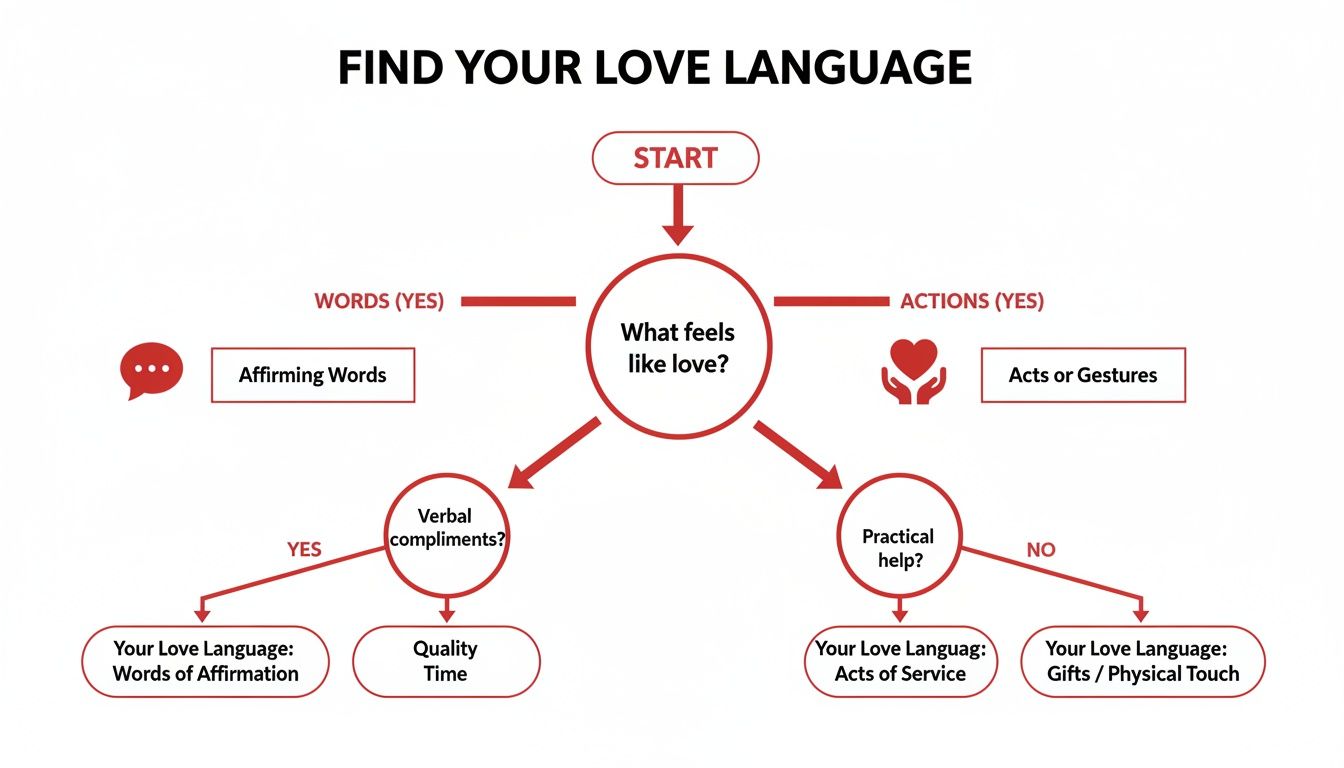
As you can see, the first big fork in the road is often between what you say versus what you do. Just figuring out which side of that line you fall on can narrow things down significantly. But there's an even better way to be sure.
Journaling Your Instincts
Let's put this into practice. For the next week, grab a notebook or keep a note on your phone. The idea isn't to overthink it—just capture your gut reactions. Use these prompts to start tracking your own patterns.
- When I wanted to make someone feel special, I… (Did you hunt for the perfect gift or plan a whole day to spend together?)
- Today, my partner seemed stressed, so my first instinct was to… (Did you immediately offer a hug, or did you start tidying up the kitchen for them?)
- To celebrate a friend's big win, I chose to… (Did you leave an enthusiastic comment on their post, or offer to help them prep for what's next?)
By tracking these small, automatic actions, you’re not just observing kindness. You're decoding the blueprint of your own needs. The way you nurture others is a mirror of how you need to be nurtured.
After just a few days, you'll probably start to see a pattern. The love you give so freely is often the kind your heart quietly asks for. But your actions are only one part of the equation. What if the things that hurt you tell an even more powerful story?
What Your Pain Points Reveal
Sometimes, the clearest signs of what we need are hidden in what hurts us the most.
While noticing how you give love is a great start, the moments that really sting often tell a much deeper story. Think about it: our biggest relationship frustrations aren't random annoyances. They're direct signals from our emotional core.

What truly gets under your skin? Does it feel like a gut punch when your partner is glued to their phone during what you considered your time together? That sharp reaction is a massive clue, pointing straight at Quality Time.
Learning to Read Your Emotional Triggers
These disproportionate emotional responses are like your personal decoder ring. It’s not about blaming your partner; it’s about finally understanding your own wiring. What feels like a minor hiccup to someone else can feel like a five-alarm fire to you. That's a signal.
Let's get specific.
- Does a forgotten anniversary or a thoughtless gift feel like more than just an oversight? If that stings because it means you weren't being thought of, your love language is probably Receiving Gifts. It's the thoughtfulness that fills your tank.
- Or maybe a single, harsh comment completely erases a dozen kind actions. If those words stick with you, replaying in your head, it's a strong indicator that Words of Affirmation are absolutely essential for you to feel secure.
Your pain is a compass. The things that leave you feeling empty when they're absent are the very things that make you feel whole and loved when they're present. This is about translating that hurt into understanding.
Why It Feels So Personal When Needs Don't Align
This dynamic is incredibly common. Research shows that only about 26.5% of partners naturally share the same primary love language. That leaves the vast majority of us navigating these mismatches.
This explains why an action that screams "I love you" to one person can completely miss the mark for another. It’s also why tuning into your own triggers is so crucial, a point backed by research on love language compatibility.
By pinpointing what hurts most, you can finally put a name to what you need. But looking inward is just one piece. Now, let’s talk about how to confirm what you’re sensing and get a crystal-clear answer.
Confirm Your Love Language with a Quick Test
All that self-reflection is a fantastic start, but our feelings can be messy. After you've spent time journaling and observing your reactions, taking a well-designed test can bring everything into sharp focus.
Think of it as the final piece of the puzzle. It helps turn your hunches and best guesses into confident knowledge.
A structured quiz cuts through the noise. Instead of just relying on scattered memories, it walks you through specific scenarios. This forces you to make choices that reveal what you truly prefer deep down, giving you the clarity you need.
The best part? It's not a huge commitment. A modern, quick test can give you an actionable profile in just a few minutes—something you can even share with your partner to start a great conversation.
Why a Modern Test Matters
The love languages concept is everywhere, but that doesn't always make it easy to figure out your own. Research shows many people rate all five languages highly, which can make diagnosing yourself tricky. This is why a streamlined, modern test can be so helpful. You can read more about the science behind the love languages.
Here at The Love Language Test, we’ve refined the whole process. We designed our quiz to be:
- Fast: It takes just 3-5 minutes to complete.
- Focused: With only 15 questions, it gets straight to what matters.
- Actionable: You get instant, personalized results with practical tips.
This approach is built to give you a clear, reliable answer without the confusion. It transforms your journey of self-discovery from a vague question into a concrete plan.
Taking a test isn’t about getting a label; it’s about getting a starting point. It gives you a clear, simple way to begin conversations that build stronger, more empathetic connections in your life.
Ready to find out for sure? You can take our free love language quiz right now and discover your primary love language in minutes.
Once you have your results, the real fun begins: learning how to share them. But how do you start that conversation without sounding demanding? Let's explore some simple ways to talk about your needs.
How to Talk About Your Love Language
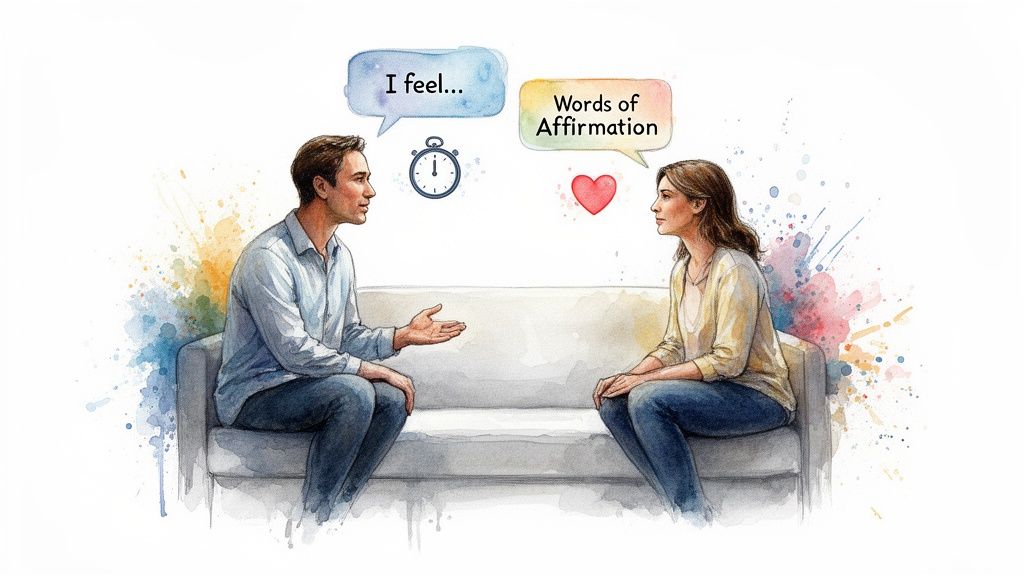
Okay, so you’ve figured out your love language. That’s a huge win. But knowing it is only half the battle—the real magic happens when you start talking about it with the people you love.
This isn't about making demands or handing someone a rulebook. Think of it more as an invitation, a way to build a bridge for a deeper connection with your partner.
Timing is everything. This isn't a conversation to have mid-argument or when one of you is rushing out the door. Find a quiet, relaxed moment when you can both be present without distractions. A gentle start makes all the difference.
Turning Knowledge Into Connection
Instead of a blunt announcement like, "My love language is Quality Time, and you're not speaking it," try framing it as a positive. The goal is to share what fills your emotional tank, not point out what’s missing.
Focusing on "I feel" statements tied to specific actions is key. It moves the conversation from a potential complaint to a clear, actionable request for connection.
Let’s break down what this sounds like for each of the 5 love languages:
- Words of Affirmation: Swap "You never compliment me" for "It means so much to me when you tell me you're proud of me. It honestly makes my whole day."
- Acts of Service: Instead of "You never help around the house," try, "I feel so cared for when you take care of a chore without me asking. It's a huge weight off my shoulders."
- Receiving Gifts: To avoid sounding materialistic, focus on the heart behind it. "You know, the best gifts are the ones that show you were thinking of me, no matter how small."
- Quality Time: Ditch "You're always on your phone" for "I feel so close to you when we can put our phones away and just catch up. I really cherish that time."
- Physical Touch: This can be as simple as, "I feel so connected and safe when we’re walking and you reach for my hand." This communicates a need for reassuring touch.
Below are a few more practical scripts to help you get the conversation started in a positive and constructive way.
Communicating Your Needs by Love Language
| Your Love Language | What to Say | Why It Works |
|---|---|---|
| Words of Affirmation | "When you leave me those little notes, it makes me feel so appreciated. I save all of them." | It's specific and shows the positive impact of their actions, encouraging more of the same behavior. |
| Acts of Service | "Would you be willing to handle dinner on Tuesdays? It would help my week feel so much more manageable." | This is a clear, kind request—not a demand. It gives them a concrete way to show you love. |
| Receiving Gifts | "I saw this little plant at the market and it reminded me of you." (When giving a gift) | Modeling the behavior shows them what it means to you. It's about thoughtfulness, not price tags. |
| Quality Time | "I'd love to set aside one night a week just for us—no phones, no TV, just connecting. I miss that." | It frames the need as a desire for more connection and suggests a collaborative solution. |
| Physical Touch | "Can I have a hug? I've had a long day and I think it would really help." | It's a direct, vulnerable request that clearly states what you need and why, without pressure. |
Remember, this is about explaining what fills your cup, not criticizing them for not knowing how to fill it before.
This isn't just about getting what you need. It's about creating a safe space where both people feel comfortable sharing their emotional blueprints. This conversation has to be a two-way street.
Making It a Shared Journey
After you’ve shared, the most important next step is to flip the script.
Ask them, "What about you? What makes you feel the most loved?"
This single question transforms your personal revelation into a shared journey of discovery. It shows you’re just as invested in learning their language as you are in teaching them yours. And if you're curious, our guide on how to figure out your partner's love language has some great tips.
This dialogue is where self-awareness blossoms into a stronger bond built on empathy.
Got Questions About Love Languages? We've Got Answers
Once you start digging into love languages, a few questions always seem to pop up. It's totally normal. Getting a handle on these nuances is what helps you take this from a neat idea to something that genuinely makes your relationships stronger.
Let's clear up some of the most common ones.
Is My Love Language Set in Stone?
Nope. And that’s a good thing. While your primary love language often connects back to your childhood, it’s not permanent. Life is always changing, and so are our needs.
Big life shifts are often the catalyst. Becoming a parent, navigating a stressful career change, or getting through a tough personal season can reshuffle what makes you feel loved.
For instance, someone who thrived on Quality Time might become a new parent and find that Acts of Service—like their partner handling a 3 AM feeding—feels like the purest form of love. As we grow, what we need from others grows with us.
Can I Have More Than One?
This is probably one of the most frequent questions, and the answer is a big YES. It's incredibly common to have a primary language and a very close second. Don't think of it as a single label. It's more like your unique emotional profile.
You might feel most loved through Words of Affirmation, but also feel a deep sense of connection from Physical Touch. That's not a conflict—it's just a more complete picture of what makes you tick. The key is to honor all the ways you feel cared for.
The goal isn't to force yourself into a single box. It's to understand the unique combination of languages that makes you feel truly seen and cherished.
What If My Partner and I Are Totally Different?
Welcome to the club! Seriously, most couples find they have different primary love languages. This isn't a red flag or a sign of doom. It’s actually a fantastic opportunity to be more intentional about how you show up for each other.
It all comes down to empathy and a willingness to try.
Learning to "speak" your partner's language, even if it feels foreign at first, is one of the most powerful things you can do. It sends a clear message: "I see you. Your needs matter to me, and I want to love you in the way that means the most to you."
Ready to put all this insight to work? The best place to start is by getting crystal clear on your own needs. At The Love Language Test, we’ve created a quick, free, and insightful way to pinpoint your primary love language.
Discover how you give and receive love by taking the free test at The Love Language Test official website.