
Resolving conflict is less about winning an argument and more about shifting your perspective. It’s about moving from a place of blame to a place of understanding. It’s learning how to communicate what you need without making your partner the enemy.
When you start to see disagreements as opportunities to learn about each other—instead of threats to your connection—everything changes. This is a skill you can absolutely build together, and understanding your unique emotional needs is the first step.
Curious about what makes you and your partner tick? Discovering your love languages can be an eye-opening start. Discover your love language and see how it shapes your interactions.
Why All Happy Couples Fight

That tight knot in your stomach during a fight? We've all been there. So many of us were raised to believe that conflict is a red flag—a sign that the relationship is failing.
But what if the exact opposite were true? The reality is, conflict is a necessary part of any healthy, growing partnership.
Disagreements themselves aren't the problem; it’s how you handle them that matters. The couples who thrive don’t avoid arguments. They’ve learned how to argue with connection in mind, turning that friction into a bridge for deeper intimacy. But how do they actually do it?
The Real Triggers Behind Arguments
Most fights aren't really about the dirty dishes or being five minutes late. Those are just the surface-level symptoms. Dig a little deeper, and the real triggers usually boil down to two fundamental issues:
- Unmet Needs: One or both partners feel unseen, unappreciated, or disconnected.
- Mismatched Communication: A message is sent with one intention but received with a completely different, and often hurtful, one.
The moment you learn to see a disagreement as an invitation to understand your partner's underlying needs, the whole dynamic shifts. You stop fighting against each other and start solving the problem together. This mindset is the foundation for navigating any conflict with grace.
So, where do these unmet needs come from? Often, they're rooted in a simple disconnect in how we each give and receive love. You might be showing love in a way your partner doesn't fully recognize. Learning about the five distinct love languages can be a game-changer in understanding this emotional dialect.
"Conflict is the price we pay for a deeper intimacy." – Dr. Sue Johnson
This isn't about finding some magic trick to eliminate arguments forever. It’s about building the skills to move through them constructively. The goal is to come out the other side feeling more understood and more connected than you were before.
It all starts by reframing conflict not as a battle to be won, but as a conversation to be had. Before we dive into the specific techniques, this core belief is crucial. Because a shared goal of connection is the most powerful tool you have.
The 69% Rule: Why Most Relationship Fights Are Unsolvable
What if I told you that most of the arguments you have with your partner are impossible to solve? It’s a tough pill to swallow, but here’s the secret: embracing this idea can actually save your relationship. It’s the key to breaking that exhausting cycle of having the same fight over and over again.
Not all disagreements are created equal. Relationship experts have discovered that conflicts really fall into two buckets: the solvable ones and the perpetual ones. Solvable problems are situational—like who’s going to take out the trash this week. But perpetual problems? They’re the ones that keep coming back, no matter what.
These are the arguments rooted in fundamental differences between you and your partner—your personalities, your values, your ingrained habits. Trying to “win” these is like trying to argue the sun out of the sky. It’s a recipe for burnout and bitterness, but there's a better way.
How to Spot a Perpetual Problem
So, how do you know if you’re stuck in a perpetual loop? It’s that feeling of déjà vu, where you're having the exact same conversation you had last month, just with slightly different details.
Think about these classic examples. Do any of them sound familiar?
- The Spender vs. The Saver: One of you feels secure by saving every penny, while the other finds joy in spending freely. This isn't just about a single purchase; it's a deep-seated philosophy.
- The Social Butterfly vs. The Homebody: One person recharges by being around lots of people, and the other needs a quiet night at home to feel sane.
- The Neat Freak vs. The Creatively Messy: One thrives in a perfectly organized space, while the other is totally comfortable with a little (or a lot of) clutter.
- The Planner vs. The Spontaneous Spirit: One needs a detailed itinerary for vacation, and the other just wants to see where the day takes them.
The moment you recognize these patterns, everything can change. The goal isn't to erase these differences but to stop treating them like character flaws that need to be fixed. Instead, you learn to navigate them with a little humor, a lot of acceptance, and some real empathy.
This simple shift in mindset frees up so much emotional energy. You stop fighting an unwinnable war and start building a bridge of mutual understanding. But how do you build that bridge?
The Real Goal Isn't Winning—It's Managing
Research from the renowned relationship expert Dr. John Gottman dropped a bombshell on the therapy world: a staggering 69% of all relationship conflicts are perpetual problems. They’re not a sign that your relationship is broken; they’re a sign that you’re with another unique, complex human being. You can explore Gottman's full findings on managing conflict on their website.
The most successful couples don't magically solve these issues. They just get really good at managing them so they don’t take over the relationship. This is where the real work—and the real beauty—of partnership comes in. You learn to dance with your differences instead of trying to force your partner to change their steps.
The big takeaway here is that when couples get stuck on these perpetual issues, it’s easy to start pulling away emotionally. The real goal is to keep talking, keep connecting, and keep the affection flowing, even when you fundamentally see things differently.
"A relationship is a contract of mutual acceptance. You're saying, 'I know you have these flaws, and I'm choosing you anyway.' The goal is not to change the person, but to dance with them." – Esther Perel
This is exactly where understanding each other’s Love Language becomes a game-changer.
If your partner’s primary love language is Words of Affirmation, just saying "I can see why you feel that way" can completely soften the tension, even if you don't agree.
If their language is Physical Touch, a simple hand on their arm can send a powerful message: "We're a team, even when this is hard." It shifts the entire dynamic from winning an argument to preserving your connection. Knowing their language gives you a cheat code for showing empathy right when it’s needed most.
Not sure what your primary love languages are? You can discover your love language with our quick, free test. Think of it as getting the map you need to navigate these tricky, lifelong conversations with more love and a lot less conflict.
A Practical Guide to Navigating Disagreements
When you're in the middle of a conflict, emotions run high and your brain can feel completely hijacked. It’s so easy to slip back into those old, unhelpful habits—raising your voice, shutting down completely, or letting words fly that you instantly regret. Learning to handle conflict isn't about becoming a perfect communicator overnight.
It's about having a reliable roadmap for when you feel lost and overwhelmed. The real goal is to shift a disagreement from a battleground into a brainstorming session. You’re not opponents; you're a team trying to solve a problem. This takes some real, practical skills, but they're skills anyone can learn. These are the foundational techniques for building real, lasting understanding.
Start the Conversation Softly
Believe it or not, the first three minutes of a tough conversation can often predict its entire outcome. If you come in hot with criticism or blame—what relationship experts call a "harsh startup"—your partner is almost guaranteed to get defensive. Just like that, the conversation is doomed before it's even started.
A "softened startup," on the other hand, is all about expressing what you need without attacking your partner. It’s a gentler, less confrontational way to bring up a tricky subject. This one small shift can completely change the tone of the whole interaction, and here’s how to do it.
Here's how to pull it off:
- Talk about your feelings. Start with "I" to describe your own emotional state.
- Describe the situation, not the person. Stick to the facts of what happened, without judgment.
- State a positive need. Clearly say what you need to feel better or fix the issue.
For example, instead of launching with, "You never help with the chores! I have to do everything myself!" try this instead: "I’m feeling really overwhelmed with all the housework. I would appreciate it so much if we could tackle the kitchen together."
See the difference? One invites a fight, the other invites teamwork. This simple change is more powerful than you think.
Use “I-Statements” to Express Yourself
Blaming language is like throwing gasoline on a fire. Phrases like "You always…" or "You never…" instantly put your partner on the defensive. Once that happens, they can't actually hear your concern. They've stopped listening and started building a case for their rebuttal.
"I-statements" are an incredibly powerful way to sidestep this trap. They keep the focus on your experience and your feelings, not on your partner's supposed flaws. This structure allows you to share your hurt or frustration without making it sound like an accusation, and it follows a simple formula.
Here’s a simple, effective framework:
I feel [your emotion] when [the specific, non-judgmental situation] because [how it impacts you]. I would really appreciate [a specific, positive request].
Let's try this with a classic sore spot: money. Instead of, "You're so irresponsible! You spent way too much again," you could say: "I feel anxious when I see large, unexpected charges on our credit card because I worry about staying on budget. I would appreciate it if we could chat before making purchases over $100."
This isn’t about being soft; it's about being strategic and clear. By taking the blame out of the equation, you open the door for your partner to listen with empathy instead of getting their back up. This leads to an entirely different kind of conversation.
To make this crystal clear, here’s a breakdown of how to reframe common complaints.
From Blame to Understanding: A Communication Shift
| Instead of This (Blaming Language) | Try This (I-Statement) | Why It Works |
|---|---|---|
| "You never listen to me." | "I feel unheard when I'm talking and the TV is on. I would love it if we could pause it so I can have your full attention." | It focuses on your feeling of being unheard and offers a simple, positive solution instead of a broad accusation. |
| "You're always late. It's so disrespectful." | "I feel anxious and unimportant when I'm left waiting for a long time. I would appreciate a text if you're running late." | This explains the impact of the action on you without attacking their character, making them more likely to respond with care. |
| "Why do I have to do everything around here?" | "I'm feeling exhausted and overwhelmed by the chores. I would feel so supported if we could split the weekend to-do list." | It frames the problem as a shared one and invites collaboration, turning a complaint into a team effort. |
Shifting your language takes practice, but it's one of the most effective ways to turn a potential fight into a moment of connection. But what happens once you’ve expressed yourself?
Master the Art of Active Listening
Conflict isn’t a monologue. It's just as much about making your partner feel heard as it is about expressing yourself. Active listening isn't just staying quiet while you wait for your turn to talk. It means you are fully focused, trying to understand, and responding in a way that shows you've taken in what they said.
This single act builds incredible trust and shows respect, even when you're on opposite sides of an issue. When your partner feels genuinely understood, their defensiveness melts away, making them much more open to finding a solution with you. True listening is one of the greatest gifts you can give in a relationship.
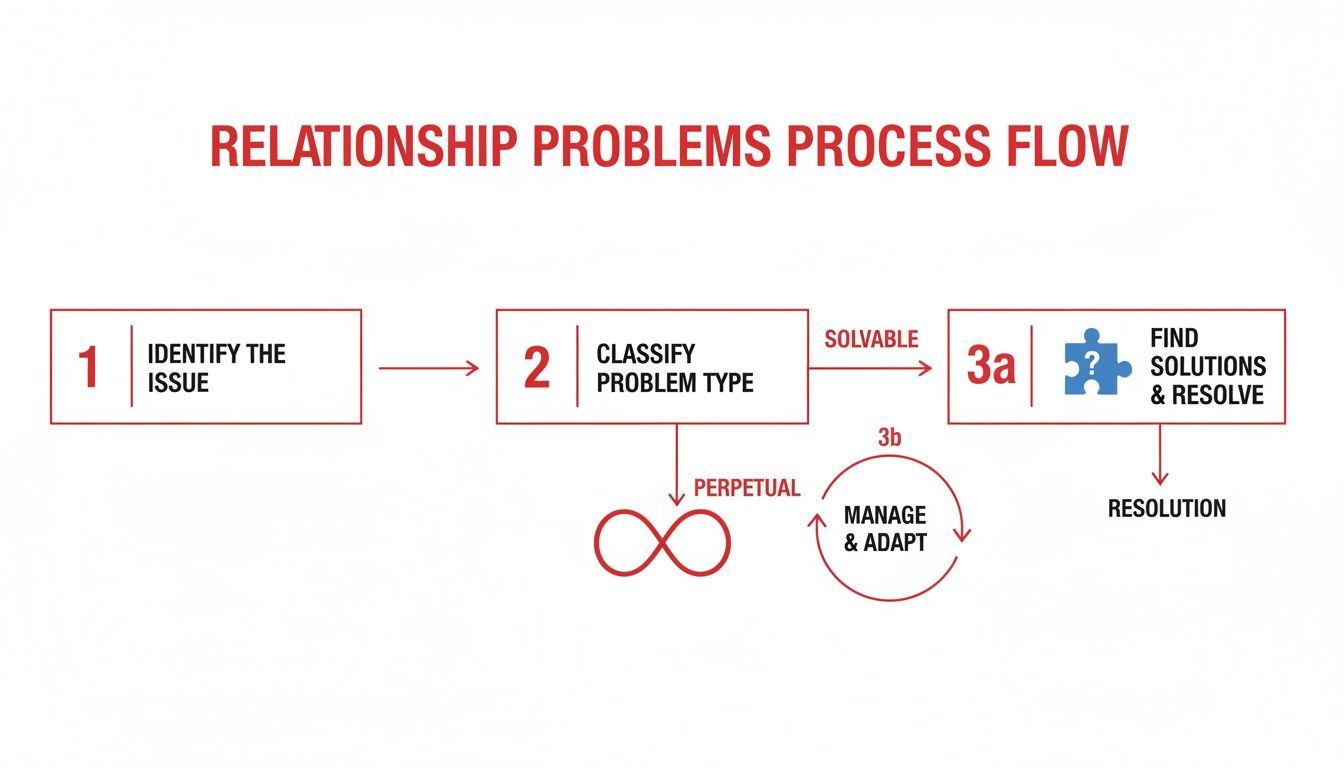
As this flowchart shows, sometimes the goal isn't to "solve" a problem for good, especially those recurring ones. The real work is in learning how to manage it together with open communication and empathy. But even with the best intentions, things can get too heated.
Know When to Hit Pause and De-Escalate
Sometimes, no matter how hard you try, an argument just spirals. Voices get louder, hearts start pounding, and rational thought flies right out the window. This isn't just being "angry"—it's a physiological state called emotional flooding. Your nervous system is so overloaded that it's biologically impossible to have a productive, empathetic conversation.
Learning to spot the signs of flooding is a relationship-saver. Look for a racing heart, shallow breathing, a feeling of being detached, or that overwhelming urge to either run away or say something cutting. Once you're flooded, continuing the argument is completely pointless.
The smartest move you can make is to take a strategic timeout.
- Have a signal. Agree on a simple word ("pause") or a hand gesture that means you need a break.
- Take at least 20 minutes. That's how long it generally takes for the body's stress response to calm down.
- Do something distracting and soothing. The key here is to not spend the time stewing over the argument. Read a book, listen to music, take a walk—anything to get your mind off it.
- Promise to come back. Agree on a time to return to the conversation. This ensures the timeout feels like a pause, not an escape.
This isn't about avoiding the problem. It’s a mature way to make sure that when you do talk, you’re both in a mental space to actually solve something. You can find more practical skills for better dialogue in our guide on how to improve communication in relationships. These techniques build a foundation of mutual understanding, which is the key to navigating any storm together.
What Decades of Love Can Teach Us About Conflict
When you see a couple who has been together for 40, 50, or even 60 years, it’s tempting to think they found a secret to a fight-free life. The reality is actually much more inspiring. Their real strength isn't avoiding conflict—it's mastering the art of repair.
They’ve learned that the goal isn't to win the fight, but to protect the connection. Over decades of practice, these couples figured out the surprisingly simple habits that build resilience, intuitively doing what relationship experts now study and teach.
This wisdom isn’t some complicated formula. It's a commitment to a few core ideas that guide them through disagreements, making sure they always find their way back to each other. So, what are these time-tested strategies?
They Prioritize Listening Over Winning
Couples who go the distance know a fundamental truth: feeling heard is far more important than being right. When an argument starts, their first move isn’t to build a case for their own side. It's to make space for their partner’s feelings.
They listen with the intent to understand the emotion behind the words, not to poke holes in the argument. This simple act of validation can instantly bring the temperature down, shifting the dynamic from opponents back to partners.
This isn’t just a nice thought; it’s backed by research. A study of 1,112 individuals across 48 countries revealed that while long-term couples use various conflict strategies, three simple ones—listening, avoiding unnecessary confrontation, and communicating well—accounted for a massive 43% of all their methods. You can read the full research about what long-term couples can teach us.
"The couples who are ‘masters’ of relationships aren’t the ones who don’t have conflict. They’re the ones who know how to repair the bond after a conflict." – Dr. John Gottman
This commitment to listening and reconnecting quickly is the secret ingredient that keeps their bond strong through whatever life throws at them. But what does that reconnecting look like?
Repair Attempts Are Fast and Fluent
Long-term couples are pros at hitting the reset button. They don’t let bad feelings simmer. Instead, they make quick, often small, gestures to reconnect after a fight. This might be a joke to break the tension, a shared look, or a simple, “Okay, this is getting silly now.”
These little "repair attempts" are the emotional glue holding the relationship together. They know that reconnecting is way more important than proving a point. This is where knowing your partner's love language becomes a game-changer.
Think about how powerful it would be to tailor your repair attempt perfectly to what makes your partner feel most loved.
- Words of Affirmation: A genuine apology can mend the rift almost immediately. Saying, "I'm so sorry I hurt you. I love you," speaks directly to their need for reassurance.
- Physical Touch: After a tense talk, a simple hug or taking their hand can say what words can't. It sends a clear message: "We’re still a team. We're okay."
- Acts of Service: Making them a cup of tea after an argument or handling a chore they dread is a powerful way to show you care and want to ease the tension.
- Quality Time: Suggesting a walk to cool off together shows you’re committed to working through it as a unit, putting the connection above the conflict.
- Receiving Gifts: Bringing home their favorite candy or a small, thoughtful item can be a sweet olive branch, a tangible way of saying, “I was thinking of you, even when we were upset.”
Using their primary love language to repair a disconnect is like having a direct line to their heart. It dramatically improves your ability to close the gap and reminds you both of what truly matters. Not sure what your languages are? Discover your love language with our free test and find a more effective way to reconnect.
Using Mindfulness to Stay Calm in Heated Moments

When an argument starts to escalate, your body can go on high alert. Your heart pounds, your breathing gets shallow, and your rational mind feels a million miles away. This is your body’s ancient “fight or flight” response kicking in—a survival mechanism that is incredibly unhelpful during a disagreement with the person you love.
This physiological reaction, often called emotional flooding, makes it almost impossible to think clearly, listen with an open heart, or find a way forward. It’s in these moments that we say things we don't mean and react in ways we later regret.
But there is a powerful tool you can use to stay grounded when things get tense. That tool is mindfulness.
What Is Mindfulness in a Relationship?
Mindfulness isn't about sitting in silent meditation for hours. In the context of a relationship, it’s the simple practice of paying attention to the present moment without judgment. It’s about noticing your feelings, thoughts, and physical sensations as they come up, creating a small but crucial gap between feeling an emotion and reacting to it.
This practice can actually lower the stress hormones that fuel emotional flooding, allowing you to stay present instead of getting swept away by reactivity. It helps you shift from a place of automatic defense to one of conscious choice.
Mindfulness is the space between stimulus and response. In that space lies our power to choose our response. In our response lies our growth and our freedom.
This is the space where you can learn to describe your feeling ("I am feeling hurt right now") instead of launching an attack ("You always make me feel this way"). It’s a subtle but profound shift that can completely change the direction of a conversation. It's also where you can see how your internal state connects to your outward actions. For more on these patterns, you might be interested in learning more about attachment styles and how they shape our reactions.
Simple Mindfulness Exercises for Heated Moments
When you feel an argument starting to boil over, you can use these simple, in-the-moment exercises to calm your nervous system and regain control. You don’t even have to leave the room.
- The Three-Breath Pause: Inhale slowly through your nose for four counts, hold for four, and exhale slowly for six. Repeat this three times. This simple act signals to your nervous system that you are safe, helping to dial down the panic response.
- Feel Your Feet on the Floor: Press your feet firmly into the ground. Notice the sensation of the floor beneath you. This physical grounding technique pulls your attention out of the chaotic storm in your head and back into your body.
- Name What You Feel: Silently say to yourself, "This is anger," or "I am feeling defensive." By naming the emotion, you separate yourself from it just enough to observe it without being consumed by it.
This approach isn’t just a nice idea; it’s backed by research. One study found that higher mindfulness in couples was directly linked to more constructive conflict strategies, which boosted overall relationship satisfaction.
By staying calm, you create an opportunity to respond with love and intention. This is where your Love Language knowledge becomes an incredibly effective tool.
Imagine being mindful enough to notice your partner’s distress and consciously choosing to offer a reassuring hand on their back (Physical Touch) instead of escalating with a sharp retort. That single, mindful choice can be the difference between a damaging fight and a moment of genuine connection.
Still Have Questions About Conflict?
Trying out new ways to handle disagreements can feel a little clunky at first. That's totally normal. As you and your partner start exploring this new territory, you're bound to have questions. This is where we tackle some of the most common hurdles couples run into when they first start doing this work.
Think of this as your go-to guide for those "what now?" moments. The goal isn't to be perfect—it's just to make progress, one conversation at a time.
"What If My Partner Just Shuts Down?"
When a partner stonewalls or goes quiet, it’s almost never because they don't care. More often than not, it's a self-preservation instinct kicking in. They're feeling emotionally overwhelmed, or "flooded," and pushing them to talk right then can feel like an attack, making them pull back even more.
Instead of insisting they talk, try giving them an out while leaving the door open for later.
A gentle approach can completely change the dynamic. Try something like, "I can see you're having a tough time with this, and I don't want to make it worse. Why don't we take 20 minutes to ourselves and come back when we're both a little calmer?"
This simple sentence shows you respect their feelings and reminds them you’re on the same team. It shifts the goal from confrontation to connection, which makes it feel much safer for them to open back up when they're ready.
Knowing their Love Language can be a huge help here, too. A quiet, non-verbal cue—a gentle squeeze on the arm (Physical Touch) or bringing them a cup of tea (Acts of Service)—can be incredibly soothing and show you're there for them without saying a word.
"How Do We Deal with Our Different Love Languages During a Fight?"
Having different Love Languages isn't a bug; it's a feature. But in the middle of a conflict, it can feel like you're speaking two totally different emotional dialects, which is a recipe for misunderstanding. The trick is to become fluent translators for each other.
You have to learn to frame your needs in a way your partner can actually hear, and you have to get better at spotting their attempts to connect, even if it's not in your primary language. It takes a conscious effort, but it’s so worth it.
Let's say your top language is Quality Time, but your partner’s is Acts of Service. You might feel hurt and disconnected, while they feel completely unappreciated for everything they do for you.
Instead of saying, "You never spend any time with me," you can try translating your need for them:
- First, acknowledge their effort: "I know you show me you love me by fixing things around the house, and I really do appreciate it so much."
- Then, state your need clearly: "What would also make me feel really connected to you is if we could spend 30 minutes tonight just talking, with no other distractions."
This approach validates their efforts while kindly explaining what you need to feel loved. It’s not about which language is right, but about building a bridge between them. Of course, the first step is knowing what you're working with. You can both find out your profiles by taking the free love language quiz.
"What's the Right Way to Apologize After an Argument?"
A genuine, well-delivered apology is one of the quickest ways to repair your connection after things get heated. A half-hearted "sorry" can actually make things worse, but a really good apology can almost instantly soothe hurt feelings and start rebuilding trust.
A truly powerful apology isn't just a word; it’s a three-part recipe for reconnection.
- Be specific about what you're sorry for. A vague "I'm sorry" doesn't cut it. Try, "I am so sorry that I raised my voice earlier." It shows you know exactly what you did wrong.
- Acknowledge how it made them feel. This is the empathy piece. It shows you get it. For example, "I can see that when I did that, it made you feel dismissed and unheard."
- Commit to doing better. This gives them reassurance for the future. You could say, "Next time we talk about this, I'm going to make a real effort to stay calm and truly listen."
Want to supercharge your apology? Tailor it to their Love Language. This makes the gesture feel deeply sincere. If their language is Physical Touch, a warm hug as you apologize speaks volumes. If it's Words of Affirmation, a heartfelt, handwritten note can be more meaningful than you can imagine.
Every couple argues. Conflict is just part of the deal. But it doesn't have to drive you apart. By getting a handle on your own needs and your partner's communication style, you can actually use disagreements to grow closer. It all starts with a little self-awareness. At The Love Language Test, we give you the tools to figure out how you and your partner both give and receive love.
Ready to build a stronger, more connected relationship? Discover your love language today and start communicating in a way that truly lands.