
The first and most important step to better communication is a mental shift. You have to move away from trying to win arguments and start trying to understand your partner. This change in perspective is what turns frustrating, circular fights into moments of real connection.
But how do you make that shift when you feel like you're speaking two entirely different languages? Let's explore why conversations get stuck and what you can do about it.
Why Your Conversations Feel Stuck and What to Do About It
Ever feel like you and your partner are on a conversational merry-go-round? You’re both talking, but nothing gets through. It's a deeply frustrating and common feeling, but it’s rarely about who's right or wrong. It’s a sign that the communication lines are crossed somewhere beneath the surface.
Most of the time, these conversational dead ends are just symptoms of a deeper disconnect. Sound familiar?
- Unspoken Needs: You're secretly hoping your partner will just know what you need without you having to spell it out.
- Mismatched Expectations: You both have totally different ideas about how a situation should play out.
- Defensive Reactions: One person offers feedback, and the other immediately hears it as an attack, shutting the conversation down.

This kind of emotional detachment has a real cost. In the business world, a lack of connection isn't just a "soft" problem. According to a 2024 Gallup report, disengaged employees cost the global economy a mind-boggling $8.9 trillion in lost productivity.
In a relationship, the stakes are even higher. The currency isn't money; it's your emotional well-being and intimacy. You can read more about how communication challenges impact teams to see the parallels.
Being stuck in this cycle doesn't mean your relationship is broken. It just means it's time for a new playbook. The secret is to stop treating conversations like a courtroom drama and start treating them like a fact-finding mission. The first step is to recognize the hidden patterns that trip you up.
A Quick Look at Common Communication Gaps
Let's break down some of the most frequent communication snags couples run into. Seeing them laid out like this can often be the "aha!" moment you need to start making a change.
| The Problem You're Facing | What It Really Means | A Quick Solution to Try |
|---|---|---|
| "You never help around the house." | "I feel overwhelmed and unsupported." | "It would mean so much to me if you could handle the dishes tonight. Seeing a clean kitchen really helps me relax." (This appeals to Acts of Service.) |
| "You're always on your phone." | "I feel unimportant and lonely." | "Can we put our phones away for an hour and just talk? I miss connecting with you." (This focuses on Quality Time.) |
| "You don't care about my day." | "I need to feel heard and valued." | "I had a really tough day and just need to vent for a few minutes. Are you free to listen?" (This asks for Words of Affirmation through active listening.) |
Recognizing the feeling behind the complaint is the key to unlocking a more productive conversation. But what does that actually look like in practice?
From Conflict to Connection
That shift from debate to discovery is everything. It’s about learning to see that behind every frustrated comment is a hidden wish or a vulnerable feeling that's struggling to get out. When you can look past the sharp edges of the words, you create room for empathy to grow.
Key Takeaway: The goal of a healthy conversation isn't to prove you're right. It's to understand your partner's world a little better so you can solve problems together.
This single change in perspective is the most powerful thing you can do to improve relationship communication. It turns a battleground into a bridge.
But what if the problem isn’t just what you’re saying, but also how you’re listening? Really, truly hearing your partner—especially the things they aren't saying out loud—is where the real magic happens. Let’s dig into that next.
The Art of Listening to Hear What’s Not Being Said
Here's a hard truth: most of us don't really listen. We listen just enough to figure out what we're going to say next. That's not a conversation; it's just waiting for your turn to talk. Powerful communication is only half about expressing yourself. The other half is about genuinely hearing your partner.
It’s about tuning into the emotions bubbling just beneath the surface of their words. Mastering this subtle art is how you diffuse a fight before it even begins and build the kind of intimacy that lasts. So, where do you start? It all comes down to a skill called active listening, which has three core parts.
First, Give Your Undivided Attention
This sounds so basic, but it’s where everything usually falls apart. Giving your undivided attention isn't just about putting your phone down (though that’s a great start). It means turning your body toward your partner and making eye contact. It means quieting that voice in your own head that's already forming a rebuttal.
You’re sending a powerful non-verbal message: "Right now, you are the most important thing in my world." When your partner feels you’re fully present, they feel safe. And when they feel safe, they can be vulnerable. This simple act of focused presence can stop a small misunderstanding from snowballing.
But just being physically present isn't enough if your mind is still racing with judgments.
Next, Withhold Immediate Judgment
As your partner talks, you’re going to have an instant reaction. It’s human nature. You’ll feel defensive, you’ll disagree, or you’ll immediately want to jump in and solve the problem for them. The real skill here is to notice those impulses and just… set them aside for a moment.
Your job right now isn’t to agree, disagree, or fix. It's simply to understand.
Active listening isn’t about waiting for your turn to talk. It’s about a genuine desire to understand your partner’s world, even if you don’t agree with their map of it.
This creates a space of emotional safety. When your partner knows they can share what’s on their mind without being immediately corrected or shut down, they’ll actually open up more. That's when you get to the most important part of the process.
Finally, Reflect and Clarify to Confirm You’ve Got It
This is the most critical piece of the puzzle, and it's the one almost everyone skips. After your partner has shared, your goal is to reflect back what you heard to make sure you understood correctly. This isn't about repeating their words back like a parrot. It’s about summarizing the core message and the feeling behind it.
A few simple phrases can work wonders here:
- “Okay, so what I'm hearing you say is…” This shows you're making an effort.
- “It sounds like you felt really frustrated when…” This validates their emotion.
- “So, the main issue for you is… is that right?” This gives them a chance to correct you.
This single habit can de-escalate tension almost instantly. Why? Because when your partner feels truly heard, they no longer have to fight to be understood.
Let’s put it into practice. Imagine your partner says, "You're always working late! You never make time for us anymore." A defensive listener fires back with, "I have to work! Do you want us to pay the bills?" That’s a fight starter.
An active listener takes a breath and tries a different route. They might say, "It sounds like you're feeling lonely and disconnected from me because of my work schedule. Is that what's going on?" See the massive difference? The second response opens the door for connection and problem-solving. This is crucial if your partner’s primary love language is Words of Affirmation, because for them, feeling heard is the ultimate form of affirmation.
Now that you have the tools to listen better, let's talk about how to express your own needs with the same level of clarity and care.
Speaking Your Partner's Love Language
Ever feel like you're pouring all your love into a relationship, only for it to disappear into a black hole? You do thoughtful things and show affection constantly, but your partner still seems distant. It’s an incredibly common frustration. But the problem usually isn’t a lack of love. It’s a language barrier.
You might be speaking French while your partner only understands German. That’s the idea behind the Five Love Languages—a framework that helps us understand the different ways people give and receive love. When you finally start speaking a language your partner instinctively understands, it’s like a light turns on. The disconnect fades, and your efforts finally land the way you intended.
This is where true connection begins.
Understanding the Five Languages of Love
To really improve relationship communication, you have to stop guessing what makes your partner feel loved and start learning their unique emotional blueprint. Each of the five languages is a distinct way of communicating care and affection. Here's a quick rundown:
Words of Affirmation: This is all about using words to build your partner up. It goes beyond simple compliments. It’s about expressing genuine appreciation, encouragement, and empathy. Saying, "You handled that stressful situation at work so well," is worlds more powerful than a generic, "You're great."
Acts of Service: For people who speak this language, actions truly do speak louder than words. It’s about anticipating their needs and easing their burdens. Think making their coffee before a huge meeting or quietly taking care of a chore you know they absolutely dread.
Receiving Gifts: This one gets a bad rap for being materialistic, but it’s not about the price tag. The gift is a tangible, physical symbol that you were thinking of them. It could be as simple as their favorite snack you grabbed on the way home or a thoughtful present that proves you really listen.
Quality Time: This is about giving your partner your undivided attention. No phones, no TV, no distractions. Just you and them, fully present in the moment. A 20-minute walk where you genuinely connect is far more valuable than two hours sitting on the same couch scrolling through your phones.
Physical Touch: This language is about expressing love through physical connection, and it’s about so much more than just sex. It's a reassuring hand on their back, a long hug at the end of a hard day, or holding hands while you walk. It communicates safety, comfort, and closeness in a way words can’t.
Understanding these different styles is the first, crucial step. If you want to go a little deeper, you can explore more about what the 5 love languages are and how they work and see more detailed examples.
This all hinges on being able to listen—not just hear, but truly listen—to what your partner is communicating, both with their words and their actions.
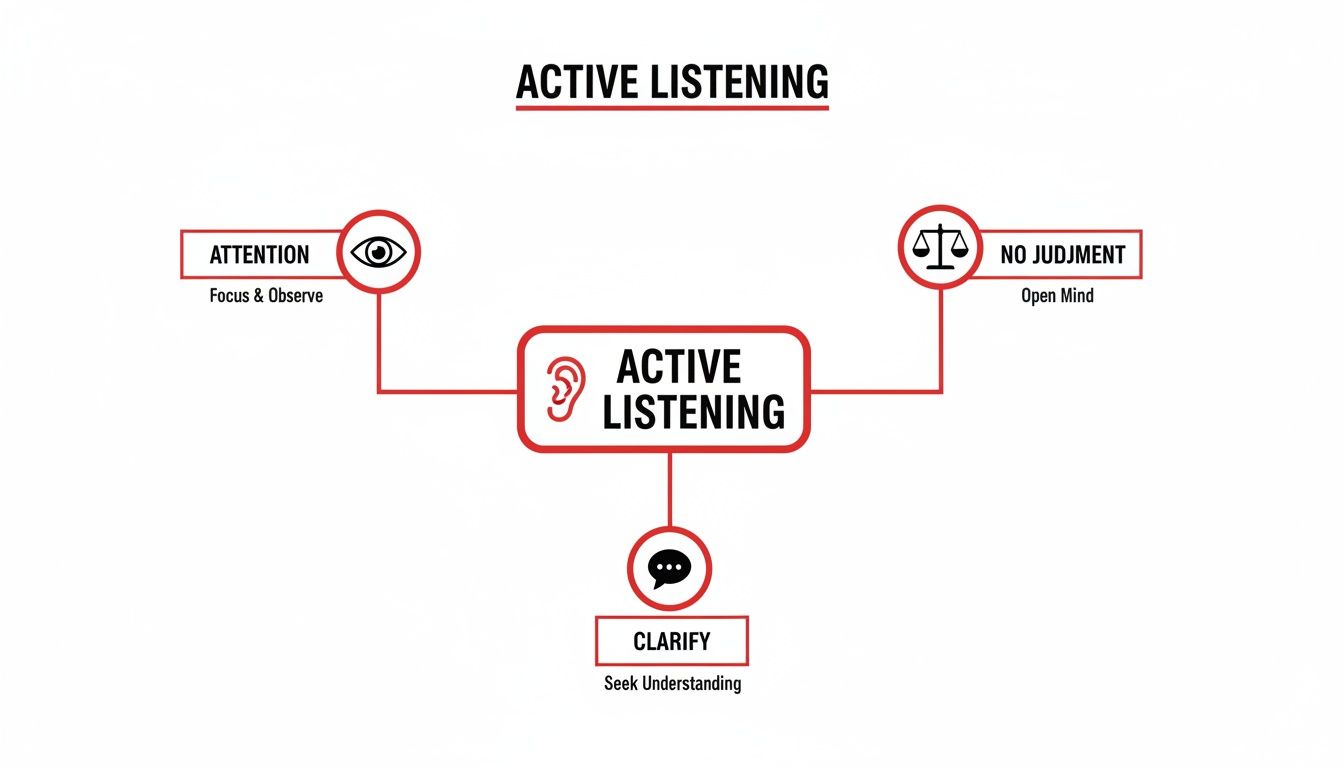
As you can see, real listening requires your full attention, an open mind, and a willingness to clarify what you're hearing instead of just assuming.
Stop Guessing and Start Connecting
The real magic of this framework isn't just knowing the languages exist; it’s about pinpointing which ones you and your partner speak. This insight turns vague, sometimes fruitless efforts into targeted, effective actions that make your partner feel truly seen and cherished.
The impact is huge. Over 65% of users report feeling more understood by their partners within just a few weeks of discovering their love languages.
Your Next Step: Stop the guesswork. The single most effective thing you can do right now is to discover your and your partner's primary love languages. Take the quick, free quiz on The Love Language Test to get your personalized results.
Once you have this invaluable insight, you can start applying it daily. But knowing how to show love is only half the battle. Knowing how to navigate disagreements when things get tough is where your connection can truly deepen and grow stronger.
Navigating Difficult Conversations Without a Fight
Every couple has to talk about the tough stuff. Money, intimacy, meddling in-laws, where you see yourselves in five years—these conversations are simply part of sharing a life together. But the health of a relationship isn’t about avoiding conflict. It’s about how you handle it when it shows up.
Too often, we walk into these talks ready for a fight. We have our armor on and our defenses up. This almost always ends with both people feeling hurt, unheard, and more disconnected than before. The real goal isn't to win the argument; it's to understand your partner.
So, how do you actually pull that off when emotions are running high?
Ditch Blame with a Simple Switch
One of the fastest ways to derail a conversation is by pointing fingers. Phrases like "You always…" or "You never…" are like tossing a lit match on a pile of dry leaves. They immediately force your partner into a defensive crouch, making it impossible for them to actually hear what you need.
The fix is surprisingly straightforward: use "I" statements. This isn't just some fluffy therapist trick; it’s a game-changer for owning your feelings without attacking your partner. Instead of saying, "You never help me clean up," try this: "I feel really overwhelmed and anxious when the kitchen is messy after we eat."
See the difference? That small tweak turns a criticism into a vulnerable, honest share about your own experience. It invites empathy, not a defensive comeback.
When you share how you feel instead of what your partner did wrong, you open the door for connection. It’s no longer about assigning fault; it’s about solving a problem together.
This one shift can fundamentally change the whole dynamic. But where and when you have the conversation matters just as much.
Choose Your Time and Place Wisely
Have you ever tried to have a serious conversation when one of you is exhausted, hangry, or rushing out the door? It’s a recipe for disaster. The context of a conversation matters just as much as the content. Agreeing to chat when you’re both calm, fed, and can give each other your full attention builds a foundation of mutual respect right from the start.
- Avoid the ambush. Don't spring a heavy topic on your partner the second they walk in from a brutal day at work.
- Find a neutral zone. Pick a time and place where you won’t be interrupted and you can both feel at ease.
- Check in first. A simple, "Hey, is now a good time to talk about something on my mind?" shows you respect their headspace.
Setting the stage for a good conversation shows you value both your partner and the relationship itself. But what happens when the conversation starts getting heated anyway?
Use Love Languages as Your Secret Weapon
Even with the best intentions, tough talks can get emotional. This is where knowing your partner’s primary Love Language becomes an incredible tool for de-escalation. It lets you send a clear signal of connection and care, right when it’s needed most.
Consider these options:
- Physical Touch: If a discussion about finances gets tense, just reaching out to gently hold their hand can be a silent reminder that you’re a team. It says, “It’s us against the problem, not me against you.”
- Words of Affirmation: You could pause and say, "I know this is hard to talk about, and I really appreciate you being willing to work through this with me." This validates their effort and immediately softens the tone.
- Quality Time: Suggesting a brief timeout can work wonders. "Let's take five, make a cup of tea, and come back to this. You are more important to me than this issue."
Weaving in these small, deliberate acts of love reinforces a sense of safety and trust. For a deeper dive, our guide on how to resolve conflict in relationships has even more strategies like this.
But how do you make these skills a lasting habit?
Building Daily Habits for a Lasting Connection
Grand gestures are nice, but the real strength of a relationship isn't built on fireworks. It’s forged in the small, quiet moments that happen every single day. Great communication isn't a destination you arrive at; it's a daily practice you actively cultivate over time. This creates a deep well of trust that can get you through anything.

Think of these daily rituals as deposits into your relationship’s emotional bank account. When life gets stressful or conflicts arise, you'll have a rich reserve of positive connection to draw from. The trick is to make these habits feel natural and sustainable—and to tailor them to how your partner actually feels loved.
This is where understanding their love language becomes your secret weapon.
Tailoring Rituals to Your Love Languages
Generic advice is forgettable. To make a real impact, you have to create communication habits that speak directly to your partner’s unique emotional wiring. That personal touch makes the effort feel genuine and helps to truly improve relationship communication.
Here are a few ideas:
For a Quality Time Partner: The goal here is pure, undivided attention. Try scheduling a daily 15-minute, device-free check-in. No TV, no scrolling through phones—just the two of you. Ask open-ended questions like, "What was the best part of your day?"
For a Words of Affirmation Partner: Words are their love currency. Start a small ritual of leaving notes for each other. It could be a sticky note on the bathroom mirror or a quick text during a busy workday saying, "Thinking of you and so grateful you're in my life."
For an Acts of Service Partner: For them, actions really do speak louder than words. Find one small task you can do to ease their daily burden. Maybe it’s making their coffee just the way they like it in the morning or taking over a chore you know they dread.
For a Receiving Gifts Partner: This isn't about spending a lot of money; it's the thought that counts. A gift is just a tangible symbol that says, "I was thinking of you." It can be their favorite snack from the store or something tiny you saw that made you smile and think of them.
For a Physical Touch Partner: Consistent, non-sexual touch is vital for feeling connected. Make it a habit to start and end each day with a real hug—one that lasts at least twenty seconds. Hold hands while you watch a movie or give them a quick shoulder squeeze as you walk by.
These simple, language-specific actions create a steady stream of positivity. For more inspiration, check out our guide to fun and meaningful bonding activities for couples.
Making Connection Effortless with Smart Tools
Let’s be real—in a busy world, consistency can be a challenge. But some modern tools can actually support, rather than get in the way of, human connection. The data is compelling: a 2023 Global CommTech Report shows that tools designed to improve communication can significantly boost relationship satisfaction.
In fact, when people take a free quiz like The Love Language Test, 70% share their results with their partner, sparking 55% more meaningful conversations.
These daily habits aren't just about avoiding fights. They’re about building a relationship that feels like a safe harbor—a place where you both feel seen, heard, and loved. They make excellent communication a natural part of your life together.
But even with the right habits, questions will pop up along the way.
Your Communication Questions Answered
Look, even with the best game plan, working through the knots of a relationship is going to bring up some questions. It's totally natural. As you start trying out these new ways of talking and listening, you’ll naturally wonder how it all fits into your specific situation.
Let's dig into some of the most common questions I hear from couples just starting this journey.
What If My Partner and I Have Different Love Languages?
This is easily the most frequent question, and the answer is simple: it’s completely normal. In fact, it’s far more common for partners to have different primary love languages. This isn't a red flag for incompatibility; it's an open invitation to grow together. Think of it like becoming bilingual for the person you love.
The goal isn't to make them speak your language. Instead, you each learn just enough of the other's "native tongue" to connect in a way that truly lands. That deliberate effort is one of the most powerful ways to show you care. The first step is for both of you to actually know your languages.
You can figure it out in a few minutes with the free quiz over at The Love Language Test. Once you have that intel, you can start getting creative and bridging the gap between your unique styles.
How Quickly Can We Expect to See Changes?
Honestly, you can start to feel small, positive shifts almost right away. That "aha!" moment from just figuring out your love languages can reframe years of misunderstandings in an instant. The very first time you consciously try to speak your partner's language or really listen, you can make that single conversation better.
But building new habits takes time and consistency.
Most couples tell me they feel a real, tangible sense of connection within a few weeks of making a conscious effort. Deep, lasting change, where this becomes your new normal? That often takes a few months of dedicated practice.
Patience is your best friend here. Celebrate the small wins, like getting through a tough topic without raising your voices. Those little victories build momentum for the long haul.
What Can I Do If My Partner Is Not Interested?
This is a tough one, but it's not a dead end. You can't force someone to change or join you on this journey, but you can absolutely change your own actions. And often, changing your own behavior inspires a completely different response from them. Think of it as leading by example.
Start by modeling the kind of communication you want to have.
- Practice active listening with everything you've got, even if they aren't reciprocating.
- Use "I" statements to talk about your feelings without making it sound like an accusation.
- Take an educated guess at their primary love language and start speaking it, no strings attached.
Watch their reactions. So often, when someone starts to feel genuinely seen, heard, and loved, their defensive walls start to come down. That's when they become more open to working on things together. You can’t change your partner, but you can always change the dynamic.
Ready to stop guessing and start connecting on a deeper level? Discovering your love language is the most powerful first step you can take. Visit The Love Language Test to take the free 5-minute quiz and get the personalized insights you need to transform your relationship.