
You've probably heard about the five love languages: Words of Affirmation, Quality Time, Acts of Service, Physical Touch, and Receiving Gifts. But understanding this framework is more than just a fun personality quiz; it's the first real step toward building connections that actually last. It’s the key to finally understanding why we all give and receive affection so differently.
But what happens when your good intentions get lost in translation?
Why Your Good Intentions Aren't Enough
Ever felt like you’re shouting your love from the rooftops, but your partner isn't hearing it? It’s like trying to deposit Japanese Yen into a bank that only accepts Euros. The currency is valuable, but the bank can't process it. The same thing happens when we express love in a way our partner can't "receive."
This is where understanding the types of love languages goes from a neat idea to an essential relationship tool. It’s a practical way to stop feeling unheard and unappreciated. Ready to decode your own relationship's blueprint?
This concept map brings to life how love is given, received, and, all too often, completely misunderstood.
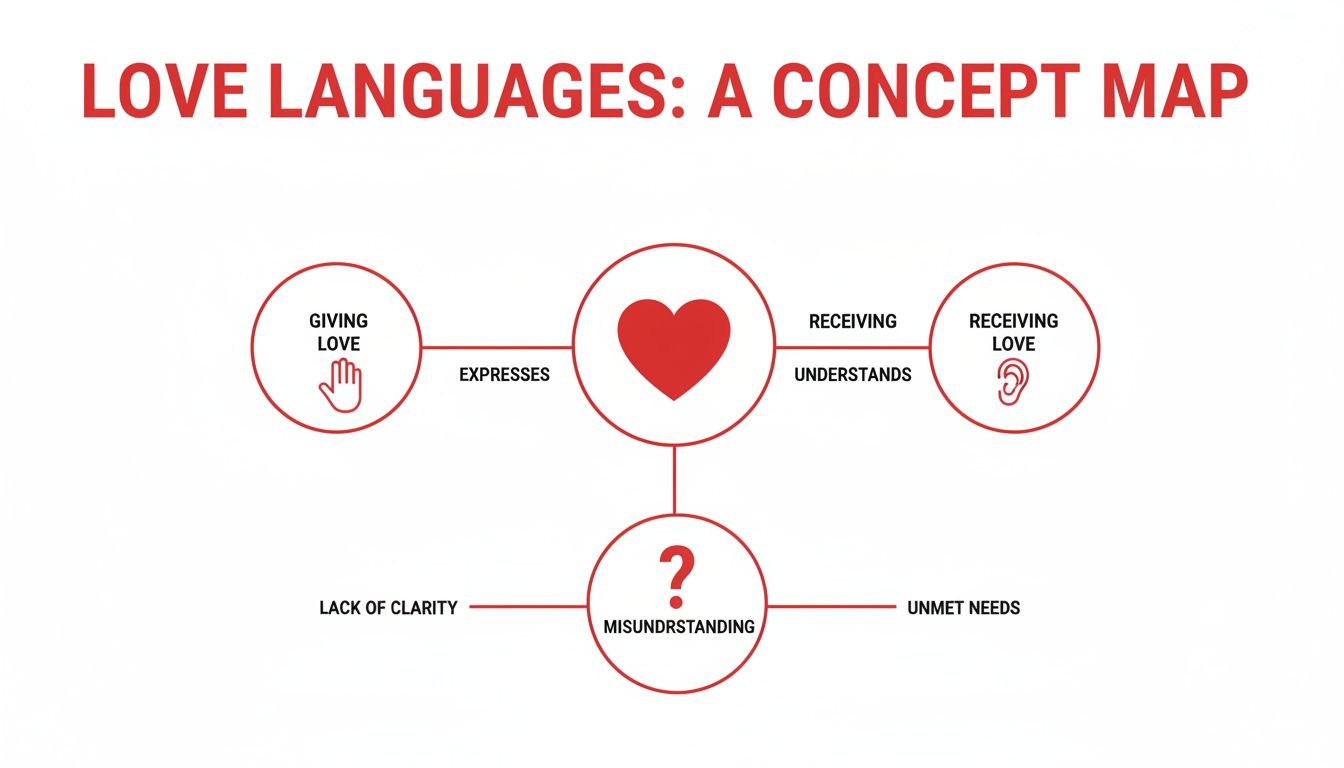
As you can see, a mismatch between the 'giving' and 'receiving' channels leads straight to confusion. Before you can bridge that gap, you have to figure out your own emotional blueprint first.
To get started, here’s a quick snapshot of what each of the five love languages looks like in the real world.
The 5 Love Languages at a Glance
| Love Language | What It Looks Like | What It Communicates |
|---|---|---|
| Words of Affirmation | Unsolicited compliments, verbal encouragement, kind words. | "I see you. I value you. I believe in you." |
| Quality Time | Uninterrupted and focused conversations, one-on-one time. | "You have my full attention. You are my priority." |
| Acts of Service | Doing chores, running errands, helping with a task. | "Let me take something off your plate. I want to help." |
| Receiving Gifts | Thoughtful gifts, big or small, that show you were on their mind. | "I was thinking of you. You are known and cherished." |
| Physical Touch | Hugs, holding hands, a comforting touch on the shoulder. | "I am here with you. I feel connected to you." |
Think of this table as your cheat sheet. It’s a starting point for decoding how you and the people you care about experience love most deeply.
Quality Time: The Language of Undivided Attention
We live in a world overflowing with distractions. Notifications ping, emails demand replies, and our to-do lists never seem to end. That’s why giving someone your focused, undivided attention has become one of the most profound ways to show you care.
This is the very heart of Quality Time. It’s a love language that says “I choose you” over everything else demanding my focus. It’s not about just being in the same room; it’s about creating real, intentional moments of connection.

Think of a dinner where the phones are put away, a long walk with no destination, or a conversation where you feel completely heard. If shared experiences make you or your partner feel most cherished, this is likely a primary love language for one or both of you.
But how do you practice this in a busy life?
What Quality Time Looks Like
In practice, Quality Time is about making someone feel like the center of your universe, even for a little while. It’s less about the hours you spend together and more about the depth of connection you build in those moments.
And it’s a popular one. A survey of over 7,100 American adults revealed that Quality Time was the most preferred love language, with 31.5% selecting it as their number one way to receive love.
For someone whose love tank is filled this way, creating these intentional moments means everything. To dive deeper, you can explore our complete guide on what the Quality Time love language really means. But now, let's see how this compares to showing love through helpful actions.
Acts of Service: The Language of Helpful Actions
You know the saying, "Actions speak louder than words"? For some people, that’s not just an expression—it’s the absolute truth. This is the core of the Acts of Service love language, where doing something thoughtful becomes the clearest way to say, "I love you."
This language isn't about grand, sweeping gestures. It's about seeing the weight of daily life on someone's shoulders and stepping in to lighten the load without being asked.

Think of it as a quiet partnership. It's the helping hand that says, "I see you're overwhelmed, and I'm here to help." When you proactively step in, you're not just completing a task; you're showing you care enough to notice and act.
But there's a right and a wrong way to do this.
How to Speak the Language of Service
Speaking this language fluently is all about showing your love through genuine support. It's the small, consistent efforts that really make a difference and fill up their emotional tank.
- Taking out the trash before they even have to think about it.
- Making them a cup of coffee exactly how they like it in the morning.
- Running that one stressful errand they've been putting off all week.
A Crucial Point: There's a big difference between a loving act and a resentful obligation. For an act of service to truly connect, it has to come from a place of positivity. It needs to feel like a gift, not just another chore you're begrudgingly checking off your list.
When these simple actions are done with a genuine heart, they can feel more profound and loving than any flowery poem. Now, let’s switch gears from doing to saying, and explore how simple words can be just as powerful for others.
Words of Affirmation: The Language of Spoken Appreciation
Ever feel a genuine boost when someone says, “I’m so proud of you,” or “You handled that situation brilliantly”? If hearing words like these makes your heart sing, then your primary love language is likely Words of Affirmation.
This language is all about the power of words—spoken or written—to build someone up and show them they matter. It’s not about empty flattery; it’s about sincere compliments, heartfelt encouragement, and kind words that land at just the right moment.
For someone who speaks this language, an unsolicited, specific compliment can mean the world. It often hits home much harder than a routine "I love you."
It might seem like a common preference, but a YouGov poll of 1,000 Americans found that Words of Affirmation was the top choice for only 19% of people. This really drives home how crucial it is to understand what truly fills your partner’s emotional tank.
For this love language, simple gestures can make a huge impact:
- Leaving a thoughtful note on the counter before you leave for work.
- Sending a quick, supportive text before they head into a big meeting.
- Simply telling them how much you appreciate who they are as a person.
But what if you’re someone who shows love through actions, not words? Don’t worry, we’ll get into a language that requires no talking at all.
Physical Touch & Receiving Gifts: More Than Meets the Eye

Let’s round out the five love languages with two that are incredibly powerful but often misunderstood: Physical Touch and Receiving Gifts. They might seem straightforward, but there’s a lot going on beneath the surface.
First up, Physical Touch. This one is about so much more than what happens in the bedroom. At its core, this language is about using your physical presence to create feelings of safety, comfort, and connection.
Think about a reassuring hand on the shoulder during a tough conversation, or a long, warm hug after a draining day. Those moments can speak volumes without a single word being said. Of course, it’s absolutely critical to remember that consent and personal boundaries are the foundation of this language.
But there's another language that's just as tangible.
It's Truly the Thought That Counts
Next, let's unpack Receiving Gifts. It's easy to dismiss this one as materialistic, but that completely misses the point. For someone whose primary love language is receiving gifts, the gift itself is a tangible symbol of affection.
A thoughtful present, big or small, sends a clear message: “I was thinking of you. You are on my mind.” The real value isn’t in the price tag; it's in the symbolism. It could be as simple as bringing home their favorite snack from the store.
This is why a forgotten birthday can be so devastating for someone who speaks this language. It’s not about the missed thing—it’s about the missed gesture. It can feel like a deep, personal rejection.
Understanding these languages is the first step. But what happens when your way of showing love doesn't match how your partner needs to receive it? That's where things get interesting.
What to Do When Your Love Languages Don't Match
So, you’ve figured out your love language, and it’s completely different from your partner’s. It's one of the most common relationship puzzles out there: You need undivided attention (Quality Time), but your partner shows love by fixing the leaky faucet (Acts of Service).
This disconnect can leave both of you feeling lonely and unappreciated, even when you’re both trying your best. But here’s the good news: having different languages isn’t a red flag for incompatibility. Far from it.
Think of it as an invitation to become emotionally ‘bilingual’—a chance to intentionally learn to speak a language that isn't your own, for the sake of the person you love.
And the effort is absolutely worth it. A study in PLOS ONE found that couples who intentionally expressed love in their partner's preferred language reported much higher relationship and sexual satisfaction. A little conscious effort goes a very long way.
This completely shifts the narrative from, "Why don't they show me love the way I want it?" to, "How can I show love in a way they’ll truly feel it?" This is a game-changer, especially when you consider how differently men and women are often socialized. For more on that, check out our guide on understanding men’s love languages.
Bridging the Gap When Languages Differ
Learning a new love language takes practice. It’s about finding small, actionable ways to step outside your comfort zone and into theirs.
Here are a few practical ideas for bridging the communication gap when your primary love languages don't quite align.
| If Their Language Is… | And Yours Is… | Try This Bridge Action |
|---|---|---|
| Words of Affirmation | Acts of Service | Leave a handwritten note on the counter before you leave for work, telling them one thing you admire about them. |
| Physical Touch | Receiving Gifts | When you hand them a small, thoughtful gift, also give them a warm, lingering hug to go with it. |
| Acts of Service | Quality Time | Instead of just watching a movie, offer to take care of a chore they dislike first, freeing them up to relax with you. |
| Receiving Gifts | Words of Affirmation | Pick up their favorite coffee and say, "I was thinking of you and wanted you to have this." |
| Quality Time | Physical Touch | Suggest a device-free walk and make a point to hold their hand, linking your language with their need for focused attention. |
The key isn't to change who you are, but to stretch your ability to express love in new ways. It’s a powerful testament to your commitment, showing them you care enough to meet them where they are.
Putting It All Together: Your Next Step to a Deeper Connection
Reading about the five types of love languages is a fantastic start, but the real magic happens when you move from learning to doing. Are you really sure which language you speak? And just as importantly, do you know what truly makes your partner, kids, or best friend feel cherished?
Guessing is a recipe for missed signals and hurt feelings.
When you pinpoint your own love language, you can finally ask for what you need. And when you learn your partner's, you can show them you care in a way they can actually feel. If you're ready to put this all into practice, the first question to ask yourself is, "What is my love language?" Answering that is the key to unlocking everything else.
Common Questions About Love Languages
Once you start digging into the five love languages, a few questions almost always pop up. Thinking through these is a huge part of using this knowledge to actually strengthen your relationships.
This whole process is about connection, not just putting yourself in a box. So what happens if the box you put yourself in a few years ago doesn't quite fit anymore?
Can My Love Language Change Over Time?
Absolutely. While you might have a core language that’s been with you for years, big life changes can definitely shuffle the deck. For instance, a new parent who’s overwhelmed might suddenly find that Acts of Service from their partner feels like the purest form of love on the planet.
Likewise, navigating a difficult season at work could make you crave Words of Affirmation more than ever. It's totally normal—and healthy—to check in with yourself and your partner from time to time about what’s feeling most impactful right now.
But what if you feel like you resonate with all of them?
What If I Appreciate All Five Languages?
That just means you're human! It’s perfectly normal to appreciate love in all its forms. But even so, most of us still have one or two primary languages that really fill our emotional tank faster than the others.
Think of it like your favorite meal. You might enjoy an appetizer and dessert, but it’s the main course that truly satisfies you. The goal isn't to reject the other languages, but to figure out which one or two make you feel the most seen, understood, and truly cared for.
How Do I Discuss This Without Sounding Critical?
This is a great question. The key is to frame the conversation as a fun discovery you can do together, not as a performance review of your relationship. Always lead with "I" statements to share your own feelings.
Instead of pointing a finger and saying, "You never bring me gifts," try opening the door to a more collaborative chat.
"I was just learning about the love languages, and I had a lightbulb moment. I realized that thoughtful little gifts make me feel incredibly loved and seen. I'd love to figure out what makes you feel that way, too. Maybe we could explore this together?"
An approach like this feels like an invitation, not an accusation. It turns the focus toward mutual growth and understanding, which is what this is all about.
Ready to stop guessing and start connecting on a whole new level? Find out what truly makes you and your loved ones tick. Take the free, 3-minute Love Language Test and get your personalized results now!