
Ever feel like you’re speaking a different language than your partner? You plan the perfect romantic gesture, pouring your heart into it, only for it to fall flat. It's a confusing and deeply frustrating feeling that happens in even the best relationships.
This is the exact disconnect that the five love languages framework was created to solve. It’s a simple but powerful idea: we all express and receive love in distinct ways. If you don't know your partner's "language," your efforts might get lost in translation.
This isn't just a theory; it's a practical tool for improving your connection. But how do you start speaking a language you don't even know exists?
Why You Might Be Speaking The Wrong Emotional Language
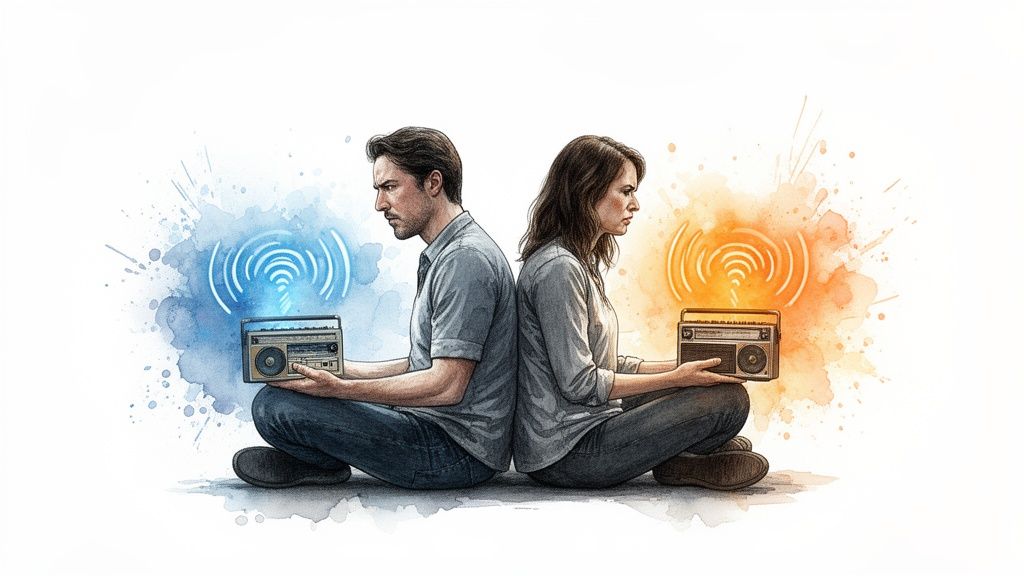
Developed by author and counselor Dr. Gary Chapman, this concept is one of the most powerful tools for understanding our relationship needs. Think of it like tuning into a radio station. If you’re broadcasting affection on an FM frequency, but your partner is set to AM, your message gets lost in static.
It's rarely about a lack of love or effort. It’s almost always a miscommunication between two people who genuinely care for each other. Learning to recognize these different emotional channels is the first step toward understanding what you need—and what your partner needs—to feel truly cherished.
Ready to see which channel you're tuned into? Let's look at the five core emotional "frequencies."
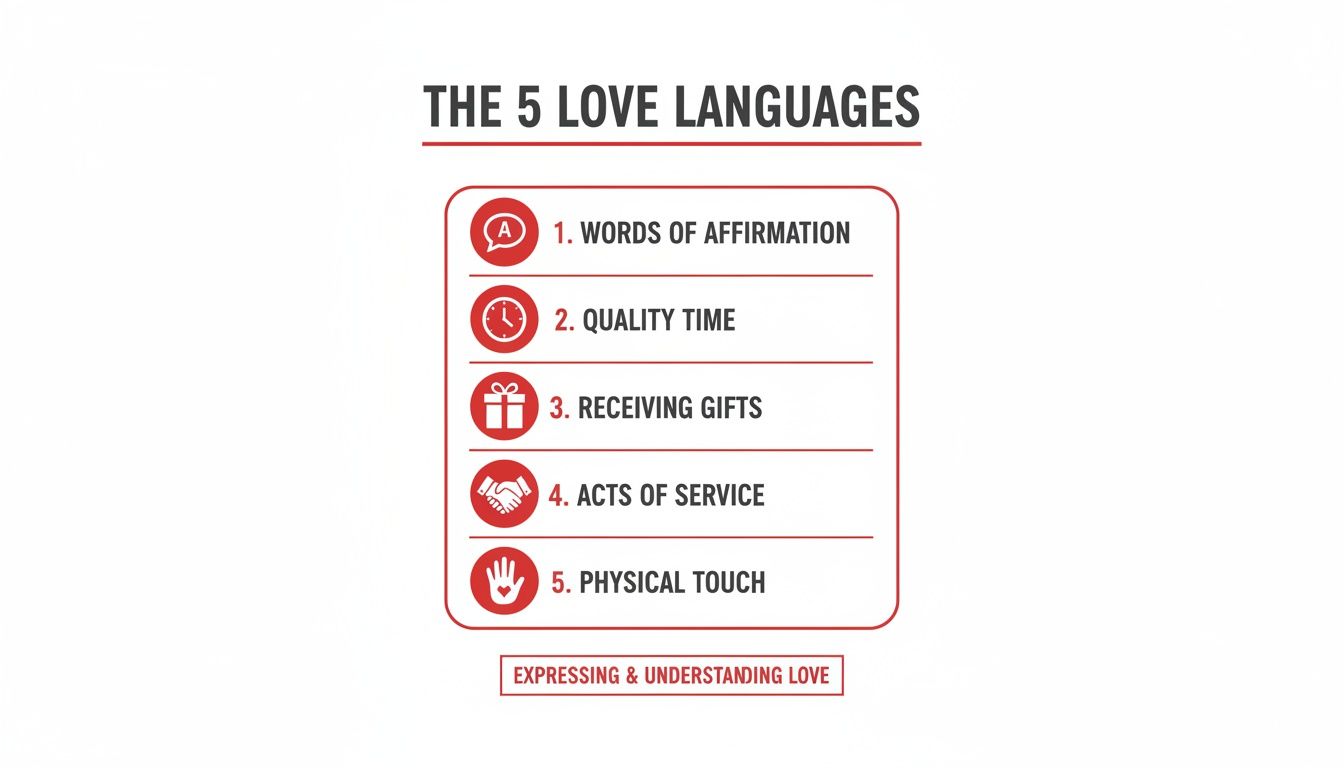
Each of these represents a unique pathway to a person's heart. Once you see them, you can turn missed signals into moments of deep connection. But to truly grasp their power, it helps to understand where this revolutionary idea came from.
The Story Behind The Five Love Languages
The concept of love languages feels so intuitive now, but it wasn't born in a research lab. It came from decades of real-world counseling sessions with couples who were deeply in love but felt like they were living on different planets.
They were talking past each other, sending out signals of affection that just weren't being received. It was a classic case of crossed wires, and it was causing real pain.
From Observation To A Global Framework
Dr. Gary Chapman, a pastor and marriage counselor, was the one listening. He started noticing undeniable patterns. Couple after couple described the same problem: one person felt unloved, while the other was exhausted from trying to show how much they cared.
It wasn't a failure of intention; it was a failure of translation. This insight led him to write his game-changing book, The 5 Love Languages: The Secret to Love that Lasts, in 1992.
The book has since sold over 20 million copies—a number that proves how deeply this idea resonates. For a deeper dive into its impact, check out this overview from Simply Psychology. But what made it so successful?
Why The Concept Endures
Chapman’s genius was in creating a tool people could actually use. He sidestepped dense psychological jargon and boiled down all those stories of frustration into five core ways people give and receive love: Words of Affirmation, Quality Time, Receiving Gifts, Acts of Service, and Physical Touch.
By naming them, he gave couples a shared vocabulary. Finally, they had a way to translate their good intentions into actions their partners could truly feel. This is the key to unlocking a deeper level of intimacy.
Understanding where what are the love languages came from shows why the concept isn't just a trend. It's a timeless framework grounded in the human need to feel seen and loved.
This simple shift has helped millions stop guessing and start connecting in ways that actually work. It gives you the power to decode what you need, and what the people in your life need from you. Now, let’s explore what each language looks like in action.
The 5 Love Languages Explained
Knowing where the idea came from is one thing, but seeing how these languages play out in your daily life is another. Each one speaks to a different core need and has its own unique way of making someone feel truly seen, valued, and loved.
Let’s break them down one by one, so you can start to see which one resonates most with you.
1. Words Of Affirmation
For some of us, words are everything. This isn't just about hearing "I love you," though that helps. It’s about unsolicited compliments, genuine words of appreciation, and verbal encouragement that lifts you up from the inside out.
If this is your partner's language, your words carry incredible weight. A specific comment like, "You handled that stressful meeting with so much confidence," can fill their emotional tank. But the flip side is also true—harsh words can cut deep and linger for a long time.
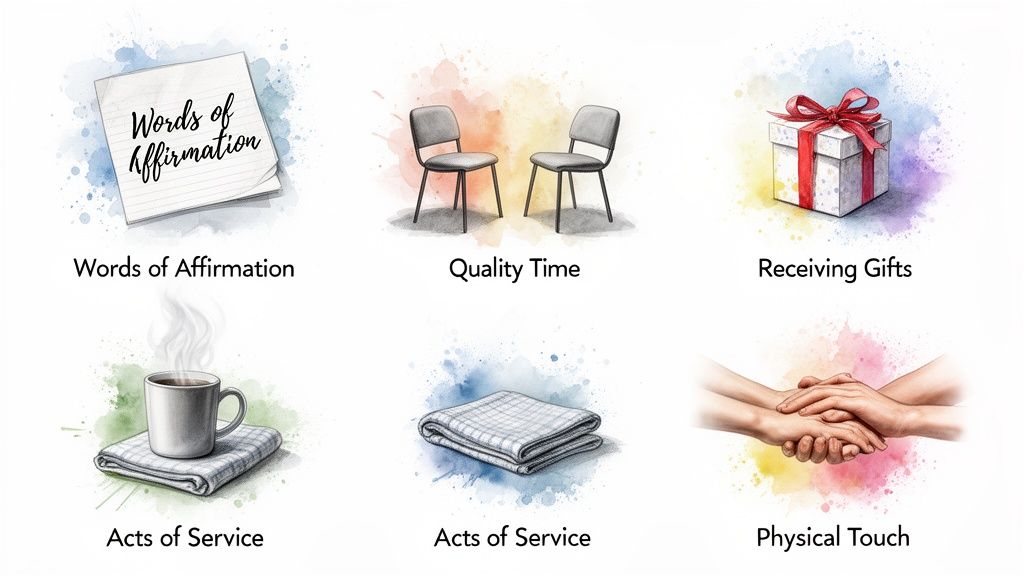
- What it looks like: Leaving a sticky note on the mirror that says, "I'm so proud of you."
- What it sounds like: "Thank you for making dinner. It was delicious, and I appreciate you."
- The core need: To feel seen, valued, and appreciated through spoken or written words.
2. Quality Time
This love language is all about one thing: undivided attention. We're not just talking about being in the same room. It's about being fully present and engaged, with no distractions.
For someone whose primary language is Quality Time, seeing their partner scrolling on their phone while they're trying to connect can feel like a profound rejection. True connection happens when you intentionally carve out time to focus only on each other. You can dive deeper in our guide on the Quality Time love language.
Quality Time is about creating shared moments where both people feel completely tuned in. The gift isn't the activity itself, but the focused attention that comes with it.
3. Receiving Gifts
This is probably the most misunderstood love language. It's easy to dismiss it as materialistic, but that’s missing the point entirely. A gift is a tangible symbol of love—physical proof that someone was thinking of you.
The value isn’t in the price tag; it’s in the thought and care behind the gesture. For someone with this language, a meaningful gift shows they are known and cherished. Forgetting a birthday or giving a thoughtless gift can feel like you've forgotten them.
4. Acts Of Service
For this language, the old saying is true: actions speak louder than words. When someone’s love language is Acts of Service, helping them with a task is the most powerful way to show you care. It’s all about easing their burdens.
This can be as simple as doing the dishes without being asked or running an errand you know they dread. These gestures communicate love by anticipating their needs and proactively stepping in to help. On the other hand, making more work for them can feel like a deep betrayal.
5. Physical Touch
Last but not least, we have Physical Touch. And no, this language isn't just about the bedroom. It’s about the security, comfort, and connection that comes from physical contact. A hug, a hand on their back, or holding hands can communicate more love than words ever could.
These simple, non-verbal cues create a powerful sense of safety and belonging. For people who speak this language, a lack of physical affection can make them feel completely isolated, even if you’re saying all the right things.
How To Discover Your Primary Love Language
So you know the five languages. That's the first step. But the real magic happens when you figure out which one is yours. This is where a little self-discovery helps you finally understand what makes you feel truly seen and appreciated in a relationship.
This process kicks off with honest self-reflection. If you pay attention, you’ll uncover powerful clues. The answers are usually hiding in plain sight; you just need to learn where to look.
So, where do you start decoding your own emotional blueprint?
Listen To Your Complaints
Believe it or not, your frustrations are one of the clearest signposts to your unmet needs. What do you complain about most often? Think back to the last time you felt disappointed or disconnected from your partner.
- Did you say, “We never spend any time together anymore”? That’s a hint toward Quality Time.
- Was it more like, “You never help me around the house”? This points straight to Acts of Service.
- Did a sharp, critical comment sting more than anything else? Your language is likely Words of Affirmation.
Our complaints often reveal what we value most. When we aren't receiving love in our primary language, we feel that absence deeply. It’s a huge piece of the puzzle.
Notice How You Show Love
Here’s another big clue: watch how you naturally show affection to others. We almost always default to giving love in the way we’d most like to receive it. It’s our native tongue, after all.
Do you find yourself picking up thoughtful little presents for the people you care about? Your language could be Receiving Gifts. Are you the first to offer a warm hug when a friend is down? You’re likely fluent in Physical Touch.
By paying attention to your instincts, you can get a very strong sense of your primary language. It’s the emotional dialect that feels most natural and authentic for you to speak.
Take The Next Step For Certainty
Introspection is a great starting point, but if you want to skip the guesswork, a structured assessment is the clearest way forward. A well-designed quiz can analyze your answers and give you a definitive result, offering insights you can use to improve your connections right away.
Ready to stop guessing and start connecting? You can find out what your love language is in just a few minutes by taking our free and simple quiz. Getting this clarity is the most powerful first step you can take.
Navigating Nuances and Common Misunderstandings
While the five love languages give us a wonderfully simple way to understand each other, human emotions are rarely so neat. We're all complex, and it’s in the gray areas where things can get confusing. Getting a handle on these subtleties is what helps you use this knowledge with more empathy.
One of the biggest hurdles is that some languages feel deeply intertwined. You might wonder, "Does a deep conversation full of encouragement count as Quality Time or Words of Affirmation?" The simple truth? It can be both. And that's perfectly okay.
Researchers have even dug into this. A 2006 study confirmed the five categories are distinct but also highlighted overlap. Specifically, it noted that Words of Affirmation and Quality Time often blend together in how we express affection. You can dig into these findings by exploring love language research further.
This overlap shows why a rigid, all-or-nothing approach is bound to fail. The goal isn't to perfectly categorize every interaction. But that's not the only common confusion.
It’s Not About Rejection
Here's another critical point: having a primary love language doesn't mean you reject affection in other forms. If your primary language is Acts of Service, it doesn’t mean a heartfelt compliment or a thoughtful gift will fall flat. Not at all.
Your primary love language is simply the expression that fills your "love tank" the fastest. It’s about preference, not exclusion.
Think of it like having a favorite food. You might love pizza, but that doesn't mean you can't enjoy a fantastic burger. In the same way, you can appreciate all forms of love, even if one speaks to your heart more deeply than the others. Understanding this is key to putting your new knowledge into practice.
How to Apply The Love Languages in Your Relationship
Figuring out your love language is that "aha!" moment, but the real magic happens when you start using that insight. Knowledge is the map, but taking action is the journey to a stronger, more connected relationship. This is where we move from theory to practice.
It all boils down to communication—but not the kind where you're making demands. The goal is to gently help your partner see the world through your eyes, shifting the conversation from criticism to genuine connection.
So how do you actually start that conversation?
From Frustration to Connection
It's easy to fall into the trap of saying things like, "You never spend any quality time with me." That phrase immediately puts the other person on the defensive. It feels like an attack.
Instead, try flipping the script and framing it from your own feelings. You could say, "I feel so close to you when we can just put our phones away and talk. Could we try that for a bit tonight?" See the difference? One is a complaint; the other is an invitation.
Of course, this is a two-way street. It's just as important to learn how to speak their language, even when it feels unnatural at first. This is where the real growth happens.
The most powerful messages of love are sent when we step outside our comfort zone to meet our partner where they are. The effort to speak an unfamiliar language is, in itself, an incredible act of love.
Your Practical First Steps
This isn't about changing who you are. It’s about expanding your emotional vocabulary so you can communicate in a way that truly lands. Remember, small, consistent efforts almost always mean more than big, flashy gestures that only happen once in a while.
- Share Your Needs Gently: Frame requests around how actions make you feel. Using "I feel…" statements encourages empathy instead of triggering defensiveness.
- Observe and Learn: Pay close attention to what makes your partner light up. Their reactions—the smiles, the relaxed shoulders—are a roadmap to their heart.
- Start Small: Don't try to do everything at once. Pick one small action this week. If it's Quality Time, maybe you can find some cheap or free date ideas to try together.
The best way to get started is to take the guesswork out of the equation. Knowing your partner's love language gives you a clear, personalized starting point for these important conversations.
Ready to stop guessing? Discover your love language with our free, simple test and get the tailored insights you need to build a more loving relationship today.
Still Have Questions? Your Love Language FAQ
Once people start digging into the love languages, a few common questions almost always pop up. Think of this as your cheat sheet for those "but what if…" moments. Getting these sorted out can help you use the concept with a lot more confidence and a lot less guesswork.
Let's tackle some of the most frequent uncertainties.
Can Your Love Language Change Over Time?
Absolutely. And it’s completely normal. While your core way of feeling loved might stay consistent, life has a way of shaking things up.
Think about new parents. Suddenly, an offer to wash the dishes (Acts of Service) can feel more loving than a thousand compliments. Big life changes or personal growth can shift what you need most. It's a great idea to check in with yourself and your partner every so often to see if anything has changed.
What if My Partner and I Have Different Love Languages?
Welcome to the club! This is the reality for most couples. Having different primary languages isn’t a red flag for incompatibility. Instead, think of it as an invitation to love each other more intentionally.
The real magic happens when you learn to bridge that gap. When you make a conscious effort to speak your partner’s language, it often means even more because they know it took real thought and care on your part.
Do the Love Languages Apply to Other Relationships?
You bet. The need to feel seen, valued, and understood is a human thing, not just a romantic one. While the expression will be different, the core ideas work wonders for friendships, family, and even coworkers.
- Friends: Knowing your friend’s language can show you exactly how to be there for them when life gets tough.
- Family: Understanding a parent or sibling's language can cut through misunderstanding and help you build stronger relationships.
It’s a powerful tool for connecting with pretty much anyone you care about. Knowing this, are you ready to finally find out your own?
Ready to stop guessing and start connecting on a whole new level? Understanding your love language is the first step toward building a stronger, more fulfilling relationship. It's a simple, clear path to finally feeling truly heard and loved.
Take the free, 3-minute quiz and get the personalized insights you need. Discover your love language at https://www.thelovelanguagetest.com/.