
Have you ever felt like you’re shouting your love from the rooftops, but your partner can't seem to hear you? Or maybe you've received a thoughtful gift when all you really wanted was a heartfelt conversation. This disconnect is incredibly common, and it often comes down to one simple question: "what is my love language?"
Understanding your love language is like getting a personalized roadmap to your own heart—and the hearts of those you care about. It’s the key to unlocking why some gestures of affection make you feel cherished and seen, while others fall flat. This guide will help you decode your emotional needs so you can build stronger, more meaningful connections. Ready to find out what truly makes you feel loved? Discover your love language with our free love language test.
What Are the 5 Love Languages?
The concept of love languages was developed by Dr. Gary Chapman after he noticed a recurring pattern in his counseling sessions. He saw couples with genuine love for each other who were still struggling to connect emotionally. The problem wasn't a lack of love; it was a lack of understanding. He identified that we all express and receive love through five core methods: Words of Affirmation, Quality Time, Receiving Gifts, Acts of Service, and Physical Touch.
Think of it like speaking different dialects. If you show affection by making dinner for your partner (Acts of Service), but they feel loved when they hear you say "I appreciate you" (Words of Affirmation), the loving gesture can get lost in translation. Learning your partner's language isn't about changing who they are; it's about learning to communicate love in a way they can truly understand.
Your primary love language is the first step toward self-awareness in your relationships. It gives you the vocabulary to articulate your needs and helps you recognize when others are showing they care—even if it's not in your native "language." This isn't just a theory; it's a practical tool for strengthening your emotional bonds.
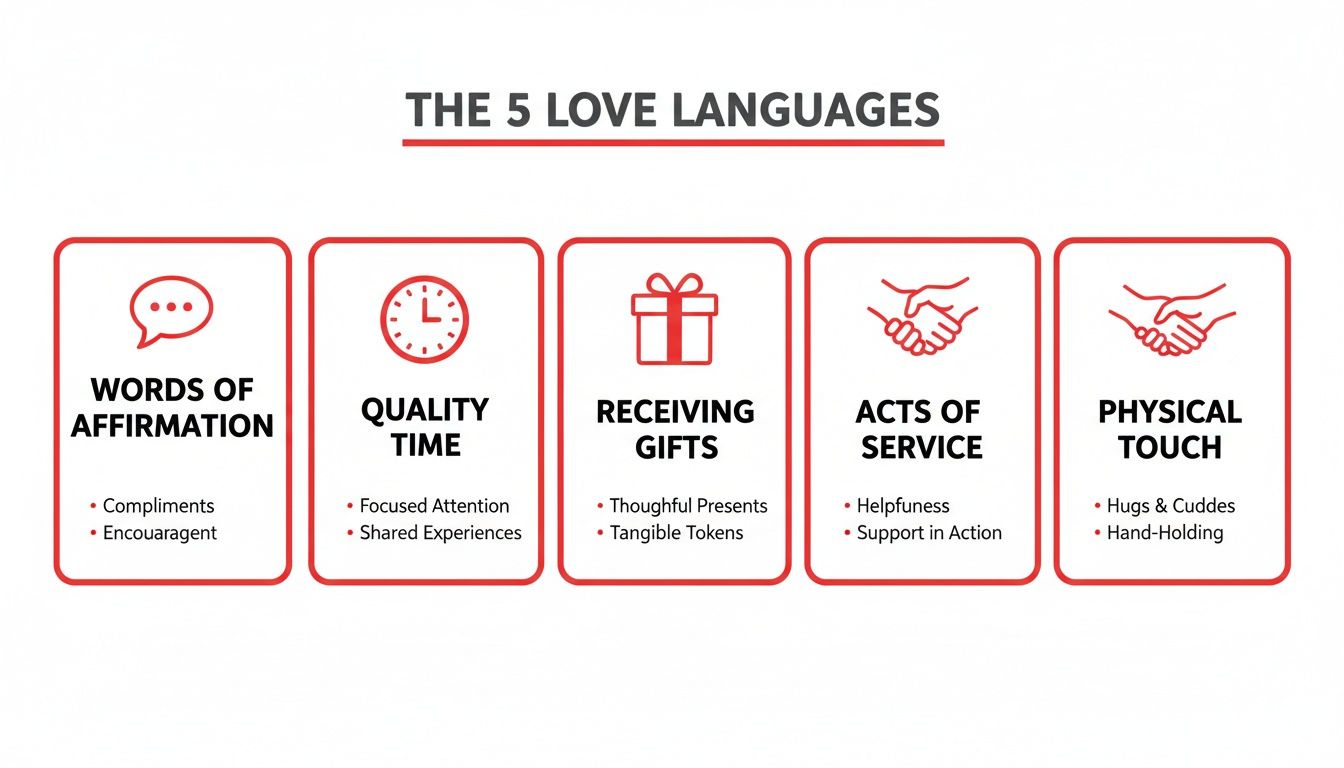
This simple visual breaks down how each of the five love languages functions as a unique expression of affection. To get an even clearer picture, here’s a quick breakdown of each one.
The 5 Love Languages at a Glance
| Love Language | What It Means to You | A Simple Example |
|---|---|---|
| Words of Affirmation | Hearing compliments, encouragement, and "I love you" makes you feel valued and appreciated. | Leaving a note for your partner that says, "I'm so proud of everything you're accomplishing." |
| Quality Time | You feel most loved when someone gives you their full, undivided attention, free from distractions. | Putting phones away to talk for 30 minutes after a long day, focusing only on each other. |
| Receiving Gifts | It’s not about materialism; a thoughtful gift is a tangible symbol that you are seen and loved. | Picking up their favorite coffee on your way home, just because you were thinking of them. |
| Acts of Service | You believe actions speak louder than words. Someone helping with tasks feels like a true act of love. | Taking care of a chore you know your partner dreads, without being asked. |
| Physical Touch | You feel most connected through hugs, holding hands, and other forms of physical affection. | A warm hug at the end of the day or a reassuring hand on their shoulder during a tough moment. |
Why This Matters for Your Relationships
When you understand this concept, you can finally stop guessing what makes your partner, friends, or family feel loved. You begin to replace assumptions with intentionality. Instead of giving love the way you want to receive it, you can start offering it in the way they actually need to receive it. That small shift can be the difference between a relationship that’s just surviving and one that’s truly thriving.
Key Takeaway: Love languages aren't about making demands. They're about giving each other a roadmap to your hearts, making it easier to show up for one another in ways that genuinely count.
A Deep Dive Into the 5 Love Languages
Okay, let's move beyond simple definitions. What do these languages really look like in everyday life? Identifying your own primary love language—and recognizing it in others—is where the magic happens. It’s the difference between simply going through the motions and creating moments of deep, authentic connection.
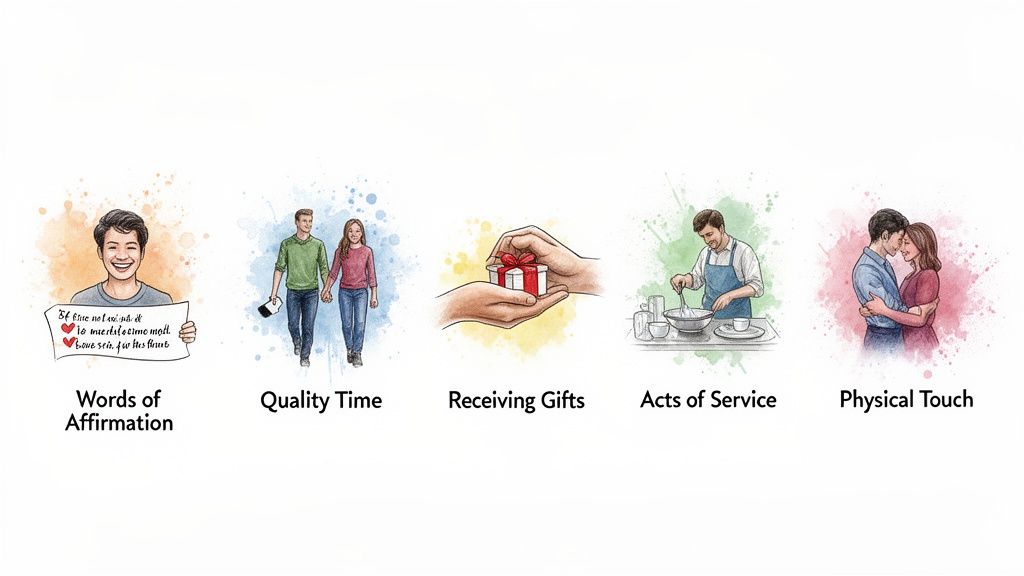
Let’s explore each language with real-world scenarios you'll recognize. This is how you'll discover why an unexpected compliment can feel more valuable than an expensive gift, or why 20 minutes of uninterrupted conversation means more than an entire evening spent in the same room but worlds apart.
Words of Affirmation
This language is all about using words to build someone up. It's so much more than a quick "I love you." It's about expressing appreciation, encouragement, and respect in a way that truly resonates. For someone whose primary language is Words of Affirmation, a sharp criticism or a harsh, careless comment can feel particularly painful.
Think of affirming words as emotional nourishment. A simple text that says, "Thinking of you and how you handled that tough meeting. You were amazing," can completely change the course of their day.
Here’s how this language comes to life:
- Give specific compliments: Instead of, "You look nice," try, "That color is amazing on you—it really brings out your eyes." Specificity shows you’re paying attention.
- Acknowledge effort, not just results: Noticing the hard work someone is putting in speaks volumes. A simple, "I see how much effort you're dedicating to this project," is incredibly validating.
- Express gratitude for the small things: "Thank you for making coffee this morning; it made my day start so much better." It’s a small comment that makes a big impact.
Quality Time
For people who speak this language, nothing says "you matter to me" more than your undivided attention. This isn't just about being physically present; it’s about putting the phone down, making eye contact, and truly listening. Distractions are the enemy of Quality Time.
This language is all about creating shared experiences and being emotionally present. The currency here isn't measured in minutes or hours, but in the depth of connection you build together.
Pro Tip: The heart of Quality Time is active listening. It’s not just hearing the words, but tuning into the feelings behind them. It’s about making someone feel completely seen and understood.
You can learn more about what are the 5 love languages in our complete guide.
Receiving Gifts
This is perhaps the most misunderstood love language. It’s often mistaken for materialism, but it’s rarely about the price tag. For a person who speaks this language, a gift is a tangible, physical symbol of love. It’s solid proof that they were on your mind when you were apart.
The real power is in the thoughtfulness behind it. A single wildflower you picked on your walk home can mean a thousand times more than a generic, expensive bouquet because it was given with true intention.
Acts of Service
For this person, actions don't just speak louder than words—they shout. This language is all about doing things you know the other person would appreciate. It's about anticipating their needs and lightening their load to make their life a little bit easier.
These acts show you're a true partner, a real team. It’s about stepping up without being asked. Things like filling up their car with gas, making dinner when you know they've had a brutal day, or tackling a chore they absolutely dread… that's pure love in action.
Physical Touch
This language is about so much more than what happens in the bedroom. It’s about using physical connection to communicate warmth, safety, and love. For someone fluent in Physical Touch, a long hug after a difficult day isn't just nice—it's a powerful and necessary source of emotional comfort.
This applies to all relationships, not just romantic ones. A reassuring hand on the shoulder of a friend, holding hands with a partner while you walk, or a simple pat on the back can build a massive sense of security and connection. Each touch is a quiet reminder that you're there for them.
How to Find Your Primary Love Language
Now that you understand the five love languages, the real breakthrough happens when you figure out which one is yours. Answering the question "what is my love language?" is like trading a generic map for a personalized GPS that guides you straight to the heart of what you need in your relationships. This doesn't require a complicated psychological analysis; it just starts with a bit of honest self-reflection.

Pay Attention to How You Give Love
Think about how you naturally show affection. When you feel a wave of love for a partner or a friend, what’s your first instinct? Do you immediately want to tell them how incredible they are? Or do you start planning a special activity just for the two of you? The way you instinctively give love is often a massive clue about how you most want to receive it.
Look at Past Hurts and Requests
Here’s another surprisingly effective trick: think about what stings the most in your relationships. Often, what hurts you most deeply is the direct opposite of your primary love language.
For instance, does a forgotten anniversary feel like more than just an oversight—like a deep, personal slight? That might mean Receiving Gifts is high on your list, because you value the thought and care behind those symbolic gestures. Or maybe it drives you crazy when your partner is glued to their phone while you’re trying to talk. That frustration is a classic sign of a deep-seated need for Quality Time.
Interestingly, it seems a lot of people feel that way. Quality Time is the most common love language in the U.S., with a whopping 38% of Americans calling it their number one.
Ask yourself this: "What do I complain about most often in my relationships?" Your biggest complaints often point directly to your unmet emotional needs—and, you guessed it, your love language.
A Quick Self-Discovery Quiz
While this isn't the official test, thinking through these scenarios can give you a pretty good idea of what resonates. Of the following gestures, which one would make you feel the most seen, cherished, and loved?
- Your partner says, "I am so incredibly proud of the person you are and all the hard work you’re putting in."
- Your partner plans an entire Saturday dedicated to your favorite activities, with their phone completely switched off.
- Your partner surprises you with a small, thoughtful item they saw that just screamed "you."
- You come home exhausted to discover your partner has already made dinner and cleaned the kitchen.
- After a really tough day, your partner gives you a long, comforting hug without saying a word.
Chances are, one of those scenarios jumped right out at you. That gut feeling is likely pointing you toward your primary love language. When you’re ready to connect the dots, you can learn more about interpreting your results and build on these initial feelings.
Common Myths About Love Languages, Debunked
The five love languages are an incredible tool for connection, but a few common misunderstandings can turn this helpful concept into a source of conflict. To make sure you're using this framework to build bridges, not walls, let’s separate the myths from reality.
One of the biggest misconceptions is that you only have one love language. While you definitely have a primary language that fills your emotional tank the most, we all benefit from all five. Think of it like your diet—you might have a favorite food, but you still need variety to be truly healthy and satisfied.
Your Language Is a Guide, Not a Weapon
Here’s another big one: using your love language as an excuse for selfish demands or as a way to criticize your partner. Saying something like, "Well, my love language is gifts, so you must not love me since you showed up empty-handed," completely misses the point.
The goal of understanding love languages is to foster empathy and connection, not to create a scorecard. It's a tool for giving love more effectively, not just for getting what you want.
Common Traps to Avoid
It's surprisingly easy to fall into a few traps that can do more harm than good. Keep an eye out for these common misinterpretations:
- "My partner should just know." This is a recipe for resentment. Healthy relationships are built on clear, kind communication—not mind-reading. It’s your responsibility to help your partner understand what you need.
- "Physical Touch is just about sex." This myth narrows a beautiful and complex language. So much of it is about non-sexual touch that builds safety and connection, like holding hands, a comforting hug, or a reassuring hand on the shoulder.
- "Love languages will fix everything." They are a powerful tool, but they aren't a magic wand. This framework works best as part of a larger relationship toolkit that includes respect, trust, and healthy conflict resolution.
Once you move past these myths, you can start using the love languages as they were intended—as a guide to genuinely understand each other and make your relationships stronger.
How to Put Your Love Language Into Practice
Discovering your primary love language is a fantastic "aha!" moment, but that's just the start. Real, lasting change happens when you turn that insight into consistent action. This is where we move from theory to practice and start creating positive shifts in how you connect with the people you care about.
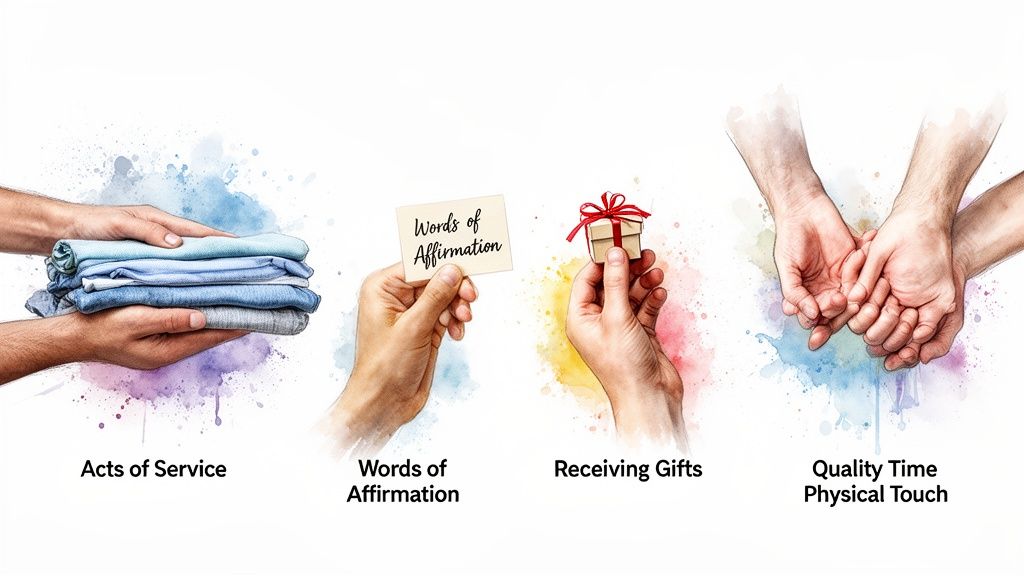
The goal is to learn to speak your partner’s language fluently, even if it feels a bit unnatural at first. You'll be amazed at how small, consistent efforts can send a clear signal that you're paying attention to what truly fills their emotional tank.
From Theory to Tangible Action
Putting this knowledge into practice is all about small, everyday gestures. For someone whose heart sings for Acts of Service, it might be as simple as tackling that one chore they always put off. If your partner’s language is Quality Time, it means consciously putting your phone face down and out of reach during dinner.
It’s about translating your affection into a format they can immediately understand and feel. This simple shift from knowing to doing is what breathes new life into a relationship.
The most powerful expressions of love are often the smallest ones, repeated over time. It’s not about grand, one-time gestures; it’s about making your partner feel seen and valued every single day through actions that resonate with them.
Practical Ideas for Speaking Each Love Language
Sometimes the biggest hurdle is just figuring out where to begin. Think of this table as your cheat sheet—a few simple, actionable ideas to get you started on the right foot.
| Love Language | Actionable Idea 1 | Actionable Idea 2 |
|---|---|---|
| Words of Affirmation | Send an unexpected text praising a specific quality you admire about them. | Verbally acknowledge their hard work in front of friends or family. |
| Quality Time | Schedule a non-negotiable "no-distraction" 20-minute chat each day to catch up. | Plan a weekend activity together, like visiting a new cafe or going for a hike. |
| Receiving Gifts | Pick up their favorite snack or drink on your way home just because you were thinking of them. | Create a small photo album of your favorite memories together as a surprise. |
| Acts of Service | Wake up a little earlier to make their coffee or pack their lunch for the day. | Take over a household chore you know they dislike without being asked. |
| Physical Touch | Make a point to give a meaningful hug when you greet each other and say goodbye. | Offer a spontaneous back rub while you're watching a movie together on the couch. |
These are just starting points, of course. The real magic happens when you tailor these ideas specifically to the person you love.
The Power of Affirming Words
Words of Affirmation might seem straightforward, but they are incredibly powerful for those who need them. In fact, 19% of Americans identify it as their primary love language.
Interestingly, a 2023 survey found that while it's popular, 29% of people believe it’s the language Americans struggle most to express, second only to Quality Time. It seems many of us find it easier to show love than to say it. You can read more about these love language findings to see how these dynamics play out in modern relationships.
Ready to Discover Your Love Language?
You’ve explored the concepts and reflected on what makes you feel appreciated. Now it's time to get a clear, definitive answer to the big question, "what is my love language?" This is your invitation to move past the guesswork and toward a deeper understanding of yourself and your relationships.
Get Your Personalized Results in Minutes
Our quick, easy, and free quiz delivers instant, personalized results. In less than 3 minutes, you’ll discover your primary love language and see a full ranking of all five. But it doesn't stop there—you also get practical tips tailored specifically to you.
Taking the quiz can be a game-changer, especially for couples. Imagine sitting down together, comparing your unique love language profiles, and unlocking a new level of empathy and understanding.
Taking the test is an act of self-discovery. It gives you the vocabulary to ask for what you need and the insight to better understand the people you love.
Ready to find out? You can take the free love language quiz right now and get your results in minutes.
Your Love Language Questions, Answered
Once you start exploring the love languages, a few common questions always come up. It’s a powerful framework, but it's normal to wonder how it all works in the real world. Let's clear up a few of those lingering thoughts to help you use this tool to build genuine connection.
Can my love language change over time?
Absolutely, and it’s completely normal. Your primary love language can shift with different seasons of your life. For example, when you become a new parent, having someone help with the dishes (Acts of Service) might feel like the most loving act in the world, even if you previously prioritized Words of Affirmation. This is why it's a great idea to check in with yourself and your partner periodically, especially during major life changes.
What if my partner and I have different love languages?
This is the norm, not the exception! Having different love languages is a beautiful opportunity for growth. The goal isn't to have the same love language; it's to become fluent in each other's. When you make a conscious effort to show love in the way your partner understands it best—even when it doesn’t come naturally to you—you're sending a powerful message: "I see you, I hear you, and I care enough to meet you where you are."
Are love languages just for romantic partners?
Not at all. This is a universal framework for understanding and strengthening all of our important relationships, from friendships to the bonds we have with our children and family members. Realizing your child feels most secure through a hug (Physical Touch) or that a close friend needs you to just listen (Quality Time) can completely transform the way you show up for them.
Conclusion
Understanding the five love languages is more than just a fun personality quiz; it’s a practical and empathetic tool for building deeper, more resilient relationships. By identifying your own primary language and learning to speak the languages of those you care about, you can replace miscommunication with understanding and frustration with connection. You stop guessing what makes people feel loved and start showing it in ways that truly matter.
Ready to stop guessing and start connecting on a deeper level? Take the first step today.
Discover your own unique love language profile in just a few minutes with The Love Language Test. Take the free, 3-minute quiz now at https://www.thelovelanguagetest.com/ and get the insights you need to build stronger, more meaningful relationships.