
Have you ever felt like you’re shouting your love from the rooftops, but your partner can’t seem to hear you? It’s a frustrating feeling, like you’re both speaking completely different languages.
Figuring out what is my partner's love language isn't about grand gestures. It's about learning to say "I love you" in a way that truly lands, turning miscommunications into moments of real connection.
This guide will show you exactly how to decode their needs. But first, you need to understand why this simple concept is such a powerful game-changer for relationships.
Why Figuring Out Your Partner's Love Language Is a Game-Changer
It’s exhausting to feel misunderstood in your own relationship. You might be showering them with thoughtful gifts when all they really crave is an hour of uninterrupted conversation.
Or maybe you're constantly cheering them on when what they truly need is a long, comforting hug. This is where the five love languages come in, offering a clear path out of the confusion.
Think of it as a practical roadmap to your partner’s heart. When you learn to speak their primary love language, you’re not just showing love—you’re showing it in the way they are best wired to receive it. This small shift can make someone feel seen, valued, and deeply understood.
But where did this powerful idea even come from?
The Simple Idea That Changed Everything
This isn’t a new concept, but its impact is massive. It came to light in Dr. Gary Chapman's 1992 book, The 5 Love Languages. It has since sold over 20 million copies for one simple reason: it gave us a vocabulary for a problem couples have faced forever.
And it’s more than a popular theory; research backs it up. One study found that couples who catered to each other's preferred love languages reported much higher relationship satisfaction. You can dig into the science behind the love languages to see just how powerful this is.
Learning your partner's love language is the difference between guessing what makes them feel loved and knowing. It turns connection into a science, not a shot in the dark.
Understanding this core idea is the first big step. But to put it into practice, you need to know what these languages actually look like day-to-day. Let's break them down, one by one.
The Five Love Languages Explained With Real-World Examples
The core idea of love languages is simple: we don't all feel loved in the same way. What makes one person feel cherished might barely register for someone else.
Learning to recognize and "speak" these five distinct languages is the key to making sure your love isn't just given, but that it's truly received.
Let's break down what these languages actually look and sound like in the real world. You might just start seeing your partner in these descriptions.
Quick Guide To The 5 Love Languages
| Love Language | What It Means | What To Do | What To Avoid |
|---|---|---|---|
| Words of Affirmation | Feeling loved through spoken or written praise, encouragement, and appreciation. | Offer genuine compliments, send an encouraging text, say "I love you" and explain why. | Harsh criticism, insults, or failing to acknowledge their efforts. |
| Quality Time | Feeling loved through focused, undivided attention and shared experiences. | Plan a date night, go for a walk with no phones, have meaningful conversations. | Distractions (like being on your phone), cancelled plans, feeling rushed. |
| Receiving Gifts | Feeling loved through thoughtful, tangible symbols of affection. | Bring home their favorite snack, pick up a small souvenir, give a "just because" present. | Forgetting special occasions, thoughtless gifts, or making them feel materialistic. |
| Acts of Service | Feeling loved when their partner helps them out and makes their life easier. | Make them coffee in the morning, do a chore they hate, run an errand for them. | Laziness, making more work for them, breaking promises to help. |
| Physical Touch | Feeling loved through physical closeness and affection. | Hold their hand, give frequent hugs, sit close to them on the couch, offer a back rub. | Physical neglect, withholding affection, being distant during hard times. |
This table is just a starting point. Let's dive deeper into the nuances of each one.
Words Of Affirmation
This language is all about using your words to build your partner up. It goes way beyond a simple "I love you." It's about expressing genuine appreciation and encouragement.
For someone whose primary language is Words of Affirmation, hearing why they are loved is just as important as knowing they are.
What it looks like:
- Sending a text that says, "I was just thinking about you and how proud I am of everything you're juggling."
- Leaving a sticky note on the mirror that says, "You've got this today. You're amazing."
- Being specific with praise: "I saw how much work you put into that project. Your dedication is incredible."
On the flip side, harsh words or un-thoughtful criticism can cut them deeper than almost anything else.
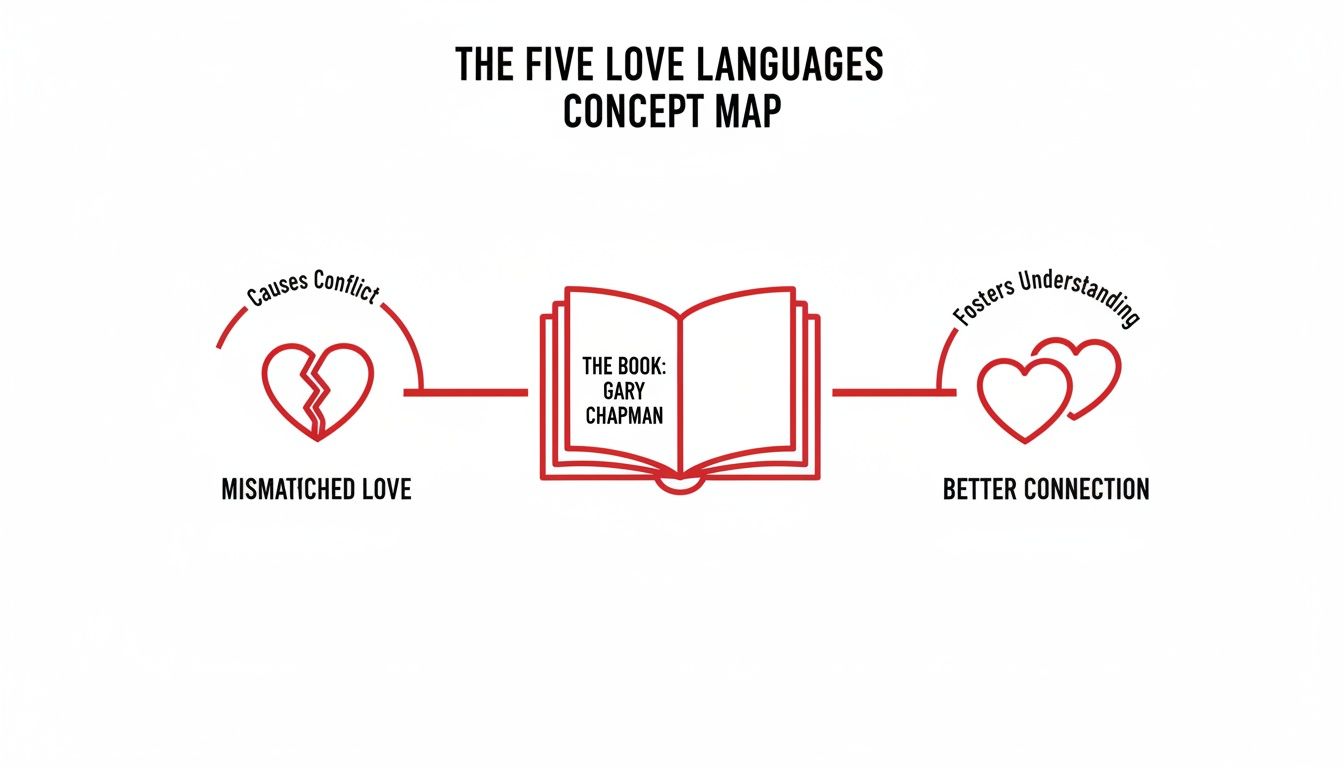
Speaking the right language nurtures the relationship, while speaking the wrong one can create distance. This highlights why figuring out your partner's specific dialect of love is so important.
Quality Time
For a person whose love language is Quality Time, nothing says "I love you" more than your undivided attention. It's not about how many hours you spend in the same room; it's about the quality of that time.
This means putting down your phone, turning off the TV, and focusing completely on your partner. They feel most loved when you are truly present, creating memories together.
If your partner feels distant even when you're physically together, it’s a big sign they're craving more focused quality time.
For them, your time is your most precious gift. When you give them your undivided attention, you are giving them a piece of your life.
Receiving Gifts
This is probably the most misunderstood love language. It’s not about materialism. For someone who values Receiving Gifts, a present is a tangible symbol of love—a physical reminder that you were thinking of them.
The magic is in the thoughtfulness behind it. It could be their favorite candy bar you grabbed at the store or a silly souvenir. The gift itself says, "You were on my mind." You can learn more about all the 5 love languages in our detailed guide.
Acts Of Service
"Actions speak louder than words" is the anthem for this love language. For these folks, feeling loved comes from seeing their partner do things to make their life a little easier.
These aren't about grand gestures. It's the small, consistent acts of support that count.
- Making their coffee in the morning, just how they like it.
- Taking care of a chore you know they hate, like doing the dishes.
- Running an errand for them when you know they're slammed with work.
Failing to follow through on promises or creating more work for them can feel like a direct and personal rejection.
Physical Touch
This language is about so much more than what happens in the bedroom. For people whose primary language is Physical Touch, emotional connection is built through physical closeness.
Hugs, holding hands, a reassuring touch on the arm—these are the expressions that fill their love tank to the brim. A gentle squeeze of the hand during a tough conversation can communicate more support than a thousand words.
Without it, they can feel isolated and unloved, even if everything else in the relationship seems fine.
How To Discover Your Partner's Love Language Without Asking
Sometimes, you can't just ask, "So, what's your love language?" Maybe they think the idea is cheesy, or you want to surprise them by connecting in a way that truly hits home.
The good news? You can become a love language detective. Your partner's daily habits are packed with clues.
You just have to know what you’re looking for. By paying closer attention, you can piece together the puzzle of what makes them feel cherished. It’s about shifting from just reacting to actively observing the patterns.
These patterns reveal their deepest emotional needs. Let’s break down the best ways to start your detective work today.

Pay Attention To How They Show Love
One of the biggest tells is how your partner naturally shows affection. We almost always default to giving love in the way we most want to receive it. It's like we're projecting our own emotional blueprint.
Think about it. If your partner’s go-to move is a spontaneous shoulder rub after your brutal day, Physical Touch is probably a big deal for them.
If they're the friend who always sends that "You've got this!" text before a big interview, they likely run on Words of Affirmation.
Here’s a quick field guide:
- The Gift-Giver: Do they always bring back a thoughtful souvenir? Do they get a genuine sparkle in their eye when they find the "perfect" gift? That’s a huge clue for Receiving Gifts.
- The Helper: Is their first instinct to ask, "What can I take off your plate?" If they show they care by fixing a wobbly chair or making dinner, Acts of Service is their language.
- The Planner: Are they constantly trying to organize date nights where it’s just the two of you? That focus on one-on-one experiences screams Quality Time.
Watching how they instinctively give love is incredibly revealing. But there's another source of clues that’s just as powerful.
Listen Carefully To Their Complaints
This one feels counterintuitive, but stick with me. Your partner’s biggest complaints are often their love language crying out for help. A complaint is a clumsy request for affection they feel is missing.
For instance, when they say, "We never do anything fun together anymore," it's not an attack. It's a massive flare signal that their Quality Time tank is on empty.
A complaint is often the sound a love language makes when it's hungry. Learning to translate these complaints into needs is one of the most powerful relationship skills you can develop.
Start listening for the unspoken need behind their frustrations.
- If you hear, "I feel like I'm doing everything around here," they're almost definitely asking for more Acts of Service.
- When they sigh and say, "You never tell me I look nice anymore," what they’re really craving is Words of Affirmation.
- And if they mention, "We don't cuddle like we used to," that’s a direct plea for more Physical Touch.
Decoding their complaints turns a potential fight into a moment of connection. You can read more about the research on relationship satisfaction here.
These observation skills will give you a solid guess. But if you want to move from a strong hunch to total certainty, there's an even more direct path.
The Easiest Way to Know for Sure? Take the Test Together
Watching how your partner acts is a great start, but it leaves room for interpretation. It’s easy to see their actions through the filter of your own love language, which might get you close but not quite hit the mark.
If you really want to move past the guesswork and get a definitive answer, there’s a much faster way.
Taking a dedicated test together gets rid of all ambiguity. It gives you both a clear, shared vocabulary to talk about your emotional needs, turning a mystery into a straightforward conversation.
From Mystery to Clarity in Three Minutes
You don't need a deep psychological dive to get powerful insights. We built a tool to help you discover what your partner’s love language is without all the fuss.
Our test is designed to be incredibly efficient. It’s just 15 carefully crafted questions that cut right to the heart of how you each give and receive love. The whole thing takes about three minutes.
Taking the test isn't just about getting an answer; it's about creating a moment. It’s an intentional act that says, "I care enough about understanding you to do this with you."
Once you've answered the questions, you get instant, personalized results. The report will pinpoint your primary love language and give you a complete profile. No more second-guessing.
A Shared Activity for a Deeper Connection
Sure, you could take the test by yourself, but the real magic happens when you make it a shared experience. Turning the quiz into a fun activity can be one of the best conversation starters you’ve had in a while.
Imagine sitting down together, sharing your results, and having one of those "aha!" moments where so many past misunderstandings suddenly click into place.
Here’s why taking the test together is so powerful:
- It Fosters Teamwork: You’re tackling something together, reinforcing that you’re a team.
- It Creates Instant Empathy: Seeing your partner's results in black and white can build immediate understanding.
- It Provides a Neutral Starting Point: The results give you an objective foundation for discussion.
Instead of just hoping you’re getting it right, you can know for sure. If you’re ready to stop guessing and start connecting, you can take our free love language quiz.
Putting Your Knowledge Into Action With Daily Practices
Figuring out your partner's love language is like finally getting the right key for a lock. But the real magic happens when you start using that key. Every single day.
This isn't about huge gestures. It's about the small, consistent things you do that quietly say, "I get you." This is where we turn the 'aha!' moment into real, lasting change.

Simple Ways to Speak Their Language Daily
The goal isn't to add chores to your day. It’s about weaving these expressions of love into the natural rhythm of your life.
If their language is Words of Affirmation:
Your words are gold. Get specific and be sincere.
- Morning Boost: A quick text can change their day. Try, "Thinking of you and that big presentation. You're going to crush it."
- Notice the Little Things: Don't let their efforts go unseen. "Hey, I noticed you organized the entire pantry. Thank you so much."
- Brag a Little: When you're with friends, mention something you're proud of them for.
If their language is Quality Time:
For them, your undivided attention is the most precious gift you can give. It's about putting the phone down and just being present.
- The 10-Minute Rule: Every evening, put your phones away for just ten minutes. No distractions—just talk and listen.
- Errands as a Date: A trip to Target can be a mini-date. It's an easy way to just be together and chat.
- Plan a "Do Nothing" Night: Block off an evening for… nothing. The point isn't the activity; it's the shared togetherness.
Making Actions Speak Louder
For some people, what you do will always shout louder than what you say.
If their language is Acts of Service:
This is all about lightening their load. Every task you take off their plate is a concrete "I love you."
- The Silent Helper: If you know they're dreading a chore, just do it. Pack their lunch or take the trash out—no fanfare needed.
- Master the Morning: Get their day started right. Have their coffee ready or warm up the car on a cold morning.
- Become the Project Manager: Don't just offer to help; take full ownership of a task, like planning the weekend trip.
If their language is Receiving Gifts:
This isn't about being materialistic. It's about tangible proof that you were thinking of them.
- The "Just Because" Treat: Grab their favorite candy bar on your way home. It’s a small way to say "you were on my mind."
- Become a Hint-Collector: When they mention something they like, make a note. Surprising them with it later shows you listen.
- Give a Memory: A gift doesn't have to be bought. Frame a photo from your favorite trip or make a playlist of "your songs."
Connecting Through Touch and Presence
For some partners, love is a deeply physical and tangible feeling.
If their language is Physical Touch:
Frequent, affectionate touch is their emotional lifeline. It builds security and connection.
- The Welcome-Home Hug: When you see them, greet them with a real hug that lasts more than a few seconds.
- Everyday Contact: When watching a movie, rest your hand on their leg or play with their hair.
- The Reassuring Squeeze: If they're venting about a tough day, a simple squeeze of their hand offers incredible support.
Finding new ways to be together is key. For more inspiration, check out our guide on bonding activities for couples.
Common Questions About Love Languages
You’ve got the basics down and have ideas for putting it into practice. But relationships are rarely that simple, right? Digging into this framework often unearths new questions.
Let’s walk through some of the most common hurdles couples run into.
What If My Partner And I Have Different Love Languages?
First off, don't panic. This is not only normal—it's the most common scenario. Think of it less as a roadblock and more as an opportunity to be intentional.
Having different languages means you have to consciously choose to show love in a way that matters to them, making each gesture more powerful. It's like learning a few key phrases in your partner's native tongue.
Can A Person's Love Language Change Over Time?
Absolutely. Our emotional needs aren't set in stone. Major life events are often the catalyst for a shift. The pressure of a new job might make someone crave Words of Affirmation.
Or after having a baby, a partner who once lived for Quality Time might find their love tank is filled fastest by Acts of Service. This is why checking in with each other is so important.
My Partner Thinks This Is Silly. What Can I Do?
Here’s the great thing: you don't need their buy-in to start making a difference. You can apply this framework on your own. Make an educated guess about their love language and just start speaking it.
When your partner starts feeling more seen and genuinely loved, skepticism usually starts to melt away. Your actions become the most convincing argument there is.
You can change the dynamic of your relationship just by changing your own actions. When your partner feels unconditionally loved, they often become more open to the process.
Is It Possible To Have More Than One Primary Love Language?
Yes, and it’s very common. Most of us have one primary language that speaks to us most deeply, but having a close second is the norm. The goal isn’t to stuff anyone into a rigid box.
Knowing their top two languages simply gives you a richer vocabulary for showing you care. It adds more tools to your relationship toolkit.
Ready to stop guessing and get some clarity? The fastest way to understand your unique love profiles is to take the test. It gives you and your partner a shared starting point for a much deeper connection.
Discover your love languages in just 3 minutes with our free, simple test.